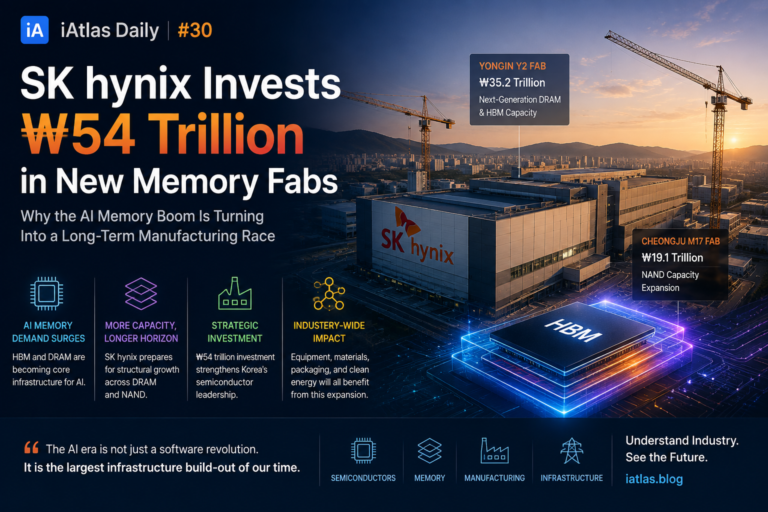
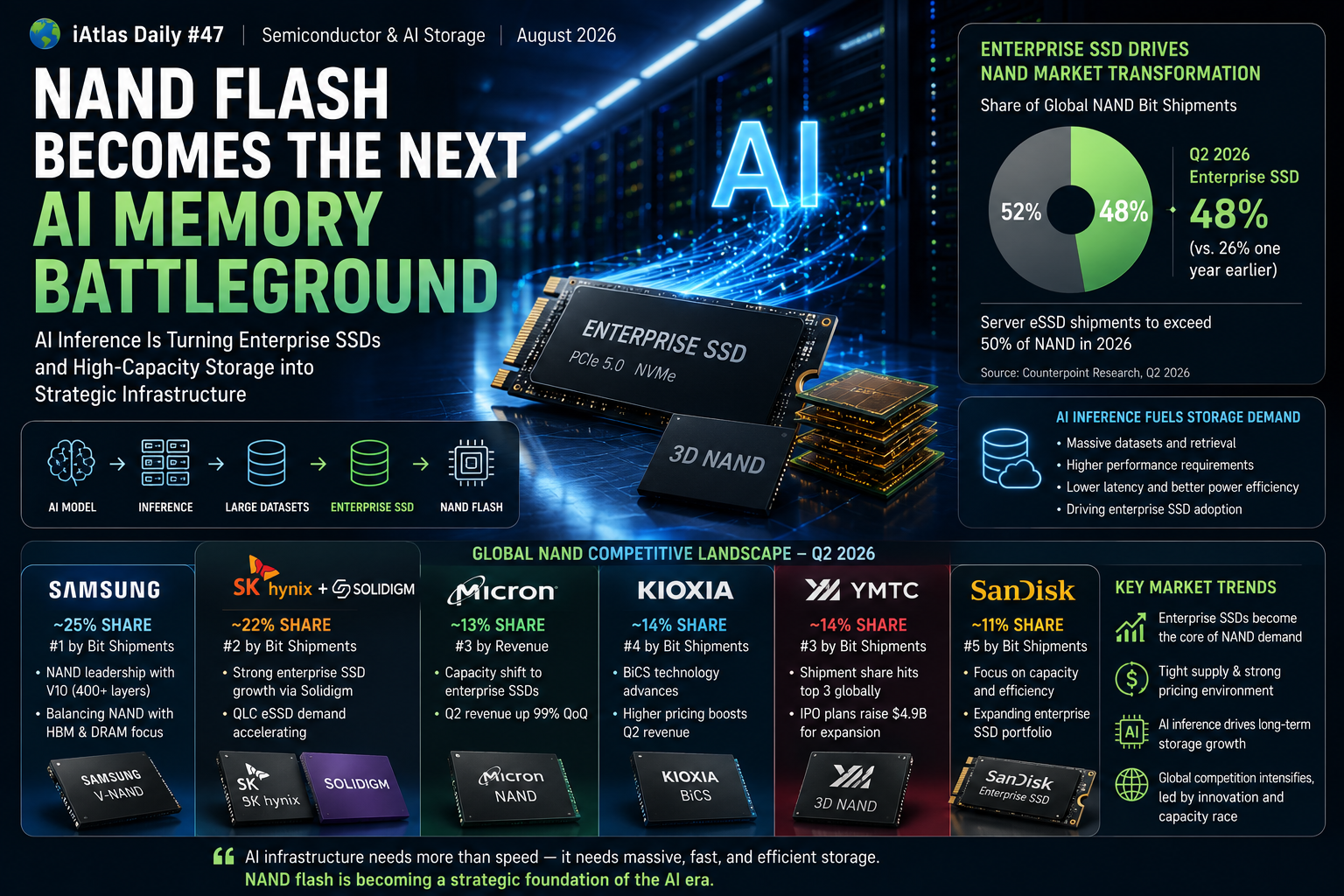
NAND Flash Becomes the Next AI Memory Battleground
AI Inference Is Turning Enterprise SSDs and High-Capacity Storage into Strategic Infrastructure
💾 iAtlas Daily #47 | Semiconductor & AI Storage | August 2026
The AI NAND Flash Market is entering a new phase as artificial intelligence expands from model training toward large-scale inference.
High Bandwidth Memory has been one of the biggest beneficiaries of the AI boom, but AI infrastructure needs more than extremely fast memory located next to accelerators.
It also needs enormous amounts of data storage.
In the second quarter of 2026, enterprise SSDs accounted for approximately 48% of global NAND bit shipments, nearly double their 26% share a year earlier, according to Counterpoint Research. The firm expects server eSSDs to absorb more than half of NAND shipments by the end of the year.
That is changing the competitive landscape for Samsung Electronics, SK hynix and Solidigm, Micron, Kioxia, SanDisk and China’s rapidly expanding YMTC.
AI is turning NAND from a storage component into a strategic layer of AI infrastructure.
💾 The Big Story
The AI memory boom is expanding beyond HBM.
During the first phase of generative AI infrastructure investment, much of the semiconductor industry’s attention focused on:
GPU -> HBM -> Advanced Packaging
That made sense.
Training increasingly large AI models requires enormous memory bandwidth, making HBM one of the most valuable semiconductor technologies in the AI ecosystem.
But AI workloads are changing.
As models move from training into large-scale commercial inference, data must be stored, retrieved and processed continuously.
That creates another infrastructure chain:
AI Model -> Inference -> Large Datasets -> Enterprise SSD -> NAND Flash
The result is a rapidly growing market for high-performance and high-capacity storage.
Counterpoint estimates enterprise SSDs represented 48% of NAND shipments in Q2 2026, while AI-driven demand contributed to record industry revenue.
🧠 1. Why AI Inference Needs So Much Storage
Training and inference have different infrastructure requirements.
AI Training
The priority is often:
Compute Performance + Memory Bandwidth
This favors GPUs, accelerators and HBM.
AI Inference
The system must repeatedly access:
- model parameters
- databases
- embeddings
- user information
- cached data
- multimedia content
- retrieval datasets
And it may need to do this for millions of users simultaneously.
That makes storage performance increasingly important.
Enterprise SSDs provide several advantages compared with traditional hard drives:
Higher Throughput
Lower Latency
Lower Power per Workload
Greater Storage Density
Faster Data Access
As inference workloads grow, storage therefore becomes part of the AI performance equation.
📊 2. Enterprise SSD Is Reshaping the NAND Market
The numbers illustrate how quickly this transition is happening.
According to Counterpoint:
| Q2 NAND bit shipments | Share |
|---|---|
| Enterprise SSD | 48% |
| Enterprise SSD one year earlier | 26% |
That is an extraordinary change in only twelve months.
TrendForce data also show the financial impact.
Combined Q2 NAND revenue among the five largest publicly listed suppliers increased 77% quarter over quarter to $68.87 billion, supported by strong AI-server eSSD demand, tight supply and higher average selling prices.
This means AI is influencing NAND in two ways:
More enterprise storage demand
Limited new NAND supply
↓
Tighter market
↓
Higher NAND prices
↓
Higher supplier revenue
NAND is becoming another major beneficiary of the AI infrastructure investment cycle.
🔵 3. Samsung Still Leads — But the Market Is Changing
Samsung Electronics remains the largest NAND supplier.
Counterpoint estimated Samsung accounted for approximately 25% of Q2 NAND bit shipments.
But that share has declined from around 32% two years earlier as Samsung prioritized higher-margin DRAM production.
This illustrates an interesting consequence of the AI boom.
Memory manufacturers have finite manufacturing resources.
They must decide how much investment to allocate toward:
HBM
Conventional DRAM
NAND
As HBM and DRAM become exceptionally profitable, capital can shift toward those technologies.
That can limit NAND supply precisely when AI storage demand is accelerating.
Samsung is also pushing NAND technology forward.
At FMS 2026, the company introduced its V10 Bonding V-NAND, using a wafer-bonding architecture and more than 400 layers. Samsung said the technology improves density and performance for growing AI workloads.
The competition is therefore not simply about producing more NAND.
It is increasingly about producing higher-density, higher-performance NAND for AI infrastructure.
🟠 4. SK hynix and Solidigm Have a Strong AI Storage Position
SK hynix occupies an unusual position in the market because of its combination with Solidigm.
SK hynix provides NAND manufacturing technology while Solidigm has built a particularly strong position in enterprise SSDs.
Counterpoint estimated the SK hynix group held approximately 22% of Q2 NAND bit shipments, ranking second globally.
Solidigm’s bit shipments increased around 40% quarter over quarter.
TrendForce also reported strong demand for Solidigm’s ultra-high-capacity QLC enterprise SSDs, helping SK hynix Group’s Q2 NAND revenue increase 89.5% quarter over quarter.
This makes the group’s portfolio increasingly relevant to the complete AI memory stack:
HBM -> DRAM -> NAND -> Enterprise SSD
For SK hynix, AI is therefore becoming much larger than an HBM opportunity.
It is becoming a memory-and-storage infrastructure opportunity.
🔴 5. Micron Is Moving Capacity Toward Enterprise Storage
Micron is also responding aggressively.
Earlier this year, TrendForce reported that Micron had been reallocating capacity away from smartphone and channel products toward enterprise SSDs.
The strategy has produced significant results.
Micron’s enterprise SSD revenue reached nearly $3.09 billion in Q1 2026, according to TrendForce.
By Q2, Micron’s broader NAND revenue reportedly increased 99.2% quarter over quarter, allowing it to move ahead of Kioxia into third place by revenue among the major listed suppliers.
This reinforces an important shift.
The most attractive NAND market is increasingly moving from:
Smartphones / PCs / Consumer SSD
toward:
Servers / AI Data Centers / Enterprise SSD
That changes where manufacturers want to allocate their most valuable production capacity.
🟣 6. Kioxia Remains an Important NAND Competitor
Kioxia remains one of the world’s major NAND technology companies.
The company continues to expand advanced BiCS NAND production while competing across data-center and enterprise storage markets.
TrendForce reported that Kioxia’s Q2 NAND revenue increased 79.9% quarter over quarter as higher NAND pricing and increased BiCS8 output supported results.
The broader competitive landscape is therefore becoming increasingly crowded.
By shipment volume, Counterpoint’s Q2 picture was approximately:
Samsung — 25%
SK hynix — 22%
YMTC — 14%
Kioxia — ~14%
Micron — 13%
SanDisk — 11%
But shipment volume alone does not tell the whole story.
The type of NAND being sold is becoming increasingly important.
7. YMTC Is Emerging as a Serious Global Challenger
One of the biggest changes in the NAND market is the rise of China’s YMTC.
Counterpoint estimates YMTC reached approximately 14% of global NAND bit shipments in Q2, putting it in the global top three by shipment volume for the first time.
The company is now pursuing a major expansion.
Its parent company recently filed for a Shanghai IPO seeking approximately 33 billion yuan — about $4.9 billion — with proceeds intended for manufacturing upgrades and next-generation technology development.
YMTC reportedly wants to challenge Samsung and SK hynix for global NAND leadership by the end of 2027.
But there is an important distinction.
YMTC’s shipment position is stronger than its revenue position.
Counterpoint notes that the company remains less exposed to high-value enterprise SSDs than some global competitors.
That means the next challenge for YMTC is not simply:
How much NAND can it produce?
It is:
Can it move into higher-value AI and enterprise storage markets?
That could become one of the most important competitive questions in global NAND.
🏭 8. NAND Supply Could Become an AI Bottleneck
There is another factor supporting the market.
Memory manufacturers are investing heavily in HBM and advanced DRAM.
That means capital expenditure is not unlimited for NAND.
TrendForce expects new NAND capacity expansion to remain relatively constrained because major suppliers are prioritizing DRAM and HBM investment.
At the same time:
AI Server Demand ↑
Enterprise SSD Demand ↑
NAND Capacity Expansion Limited
creates the possibility of sustained supply tightness.
This is a very different environment from traditional NAND cycles, where aggressive capacity expansion frequently created oversupply and severe price declines.
It does not eliminate NAND cyclicality.
But AI is changing the balance between supply and demand.
⚡ 9. Storage Is Also an Energy-Efficiency Problem
AI infrastructure has another constraint:
Electricity.
Every component in a data center consumes power.
That means storage technology is increasingly evaluated not only by capacity and speed, but also by:
Performance per Watt
High-capacity enterprise SSDs can help data centers store more information in less physical space while reducing energy consumption compared with large arrays of mechanical storage.
This becomes increasingly valuable as AI data centers encounter constraints around:
- power availability
- cooling
- floor space
- rack density
Storage efficiency therefore becomes part of the broader AI infrastructure optimization problem.
🌐 10. The AI Memory Stack Is Becoming Much Larger
The AI semiconductor opportunity can increasingly be understood as a hierarchy.
Compute
GPU / Accelerator
↓
High-Speed Memory
HBM
↓
System Memory
DRAM
↓
Fast Storage
Enterprise SSD
↓
Capacity Storage
NAND
↓
Data Infrastructure
Networking / Data Centers
Each layer performs a different role.
And each layer can become a bottleneck.
This explains why AI investment is spreading across a much wider semiconductor ecosystem.
The AI NAND Flash Market is one of the clearest examples of that expansion.
🧩 Why This Matters
The NAND market is showing several important structural changes.
AI is moving from training to inference.
That dramatically increases storage requirements.
Enterprise SSD is becoming the center of NAND demand.
Server eSSD already represents almost half of NAND bit shipments.
Product mix matters more than volume alone.
High-value enterprise products can generate far more revenue than consumer NAND.
Supply growth remains constrained.
Investment is being prioritized toward HBM and DRAM.
Chinese competition is increasing.
YMTC has already entered the global top three by shipment volume.
Together, these trends are creating a new NAND competitive environment.
🔭 What to Watch
1. Enterprise SSD Share
Counterpoint expects eSSD to exceed half of total NAND shipments by year-end.
2. Samsung’s NAND Strategy
Watch how Samsung balances HBM/DRAM investment against maintaining NAND leadership.
3. Solidigm
Its enterprise SSD strength could become increasingly important to SK hynix’s AI strategy.
4. Micron
Capacity reallocation toward enterprise storage is already producing significant revenue growth.
5. YMTC
The key question is whether shipment growth can translate into higher-value enterprise products.
6. NAND Pricing
Limited capacity expansion combined with strong AI demand could continue supporting prices.
7. AI Inference Growth
Ultimately, inference deployment will determine how large the AI storage opportunity becomes.
🧭 iAtlas Insight
The first phase of the AI memory boom belonged to HBM.
The next phase is becoming broader.
AI systems do not simply need faster processors.
They need to move and store enormous quantities of data.
That creates an expanding infrastructure stack:
GPU -> HBM -> DRAM -> Enterprise SSD -> NAND
The winners in AI memory may therefore not be determined by HBM alone.
Companies capable of supplying high-bandwidth memory, system memory and high-capacity enterprise storage together could gain a much broader position in the AI infrastructure market.
As AI moves from training models to serving billions of inference requests, storage is becoming part of the AI performance equation.
That is why NAND could become one of the next major battlegrounds of the AI semiconductor cycle.
📚 Related Articles
📊 iAtlas Daily #42: SK hynix Expands AI Memory Beyond HBM
How SK hynix is expanding its AI memory strategy across HBM, DRAM, enterprise SSDs and computational storage.
📊 iAtlas Daily #45: Korea’s Semiconductor Exports Ride the AI Memory Boom
How AI memory demand is translating into semiconductor manufacturing and Korean exports.
📊 iAtlas Daily #46: SK Telecom Builds a New AI Data Center Platform with SK Horizon
How data centers, power and connectivity are becoming physical infrastructure for the AI economy.
🔗 Sources
Market Research
- Counterpoint Research — Server-Led eSSDs Hit 48% of NAND Shipments
- TrendForce — AI Agent Boom Triggers Enterprise SSD Supply Crunch
Industry / News
- Reuters — Samsung Launches Next-Generation AI Memory Technology
- Reuters — YMTC Parent Targets $4.9 Billion Shanghai IPO
- Financial Times — YMTC Targets Global NAND Leadership
About iAtlas
iAtlas is an independent publication covering batteries, semiconductors, OLED, advanced materials, AI, and global industrial trends.
We transform complex industrial developments into clear, reliable, and easy-to-understand insights.
Whether you’re following today’s industry news or building long-term expertise, iAtlas helps you understand not only what happened, but why it matters.
Technology creates change.
Insight creates opportunity.
— iAtlas