Korea’s Semiconductor Exports Ride the AI Memory Boom
Record Chip Shipments Show How AI Demand Is Reshaping Korea’s Export Economy
🧠 iAtlas Daily #45 | Semiconductor & AI Memory | August 2026
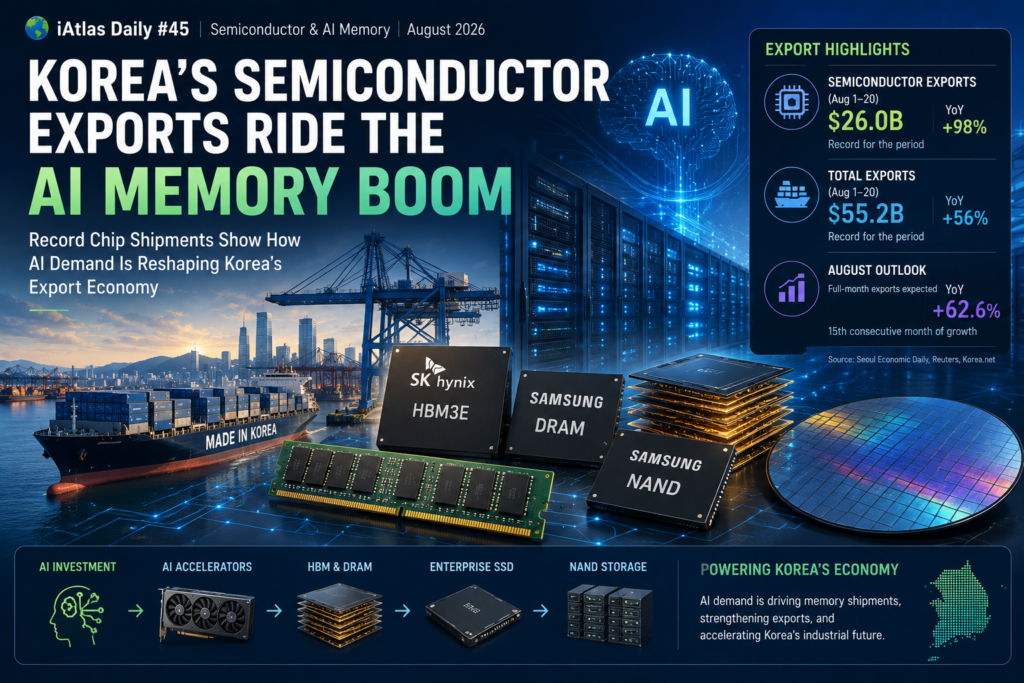
The Korea Semiconductor Exports boom is accelerating as global investment in artificial intelligence drives extraordinary demand for memory chips.
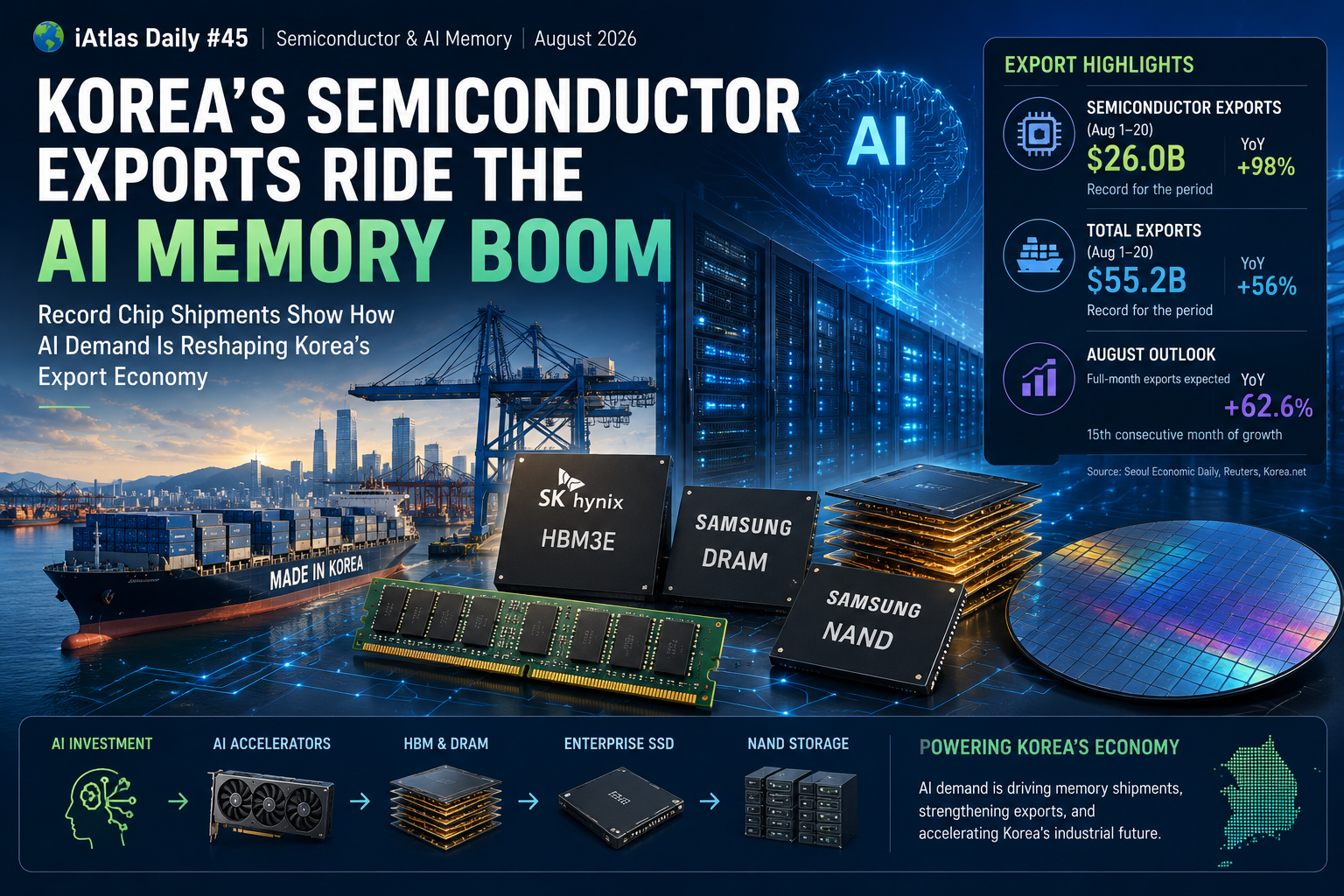
During the first 20 days of August, South Korea exported approximately $26 billion worth of semiconductors, nearly doubling from a year earlier and setting a record for the period. Total Korean exports reached $55.2 billion, up 56% year over year.
Behind those numbers is a larger industrial shift.
AI infrastructure is creating demand not only for GPUs and accelerators, but also for the memory technologies required to feed those processors with enormous amounts of data.
For Korea, that means companies such as Samsung Electronics and SK hynix are increasingly positioned at the center of the global AI investment cycle.
AI is turning memory semiconductors from a cyclical component market into one of the most strategically important layers of digital infrastructure.
📈 The Big Story
South Korea is heading toward another exceptionally strong month for exports.
During August 1–20, total exports reached a record $55.2 billion, up 56% from the same period in 2025.
Semiconductors were the biggest driver.
Chip exports reached approximately $26 billion, representing nearly half of Korea’s total exports during the period.
The strength follows an already remarkable July.
South Korea exported $98.89 billion of goods in July, the country’s second-highest monthly total ever.
Semiconductor exports alone reached approximately $41 billion, up about 179% year over year.
The pattern is becoming increasingly clear:
AI Investment -> AI Accelerators -> HBM & DRAM Demand ->
Memory Prices & Shipments -> Korea Semiconductor Exports ->
Korean Export Growth
AI infrastructure investment is now large enough to influence Korea’s national trade performance.
🧠 1. AI Is Changing the Memory Market
The semiconductor industry has always been cyclical.
Memory markets in particular have historically moved through periods of:
Shortage → High Prices → Capacity Expansion → Oversupply → Price Decline
But the current cycle has an unusual demand driver.
Artificial Intelligence.
Training and operating large AI models requires enormous memory bandwidth.
Modern AI accelerators therefore depend heavily on HBM — High Bandwidth Memory.
HBM places multiple DRAM dies vertically into a stacked architecture, allowing far more data to move between memory and processors than with conventional memory configurations.
That makes HBM an essential component of modern AI systems.
But the opportunity is expanding beyond HBM.
AI servers also require:
- server DRAM
- NAND flash
- enterprise SSDs
- computational storage
- advanced packaging
The result is a much broader memory demand cycle.
🟠 2. SK hynix Is at the Center of the HBM Boom
SK hynix has emerged as one of the most important beneficiaries of the AI memory market.
The company has built a leading position in HBM and is continuing to expand investment across next-generation products and manufacturing capacity.
SK hynix has said it expects the AI memory market to continue expanding rapidly through the end of the decade, while its latest U.S. investment illustrates how strategically important HBM has become.
The company recently broke ground on an approximately $4 billion advanced packaging and R&D project in Indiana.
The facility is expected to begin mass production of next-generation HBM4E in the third quarter of 2029, with advanced wafers manufactured in Korea before being sent to the United States for packaging and testing.
That creates an increasingly global AI memory supply chain:
Korea
Memory wafer manufacturing
↓
United States
Advanced HBM packaging & R&D
↓
Global AI Customers
AI accelerators and data centers
This is not simply an export story.
It is the international expansion of Korea’s AI semiconductor ecosystem.
🔵 3. Samsung Electronics Remains a Critical Part of Korea’s Memory Scale
Samsung Electronics represents the other major pillar of Korea’s semiconductor export industry.
Its enormous manufacturing footprint across DRAM and NAND gives Korea something relatively few countries possess:
Large-scale domestic production across multiple layers of the global memory market.
This matters because the AI boom is broadening.
HBM attracts most of the attention because of its direct connection with AI accelerators.
But a data center requires far more memory and storage than HBM alone.
A simplified AI system can be viewed as:
GPU / Accelerator -> HBM -> Server DRAM -> Enterprise SSD -> NAND Storage
As AI workloads expand, demand can therefore propagate across several memory categories.
Samsung’s scale across these markets means Korea’s AI opportunity extends well beyond a single semiconductor product.
💾 4. The AI Memory Opportunity Is Expanding Beyond HBM
The next phase may be especially important for Korea’s NAND industry.
AI systems generate enormous amounts of data.
That data must be stored somewhere.
Training datasets, model checkpoints, inference data and enterprise AI applications all require high-performance storage infrastructure.
That is increasing the importance of enterprise SSDs.
The AI infrastructure stack is therefore evolving from:
GPU + HBM
into:
Compute + HBM + DRAM + NAND + Enterprise SSD + Networking
For Korean memory manufacturers, this is significant.
The AI investment boom could support multiple semiconductor markets simultaneously rather than only HBM.
This broader demand structure is one reason the Korea Semiconductor Exports story increasingly reflects the growth of the entire AI infrastructure ecosystem.
🏭 5. Korea Has Built an Unusual Semiconductor Manufacturing Position
Korea’s export performance also demonstrates the importance of manufacturing scale.
The country has spent decades building an industrial ecosystem around memory semiconductors.
That ecosystem includes:
Semiconductor Fabs -> Materials -> Manufacturing Equipment ->
Advanced Packaging -> Testing -> Global Export Infrastructure
Samsung Electronics and SK hynix sit at the center, but hundreds of equipment, materials and component suppliers support the broader ecosystem.
This creates an important competitive advantage.
When global semiconductor demand rises rapidly, countries with established manufacturing clusters can respond faster than countries attempting to build capacity from scratch.
AI is therefore rewarding not only chip design capabilities.
It is also rewarding decades of investment in industrial manufacturing infrastructure.
🌎 6. Korea Is Becoming More Exposed to the AI Investment Cycle
There is another side to the export boom.
The stronger Korea’s semiconductor exports become, the more closely its economy becomes connected to global AI investment.
During the first 20 days of August, semiconductors accounted for roughly 47% of Korea’s total exports.
That concentration creates enormous upside when the semiconductor market is strong.
But it also creates risk.
If hyperscalers slow data-center investment, memory demand could weaken.
If HBM supply expands too quickly, pricing could change.
If competing memory manufacturers gain share, Korean companies could face greater pressure.
And if geopolitical or trade restrictions affect semiconductor supply chains, Korea could be particularly exposed.
So the current boom creates both:
Industrial Opportunity
and
Economic Concentration Risk
📊 7. August Could Extend Korea’s Export Boom
Official August trade figures are scheduled to be released on September 1.
Economists surveyed by Reuters expect total exports to increase approximately 62.6% year over year, which would mark the 15th consecutive month of export growth.
That forecast follows July’s 62.8% increase and the exceptionally strong preliminary August semiconductor data.
But the final number is less important than the underlying industrial trend.
Korea’s export growth is increasingly being powered by technologies directly connected to the AI infrastructure buildout.
That means semiconductor export data is becoming another indicator of global AI capital expenditure.
🧩 Why This Matters
The current export boom illustrates several structural changes.
AI is becoming an industrial demand engine.
AI investment is translating directly into demand for physical semiconductor manufacturing.
Memory is becoming strategic infrastructure.
HBM, DRAM and enterprise storage are essential parts of AI systems.
Manufacturing scale matters.
Korea’s decades-long investment in semiconductor production is becoming a competitive advantage.
Semiconductor exports increasingly influence Korea’s economy.
Strong memory demand is translating directly into national export growth.
The opportunity extends beyond Samsung and SK hynix.
Equipment, materials, packaging and component suppliers can also benefit from expanding semiconductor production.
This makes the AI memory boom much more than a story about two large Korean companies.
It is increasingly an ecosystem story.
🔭 What to Watch
Several indicators will show whether the boom can continue.
1. August Export Data
The September 1 release will confirm how strong Korea’s full-month export performance was.
2. HBM Supply
SK hynix, Samsung Electronics and Micron are expanding next-generation HBM capacity.
3. Memory Pricing
Strong DRAM and NAND prices are currently supporting semiconductor revenue and exports.
4. AI Capital Expenditure
Investment by hyperscalers and AI companies remains the fundamental demand driver.
5. Enterprise SSD Demand
Storage could become another important beneficiary of AI infrastructure investment.
6. Advanced Packaging Capacity
As HBM demand increases, packaging capacity could become an increasingly important bottleneck.
🧭 iAtlas Insight
South Korea’s export boom reveals something important about the AI economy.
AI may appear to be a software revolution.
But underneath the software is an enormous physical industrial system.
AI Models -> AI Accelerators -> HBM & Memory -> Advanced Packaging ->
Semiconductor Fabs -> Equipment & Materials -> Electricity & Data Centers
Korea occupies one of the most important positions in that chain: memory manufacturing.
That position is now translating directly into export growth.
The AI boom is no longer visible only in technology-company valuations or data-center investment. It is increasingly visible in factory output, semiconductor shipments and national trade statistics.
For Korea, that creates one of the largest industrial opportunities of the AI era.
The challenge will be turning today’s memory boom into a durable advantage across the broader semiconductor supply chain.
📚 Related Articles
For this article, I recommend linking only to already published iAtlas articles, rather than inserting an unpublished placeholder.
📊 iAtlas Daily #42: SK hynix Expands AI Memory Beyond HBM
How SK hynix is expanding its AI strategy across HBM, DRAM, enterprise SSDs and computational storage.
📊 iAtlas Daily #10: TSMC Advanced Packaging Expansion Signals the Next AI Boom
Why advanced packaging is becoming one of the most important manufacturing bottlenecks in AI semiconductors.
📊 iAtlas Weekly #8: AI Infrastructure Is Reshaping the Industrial Supply Chain
How AI investment is spreading from compute chips into memory, packaging, storage, power and industrial infrastructure.
🔗 Sources
- Reuters — South Korea’s August export outlook
- Seoul Economic Daily — Korea chip exports hit $26 billion in first 20 days of August
- Korea.net — July exports and semiconductor performance
- Reuters — SK hynix Indiana HBM investment
- Reuters — SK hynix AI memory market outlook
About iAtlas
iAtlas is an independent publication covering batteries, semiconductors, OLED, advanced materials, AI, and global industrial trends.
We transform complex industrial developments into clear, reliable, and easy-to-understand insights.
Whether you’re following today’s industry news or building long-term expertise, iAtlas helps you understand not only what happened, but why it matters.
Technology creates change.
Insight creates opportunity.
— iAtlas