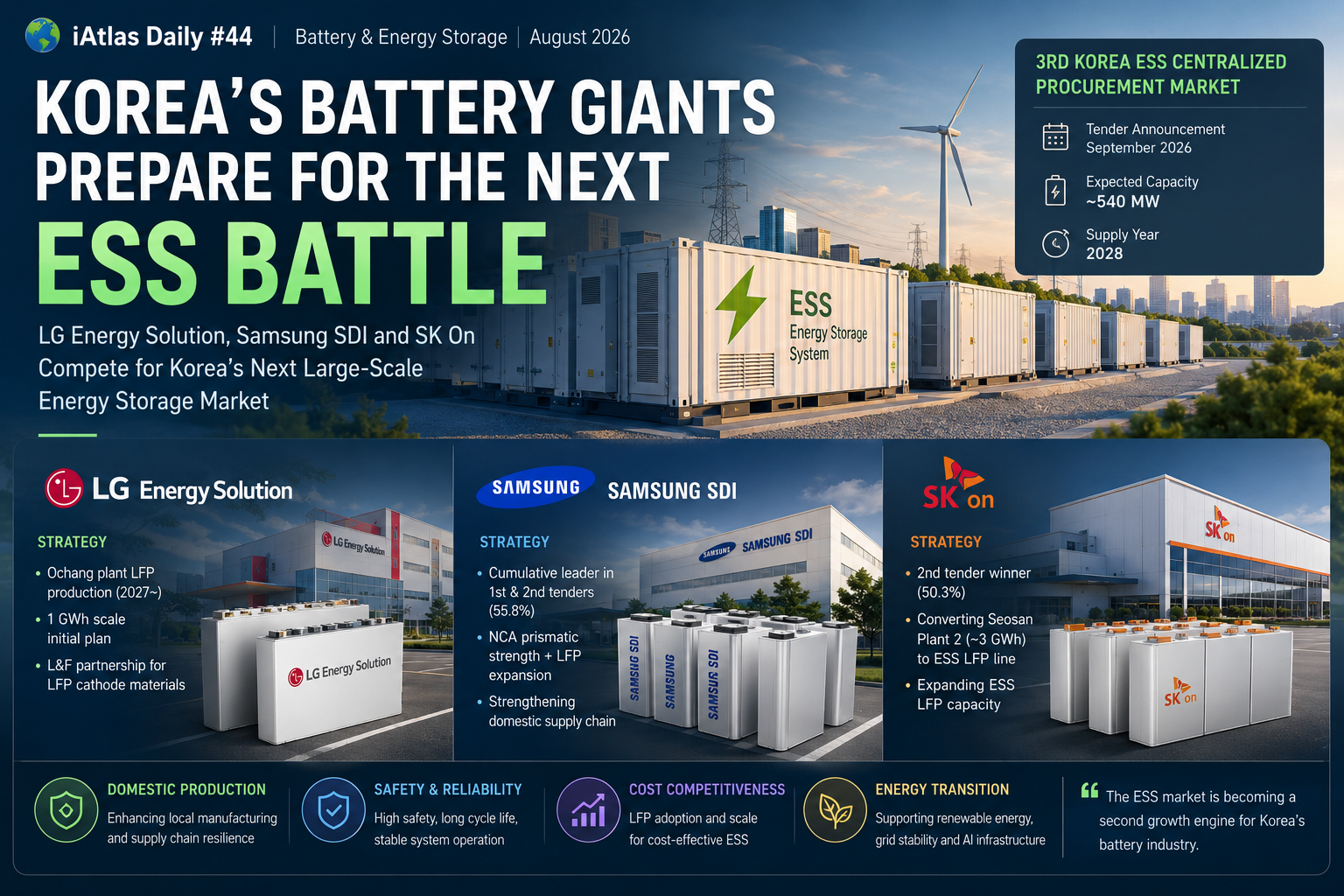
Korea’s Battery Giants Prepare for the Next ESS Battle
LG Energy Solution, Samsung SDI and SK On Are Competing for Korea’s Next Large-Scale Energy Storage Market
📊 iAtlas Daily #44 | Battery & Energy Storage | August 2026
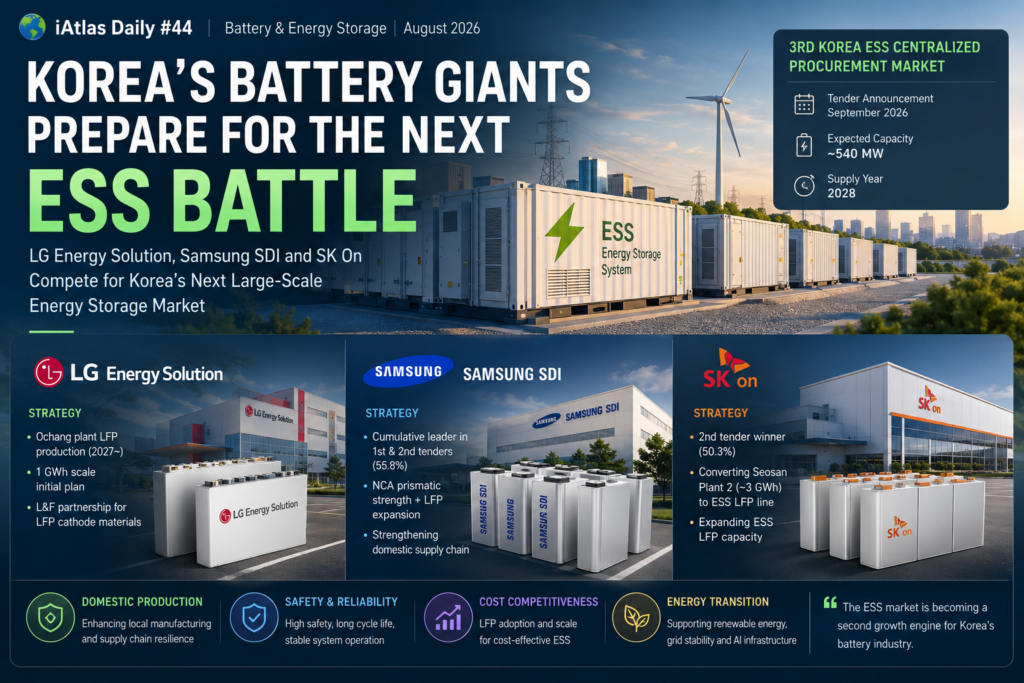
The Korea ESS Battery Market is entering a new phase as LG Energy Solution, Samsung SDI and SK On prepare for the third round of Korea’s centralized energy storage system procurement program.
The upcoming tender is expected to cover roughly 540 MW of ESS capacity, with the bidding process expected to begin in September. After Samsung SDI dominated the first round and SK On emerged as the largest supplier in the second, the third competition could become the clearest test yet of each company’s ESS strategy.
But this competition is about more than winning another battery contract.
It reflects a broader transformation across the Korean battery industry:
ESS is becoming a strategic growth market as battery manufacturers diversify beyond electric vehicles and build domestic LFP production and supply chains.
🔋 The Big Story
Korea’s three major battery manufacturers are preparing for another major ESS competition.
The Korea Power Exchange is expected to launch the third centralized ESS contract market tender in September, with approximately 540 MW of capacity anticipated for the 2028 supply requirement.
The first two rounds produced very different results.
First Tender
Samsung SDI was the clear leader.
Out of approximately 563 MW:
- Samsung SDI — 427 MW / 75.8%
- LG Energy Solution — 136 MW / 24.2%
- SK On — no awarded volume
Second Tender
The competitive landscape changed dramatically.
Out of approximately 565 MW:
- SK On — 284 MW / 50.3%
- Samsung SDI — 202 MW / 35.8%
- LG Energy Solution — 79 MW / 14.0%
Across the first two rounds, Samsung SDI remains the cumulative leader, but SK On’s second-round performance demonstrated how quickly the competitive landscape can change.
Now all three companies are adjusting their strategies.
🏭 1. Domestic Production Is Becoming a Competitive Advantage
One of the most important changes in Korea’s ESS market is the growing importance of the domestic industrial ecosystem.
Battery price remains important.
But procurement evaluations increasingly consider factors such as:
Domestic Production -> Domestic Materials & Components ->
Supply-Chain Resilience -> Battery Safety -> ESS System Competitiveness
In the second tender, the weighting of non-price criteria—including domestic equipment utilization and safety—reportedly increased to 50% from 40% previously.
This changes how battery companies compete.
The lowest-cost battery may not automatically become the strongest bid.
Manufacturers increasingly need to demonstrate that they can provide batteries with competitive economics while also contributing to Korea’s domestic battery ecosystem.
🔵 2. LG Energy Solution Is Building a Domestic LFP Base
LG Energy Solution is preparing to strengthen one of the areas where it has previously faced a disadvantage: domestic ESS battery production.
The company is considering producing approximately 1 GWh of ESS-grade LFP batteries at its Ochang Energy Plant in Cheongju beginning in 2027, with potential expansion depending on market demand.
LG Energy Solution is also strengthening its domestic materials supply chain.
The company has established cooperation with L&F for LFP cathode materials, creating a more localized supply structure for future ESS products.
The strategy is important because LFP has become one of the dominant chemistries for stationary energy storage.
Compared with many nickel-rich battery chemistries, LFP generally offers:
- lower material cost
- strong cycle life
- high thermal stability
- suitability for stationary storage
For LG Energy Solution, domestic LFP manufacturing could therefore address both cost competitiveness and localization.
🔷 3. Samsung SDI Is Defending Its Early Lead
Samsung SDI enters the third round from a relatively strong position.
Across the first two centralized tenders, it has secured the largest cumulative share, at about 55.8%.
Its initial strategy differed from competitors.
Samsung SDI emphasized domestically produced NCA-based prismatic batteries from its Ulsan plant, highlighting energy density and domestic manufacturing capabilities.
But the market is changing.
Competitors are increasingly introducing lower-cost LFP solutions, and Samsung SDI is also preparing to expand its LFP options.
The company has already introduced its SBB 2.0 ESS platform using LFP batteries, while also strengthening cooperation with domestic materials and components suppliers.
Samsung SDI therefore faces an interesting strategic choice:
Continue leveraging NCA performance
or
Compete more aggressively with LFP
—or potentially use both depending on tender requirements.
🟠 4. SK On Is Converting EV Capacity for ESS
SK On produced perhaps the biggest surprise of the second tender.
After securing no volume in the first round, it captured more than half of the second-round market.
Now the company is preparing additional domestic ESS capacity.
SK On currently has approximately 7 GWh of battery manufacturing capacity across its two Seosan plants.
The company plans to convert about 3 GWh of Plant 2 capacity into an ESS-grade LFP production line, with the possibility of eventually expanding ESS LFP capacity in Seosan further.
This strategy also illustrates another major battery-industry trend.
Instead of building entirely new factories, manufacturers can potentially convert some existing EV battery production capacity toward ESS.
That creates a new strategic pathway:
Existing EV Battery Factory -> Line Conversion -> LFP Battery Production -> ESS Market
As EV demand growth has moderated, ESS provides manufacturers with another potential source of factory utilization.
⚡ 5. Why LFP Is Moving to the Center of the Competition
One chemistry increasingly connects all three companies:
LFP — Lithium Iron Phosphate
For years, Korean battery manufacturers built much of their global competitive advantage around high-nickel chemistries designed for electric vehicles.
ESS changes the optimization priorities.
For an EV battery, manufacturers care heavily about:
Energy Density + Weight + Driving Range
For stationary ESS:
Cost + Safety + Cycle Life + Reliability
become especially important.
That makes LFP highly competitive.
Chinese manufacturers have historically dominated global LFP production, but Korean companies are now accelerating domestic production capabilities as the ESS market grows.
The result could be an important structural change:
LFP is becoming a strategic chemistry not only for lower-cost EVs, but also for Korea’s emerging energy-storage industry.
📊 6. The Third Tender Could Be Much More Than a Domestic Contract
Winning the Korean ESS market has another strategic value.
It creates a reference project.
Large-scale ESS customers need confidence that battery systems can operate safely and reliably for long periods.
A successful domestic project can therefore demonstrate:
- system reliability
- safety performance
- manufacturing capability
- long-term operation
- supply-chain stability
That experience can potentially strengthen a battery company’s position when pursuing overseas ESS projects.
This becomes especially important as global electricity systems add more renewable generation and AI data centers increase demand for stable power infrastructure.
Domestic ESS competition can therefore become a stepping stone toward the global market.
🌎 7. ESS Is Becoming a Second Growth Engine for Battery Makers
The timing of the Korean tender is important.
The battery industry has spent years investing enormous amounts of capital in EV production capacity.
But EV demand has developed more slowly than some manufacturers originally expected.
At the same time, another battery market is accelerating:
Energy Storage Systems
LG Energy Solution provides one of the clearest examples.
The company is increasingly shifting parts of its North American manufacturing footprint toward ESS as demand grows from utilities, renewable-energy projects and AI-related power infrastructure. By the end of 2026, five of its eight regional facilities are expected to prioritize ESS production, according to Reuters.
This creates a broader industry transition:
EV Battery Growth -> Manufacturing Overcapacity -> Factory Diversification ->
ESS Production -> Grid & AI Infrastructure
ESS is therefore becoming more than a secondary battery application.
It could become a major pillar of the battery industry.
🧠 Why This Matters
The third Korean ESS tender reveals several larger changes taking place simultaneously.
Battery chemistry is changing.
LFP is becoming increasingly important across Korean battery manufacturers.
Manufacturing strategy is changing.
Existing EV battery lines can potentially be converted toward ESS production.
Supply chains are changing.
Domestic production and local materials are becoming important competitive factors.
The end market is changing.
Battery companies are diversifying beyond EVs toward grids, renewable energy and AI infrastructure.
This means the next phase of battery competition may not be defined only by EV market share.
It could increasingly depend on who can build the strongest energy-storage ecosystem.
🔭 What to Watch
The third centralized ESS tender will provide several important signals.
First — Tender Size
Current expectations point to approximately 540 MW, but the final procurement announcement will determine the actual opportunity.
Second — Evaluation Criteria
The balance between price, domestic production, supply-chain contribution and safety could strongly influence the result.
Third — LFP Strategy
How aggressively Samsung SDI, LG Energy Solution and SK On deploy LFP products will be important.
Fourth — Domestic Production
Ochang, Ulsan and Seosan could become increasingly important ESS battery production bases.
Fifth — Profitability
Competition is becoming intense. Winning market share will matter, but maintaining sustainable margins will be equally important.
🧭 iAtlas Insight
The Korean ESS competition shows how quickly the battery industry is evolving.
The first major battery race was about:
EV Range → Energy Density → High-Nickel Batteries
The emerging ESS race is increasingly about:
Cost → Safety → Cycle Life → LFP → Domestic Supply Chain
That shift has consequences far beyond a single Korean government tender.
LG Energy Solution, Samsung SDI and SK On are effectively preparing for a battery market in which electric vehicles are only one part of the demand equation.
Grid modernization, renewable energy, AI data centers and power-system stability are creating another large battery market.
The next battery competition may not be EV versus ESS. It may be about which manufacturers can build factories and supply chains flexible enough to serve both.
📚 Related Articles
📊 iAtlas Daily #43
U.S. Invests $500 Million to Build a Domestic Battery Materials Supply Chain
How lithium, cobalt, recycling, electrolyte materials and silicon anodes are becoming strategic parts of the U.S. battery ecosystem.
🔋 iAtlas Library – Battery Manufacturing Process
A fundamental guide to how battery cells move from materials and electrodes through assembly, formation and final production.
🔗 Sources
Industry Reporting
MoneyToday — Government’s 3rd ESS Tender
iNews24 — Third ESS Tender Expected Around 540 MW
Seoul Economic Daily — Samsung SDI Strengthens Domestic ESS Supply Chain
Reuters — LG Energy Solution Accelerates ESS Pivot
About iAtlas
iAtlas is an independent publication covering batteries, semiconductors, OLED, advanced materials, AI, and global industrial trends.
We transform complex industrial developments into clear, reliable, and easy-to-understand insights.
Whether you’re following today’s industry news or building long-term expertise, iAtlas helps you understand not only what happened, but why it matters.
Technology creates change.
Insight creates opportunity.
— iAtlas