Battery Thermal Management Explained: Keeping EV Batteries Safe and Efficient
🔋 iAtlas Battery #11 | 🔋 Cell Design → 🌡️ Thermal Management
Introduction
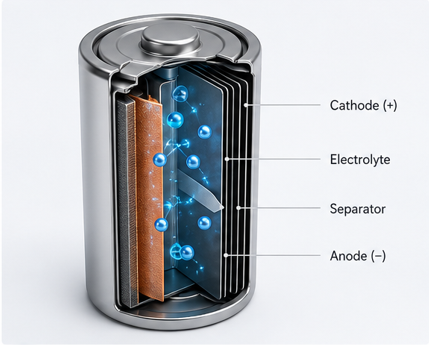
Lithium-ion batteries perform best within a relatively narrow temperature range.
If a battery becomes too hot, it can degrade more quickly or even experience thermal runaway. If it becomes too cold, charging slows down, power output decreases, and driving range is reduced.
To keep batteries operating safely and efficiently, every modern electric vehicle relies on a Battery Thermal Management System (BTMS).
Battery thermal management is therefore one of the most important technologies behind EV safety, fast charging, and long battery life.
Table of Contents
- What Is Battery Thermal Management?
- Why Temperature Matters
- Battery Cooling Methods
- Battery Heating Systems
- Thermal Runaway
- Future Trends
- Frequently Asked Questions
What Is Battery Thermal Management?
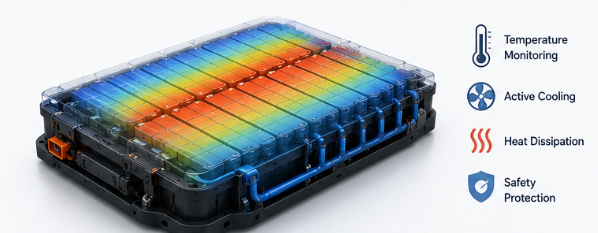
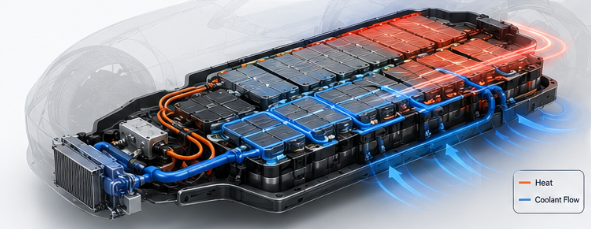
Battery thermal management refers to the technologies used to maintain battery temperature within an optimal operating range.
A BTMS continuously controls battery temperature during:
- Charging
- Fast charging
- Discharging
- High-power acceleration
- Cold-weather operation
Without proper temperature control, battery performance and lifespan decrease significantly.
Why Temperature Matters
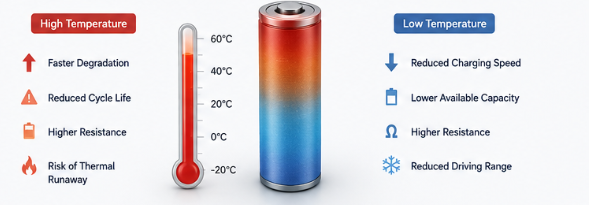
Lithium-ion batteries generally operate most efficiently between 20°C and 40°C.
Outside this range, several problems occur.
High Temperature
- Faster battery degradation
- Reduced cycle life
- Increased internal resistance
- Risk of thermal runaway
Low Temperature
- Reduced charging speed
- Lower available capacity
- Higher internal resistance
- Reduced driving range
Maintaining the proper temperature improves efficiency, safety, and battery longevity.
Battery Cooling Methods
Different manufacturers use different cooling technologies.
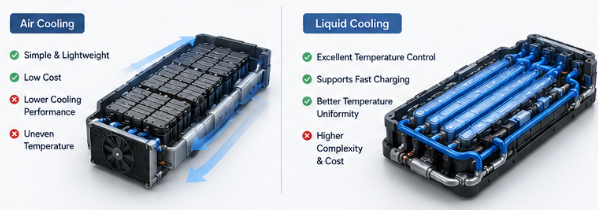
Air Cooling
Uses ambient or forced air.
Advantages:
- Simple
- Low cost
- Lightweight
Disadvantages:
- Lower cooling performance
- Uneven temperature distribution
Liquid Cooling
Uses coolant channels around battery modules or cells.
Advantages:
- Excellent temperature control
- Supports ultra-fast charging
- Better temperature uniformity
Disadvantages:
- Higher system complexity
- Increased manufacturing cost
Today, liquid cooling has become the standard solution for most electric vehicles.
Battery Heating Systems
Cold weather presents different challenges.
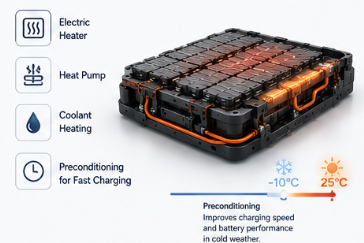
Modern EVs often include battery heating systems that warm the battery before charging or driving.
Common technologies include:
- Electric resistance heaters
- Heat pumps
- Coolant heating
- Preconditioning before DC fast charging
Battery preconditioning is particularly important for achieving maximum charging speed during winter.
Thermal Runaway
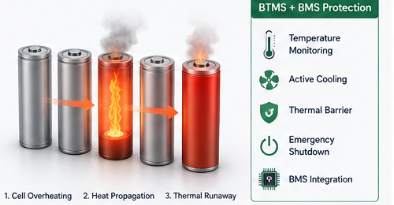
Thermal runaway occurs when heat generated inside a battery cell cannot be dissipated quickly enough.
This can trigger a chain reaction that spreads to neighboring cells.
Battery thermal management helps reduce this risk through:
- Continuous temperature monitoring
- Active cooling
- Thermal barriers
- Emergency shutdown
- Integration with the Battery Management System (BMS)
Together, BTMS and BMS form the foundation of EV battery safety.
Future Trends
Battery thermal management continues to evolve.
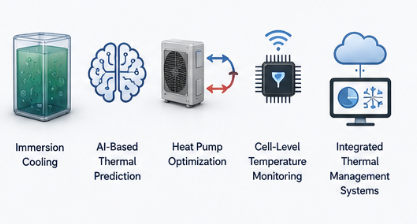
Key industry trends include:
- Immersion cooling
- AI-based thermal prediction
- Heat pump optimization
- Cell-level temperature monitoring
- Integrated thermal management systems
Future EV batteries are expected to become both safer and more energy efficient through smarter thermal control.
Frequently Asked Questions
Why do EV batteries need cooling?
Cooling prevents overheating, extends battery life, and improves charging performance.
What is the difference between air cooling and liquid cooling?
Air cooling is simpler and less expensive, while liquid cooling provides much better temperature control and is widely used in modern EVs.
What is battery preconditioning?
Battery preconditioning warms or cools the battery before charging or driving to optimize performance and charging speed.
Can thermal runaway be prevented?
Although thermal runaway cannot always be completely prevented, modern BTMS and BMS technologies significantly reduce the risk through monitoring, cooling, and protective controls.
Key Takeaways
- Battery thermal management keeps lithium-ion batteries within their optimal operating temperature.
- Proper temperature control improves safety, charging speed, and battery lifespan.
- Liquid cooling has become the dominant solution for modern EV batteries.
- Battery heating systems improve cold-weather performance.
- Thermal management and BMS work together to reduce the risk of thermal runaway.
🎓 Battery Learning Path
🔋 Cell Design
✅🔋 iAtlas Battery #8 — Cell Formats
✅🔋 iAtlas Battery #9 — Battery Pack Architecture
✅🔋 iAtlas Battery #10 — Battery Management System (BMS)
📍 🔋 iAtlas Battery #11 — Thermal Management (Current)
▶ 🔋 iAtlas Battery #12 — Cell-to-Pack (CTP) & Cell-to-Chassis (CTC)
Prerequisite: Complete the 📘 Fundamentals and 🧪 Materials learning paths before starting 🔋 Cell Design.
📖 Continue Reading
⬅ Previous Article
🔋 iAtlas Battery #10
Battery Management System (BMS) Explained: The Brain of Every Lithium-ion Battery
Discover how the Battery Management System monitors voltage, current, and temperature to maximize battery performance, extend lifespan, and ensure safe operation.
➡ Next Article
🔋 iAtlas Battery #12
Cell-to-Pack (CTP) vs. Cell-to-Chassis (CTC): The Future of EV Battery Design
Explore how Cell-to-Pack (CTP) and Cell-to-Chassis (CTC) architectures eliminate traditional modules, improve energy density, reduce weight, and reshape the future of electric vehicle battery design.
References
- International Energy Agency (IEA)
- U.S. Department of Energy – Vehicle Technologies Office
- Battery University
- Nature Energy (Battery Manufacturing Research)
About iAtlas
iAtlas is an independent publication covering batteries, semiconductors, OLED, advanced materials, AI, and global industrial trends.
We transform complex industrial developments into clear, reliable, and easy-to-understand insights.
Whether you’re following today’s industry news or building long-term expertise, iAtlas helps you understand not only what happened, but why it matters.
Technology creates change.
Insight creates opportunity.
— iAtlas