
The Infrastructure Behind Modern Industry
How Power, Cooling, Water, Gases and Utilities Keep Advanced Industry Running
⚡ Industry Infrastructure #2 | 🧭 Fundamentals → The Infrastructure Behind Modern Industry
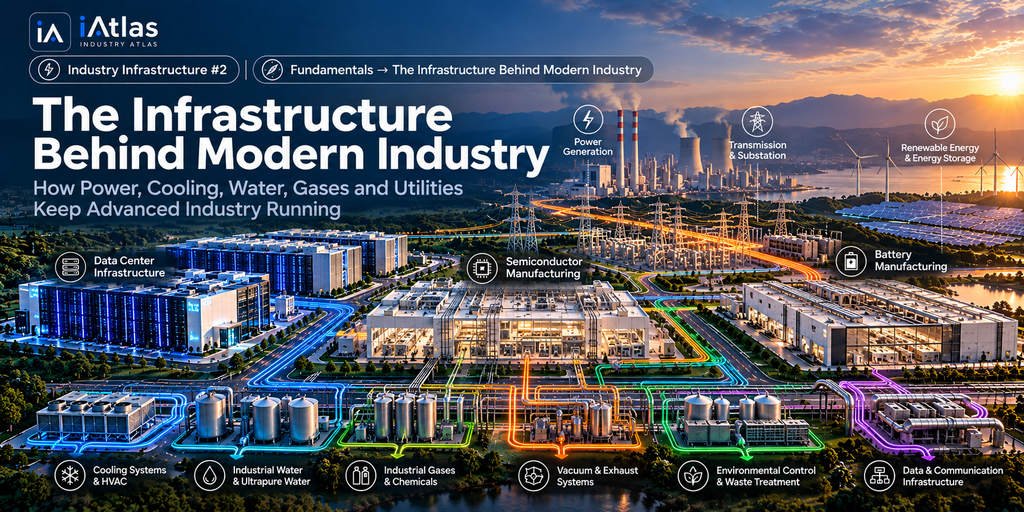
Modern factories are often defined by the products they make.
Semiconductor fabs manufacture chips.
Battery gigafactories produce energy-storage cells.
Data centers process information.
Chemical plants transform raw materials into industrial products.
But behind every visible production line is another system that receives far less attention.
Infrastructure.
Power must be delivered continuously.
Heat must be removed.
Water must meet specific purity requirements.
Gases and chemicals must arrive at controlled pressures, temperatures, and flow rates.
Waste products must be safely removed.
Temperature, humidity, particles, vibration, pressure, and contamination may all need to remain within tightly controlled limits.
Modern industry therefore operates through two interconnected layers:
Production Technology
and
Infrastructure Technology
The first creates the product.
The second makes production possible.
A Factory Is More Than Manufacturing Equipment
When people imagine an advanced factory, they usually picture the manufacturing tools.
In a semiconductor fab, that might mean lithography, deposition, etching, or inspection systems.
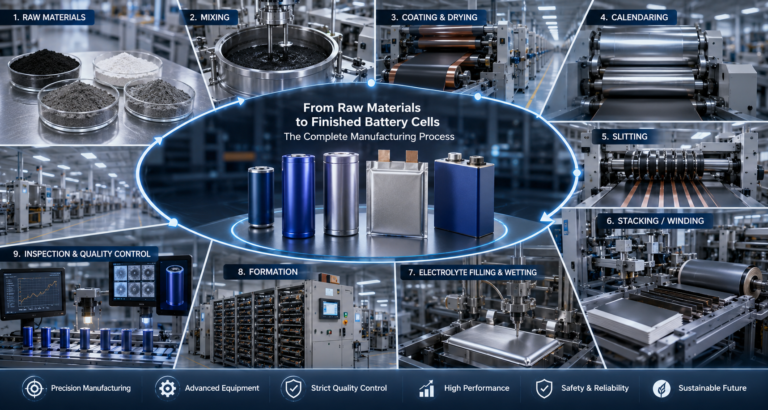
In a battery plant, it might mean coating, calendaring, winding, stacking, electrolyte filling, and formation equipment.
But manufacturing tools cannot operate independently.
They depend on a network of supporting systems.
A simplified industrial facility might look like this:
Power Grid
↓
Substation & Electrical Distribution
↓
Manufacturing Equipment
At the same time:
Cooling Systems
↓
Process Equipment
Industrial Gases & Chemicals
↓
Process Equipment
Water & Environmental Systems
↓
Manufacturing Environment
Vacuum / Exhaust / Waste Treatment
↓
Facility Infrastructure
All of these systems must operate together.
If one critical infrastructure system fails, production may stop even when the manufacturing equipment itself is functioning perfectly.
That is why infrastructure increasingly determines not only whether a factory can operate, but also how reliably and economically it can operate.
Power: The Foundation of Modern Industrial Infrastructure
Electricity sits beneath almost every modern industrial process.
Manufacturing equipment, pumps, compressors, HVAC systems, chillers, robots, data servers, lighting, monitoring systems, and process-control equipment all depend on power.
As advanced manufacturing and digital infrastructure expand, this dependence is becoming more significant.
The International Energy Agency expects global electricity demand to grow at an average annual rate of around 3.6% between 2026 and 2030, driven in part by industry, electric vehicles, cooling, and data centers.
The electricity chain behind an industrial facility can be simplified as:
Power Generation
↓
Transmission
↓
Substation
↓
Transformer
↓
Switchgear
↓
Facility Distribution
↓
Industrial Equipment
Every stage matters.
A new factory may have advanced production technology and sufficient capital, but it cannot operate without enough grid capacity.
This is one reason power availability is becoming a strategic factor in decisions about where factories and data centers are built.
Cooling: The Infrastructure That Removes Heat
Modern industry produces enormous amounts of heat.
Semiconductor processing equipment generates heat.
Industrial pumps and compressors generate heat.
Power electronics generate heat.
Data-center processors generate particularly concentrated heat loads.
Removing this heat is essential because temperature affects reliability, equipment performance, process stability, and product quality.
Cooling infrastructure may include:
- Chillers
- Cooling towers
- Heat exchangers
- Pumps
- Cooling-water loops
- Air-conditioning systems
- Air cooling
- Direct-to-chip liquid cooling
- Environmental temperature control
The importance of cooling becomes particularly visible in AI data centers.
The IEA notes that data-center electricity consumption rose rapidly in 2025, while AI-oriented computing is increasing power density and placing additional pressure on electrical and cooling infrastructure.
This creates an important industrial relationship:
More Computing
↓
More Electricity
↓
More Heat
↓
More Cooling Infrastructure
Cooling is therefore no longer merely a building service.
For high-density computing and advanced manufacturing, it is becoming a critical part of operating capacity.
Water: An Invisible Industrial Resource
Water is another infrastructure layer that is easy to overlook.
Different industries require water for very different purposes.
Some use it for cooling.
Others use it as part of the production process.
Advanced semiconductor manufacturing requires particularly high levels of water purity.
Ultrapure water, or UPW, is used to remove particles, chemicals, and other contaminants from wafers during multiple manufacturing stages.
A semiconductor facility therefore requires much more than a simple water connection.
The system can involve:
Raw Water
↓
Treatment
↓
Purification
↓
Ultrapure Water Production
↓
Process Use
↓
Wastewater Treatment
↓
Recycling or Discharge
This makes water both a production input and an environmental-management issue.
As manufacturing facilities become larger, access to sufficient water and wastewater-treatment capacity can become an important factor in site selection.
Industrial Gases and Chemicals: The Materials Behind the Process
Many advanced manufacturing processes depend on precisely controlled gases and chemicals.
Semiconductor manufacturing provides one of the clearest examples.
Deposition, etching, cleaning, oxidation, and other processes can require materials delivered at specific:
- Purity
- Pressure
- Flow rate
- Temperature
- Concentration
These materials must move from storage systems through distribution networks to process equipment without introducing contamination.
SEMI groups gas and chemical delivery among the critical subfab systems that support semiconductor manufacturing, noting that proper delivery conditions are essential for process control, yield, and safety.
The infrastructure can therefore include:
Bulk Supply
↓
Storage
↓
Gas or Chemical Distribution
↓
Point-of-Use Control
↓
Process Equipment
↓
Exhaust & Treatment
For advanced manufacturing, purity is often just as important as quantity.
A contaminant concentration that would be irrelevant in a conventional factory can become a major problem in semiconductor, OLED, battery, pharmaceutical, or specialty-material production.
Vacuum and Exhaust: Removing What the Process Does Not Need
Some industrial processes depend not on adding materials, but on removing gases or creating controlled low-pressure environments.
Vacuum systems are essential across areas such as:
- Semiconductor deposition
- Etching
- Thin-film processing
- OLED manufacturing
- Research systems
- Specialized chemical processing
But vacuum pumps are only one part of the system.
What leaves the process chamber must also be handled.
That creates another infrastructure chain:
Process Chamber
↓
Vacuum Pump
↓
Exhaust Line
↓
Abatement
↓
Waste Treatment
SEMI identifies vacuum pumps, exhaust systems, waste streams, and abatement as core parts of semiconductor subfab infrastructure.
As manufacturing becomes more complex, these support systems may need to handle larger flows, new chemical compositions, greater heat loads, and stricter environmental requirements.
Infrastructure therefore evolves alongside the manufacturing process itself.
Environmental Control: Sometimes the Environment Is Part of the Process
In many advanced industries, the surrounding environment is not merely the room where manufacturing happens.
It is part of the manufacturing process.
Semiconductor fabs require contamination control.
Battery manufacturing may require extremely low humidity.
OLED processes can require protection from oxygen and moisture.
Pharmaceutical and biotechnology production may require controlled cleanliness and pressure conditions.
That creates specialized infrastructure such as:
- Cleanrooms
- Dry rooms
- HVAC
- Dehumidification
- Air filtration
- Pressure control
- Inert-gas environments
- Temperature and humidity control
Consider lithium-ion battery manufacturing.
Certain battery materials and electrolyte-related processes are highly sensitive to moisture.
The factory therefore needs to control not only the equipment, but the air around the equipment.
This changes the economics of production.
A larger factory does not simply require more machines.
It may also require larger air-handling systems, greater dehumidification capacity, more cooling capacity, and more electricity to maintain the manufacturing environment.
Data and Communication Infrastructure Connect Everything
Modern infrastructure is increasingly digital.
Industrial facilities contain thousands of sensors, controllers, meters, drives, valves, pumps, and pieces of equipment.
These systems generate operational data continuously.
That information may be used to monitor:
- Electricity consumption
- Gas flow
- Water use
- Temperature
- Humidity
- Pressure
- Particle concentration
- Equipment health
- Emissions
- Production conditions
Industrial communication networks allow these systems to interact.
The infrastructure is therefore becoming a combination of:
Physical Infrastructure
Digital Infrastructure
A cooling system may still consist of pipes, pumps, chillers, and heat exchangers.
But sensors and software increasingly determine how efficiently that system operates.
The same is true for electrical grids.
The IEA has highlighted digital monitoring, control systems, forecasting, and AI-enhanced tools as ways to improve utilization of existing grid infrastructure.
The physical and digital layers of infrastructure are therefore becoming increasingly difficult to separate.
Different Industries Depend on Different Infrastructure Mixes
Not every industrial facility needs the same infrastructure.
What matters depends on the process.
AI Data Center
A high-performance AI data center places particularly heavy demands on:
Electricity
↓
Transformers & Switchgear
↓
UPS & Backup Power
↓
High-Density Computing
↓
Cooling
As AI servers become more power-dense, electrical and cooling infrastructure become increasingly important constraints.
Semiconductor Fab
A semiconductor fab depends on a much broader utility ecosystem:
Power
Ultrapure Water
Process Gases
Chemicals
Vacuum
Cooling
Exhaust & Abatement
Cleanroom Control
This helps explain why semiconductor fabrication plants are among the most infrastructure-intensive manufacturing facilities in the world.
Battery Gigafactory
A battery factory has a different infrastructure profile:
Power
Dry-Room HVAC
Cooling
Process Utilities
Material Handling
Safety & Environmental Systems
The manufacturing environment itself can therefore become a major contributor to facility energy consumption.
Advanced Materials & Chemical Manufacturing
Chemical and advanced-material facilities may depend heavily on:
Process Gases
Chemical Storage
Temperature Control
Ventilation
Vacuum or Pressure Systems
Hazardous Exhaust Treatment
Safety Infrastructure
Again, production equipment represents only one part of the complete industrial system.
Infrastructure Determines Industrial Scale
A technology can work successfully in a laboratory without having the infrastructure needed for mass production.
Industrial scale changes the problem.
A process that uses a small amount of gas in a laboratory may require a large bulk-gas distribution system in a factory.
A cooling system that handles a small research tool may need megawatts of capacity in a large industrial facility.
A few servers may run on standard building infrastructure.
Thousands of AI accelerators may require dedicated substations.
Scale therefore transforms supporting utilities into major industrial systems.
This is one reason technologies often face new challenges during commercialization.
The question changes from:
Can the technology work?
to:
Can the entire industrial system support it at scale?
Infrastructure Also Determines Reliability
Modern factories are designed around uptime.
When a critical manufacturing tool stops, production can be disrupted.
But infrastructure failures can be even broader.
A cooling failure can affect multiple machines.
A utility-gas interruption can stop an entire process area.
A grid failure can shut down the complete facility.
A water-quality problem can affect manufacturing yield across multiple process stages.
Infrastructure reliability therefore becomes part of manufacturing reliability.
This is why industrial facilities frequently include:
- Redundant pumps
- Backup generators
- UPS systems
- Duplicate utility lines
- Emergency gas systems
- Monitoring and alarm systems
- Preventive-maintenance programs
- Spare capacity
The more valuable the manufacturing process becomes, the more valuable reliable infrastructure becomes.
Infrastructure Is Becoming an Industrial Bottleneck
The rapid expansion of AI, electrification, renewable energy, and advanced manufacturing is increasing pressure on infrastructure supply chains.
Global grid capacity is already facing growing pressure.
The IEA reports that more than 2,500 GW of renewable-generation, storage, and large-load projects remain in grid-connection queues worldwide.
Data centers provide another example.
AI-driven investment is increasing demand for electrical equipment such as transformers, substations, switchgear, and power electronics, while simultaneously increasing cooling requirements.
These bottlenecks demonstrate an important principle:
Industrial growth is constrained not only by demand or technology, but also by the infrastructure required to support it.
The Hidden Industrial Economy
Infrastructure is often invisible because it operates behind the product.
Consumers see:
AI
but not the substations and cooling systems behind the data center.
They see:
Semiconductors
but not the ultrapure-water plants, process-gas systems, vacuum pumps, and abatement equipment behind the fab.
They see:
Electric Vehicles
but not the dry rooms, HVAC systems, power infrastructure, and utilities behind battery production.
They see:
Renewable Energy
but not the transmission networks, transformers, and storage required to integrate that electricity into the grid.
Yet these supporting industries form an enormous industrial ecosystem of their own.
Understanding Industry Means Understanding Infrastructure
Modern technologies do not exist independently.
They depend on physical systems.
AI depends on data centers.
Data centers depend on electricity and cooling.
Semiconductors depend on water, gases, vacuum, power, and contamination control.
Battery manufacturing depends on controlled environments and large-scale utilities.
Renewable energy depends on grids and storage.
The technology receiving the most attention is therefore only one part of the industrial story.
To understand how modern industry actually operates, we need to look behind the factory floor, behind the chip, behind the battery, and behind the data center.
That is where industrial infrastructure begins.
🧭 Industry Infrastructure Learning Path
Industrial infrastructure connects power, energy, data centers, advanced manufacturing, utilities, and environmental systems.
Follow the iAtlas Industry Infrastructure Learning Path to understand how these systems work together — from the basic structure of industrial infrastructure to the technologies, supply chains, and bottlenecks shaping modern industry.
You Are Here → 01. Industrial Infrastructure Fundamentals
01. Industrial Infrastructure Fundamentals
Understand the systems behind modern factories, data centers, energy facilities, and technology industries.
02. Power Grid & Electrification
Explore how electricity moves from generation to industrial users, and why grids, transformers, substations, and transmission are becoming increasingly important.
03. Data Center Infrastructure
Learn how AI and cloud computing are driving demand for power, cooling, energy storage, and electrical infrastructure.
04. Energy Storage & Flexible Power
Understand how grid-scale energy storage supports renewable energy, grid stability, and increasingly electrified economies.
05. Advanced Manufacturing Infrastructure
Explore the infrastructure behind semiconductor fabs, battery gigafactories, OLED manufacturing, and other advanced industrial facilities.
06. Infrastructure Supply Chains
Follow the companies, equipment suppliers, technologies, and industrial ecosystems supporting global infrastructure investment.
07. Industry Connections
See how AI, semiconductors, batteries, energy, manufacturing, and infrastructure increasingly depend on one another.
🔗 Related Articles
Previous Article
What Is Industrial Infrastructure? The Hidden Systems Behind Modern Industry
Start with the fundamentals and understand why infrastructure is becoming a strategic industry.
Recommended Next
The AI Infrastructure Value Chain: From Chips to Data Centers
References
- International Energy Agency (IEA) — Electricity 2026
- International Energy Agency (IEA) — Electricity Mid-Year Update 2026
- International Energy Agency (IEA) — Powering Artificial Intelligence
- International Energy Agency (IEA) — Modernising Grids in the Age of Electricity
- SEMI — The Role of Subfab Infrastructure in the Future of Semiconductor Manufacturing
ℹ️ About iAtlas
iAtlas is an independent publication covering batteries, semiconductors, OLED, advanced materials, AI, and global industrial trends.
We transform complex industrial developments into clear, reliable, and easy-to-understand insights.
Whether you’re following today’s industry news or building long-term expertise, iAtlas helps you understand not only what happened, but why it matters.
Technology creates change.
Insight creates opportunity.
— iAtlas