
Why Are Clean Manufacturing Environments Becoming More Important?
How Moisture, Oxygen, and Particle Control Influence Semiconductor, Battery, OLED, and Next-Generation Technology Manufacturing
iAtlas Daily #89 | Advanced Manufacturing & Process Control | October 30, 2026
The Invisible Environment Behind Advanced Technology
Clean manufacturing environments are becoming increasingly important as advanced technologies demand greater precision, higher material purity, and more consistent production quality.
When people think about semiconductor manufacturing, they often imagine silicon wafers, advanced lithography equipment, and microscopic transistors.
When they think about batteries, they picture electrodes, electrolytes, and large manufacturing facilities.
But there is another factor that can determine whether these technologies work as intended.
The environment in which they are manufactured.
Even small amounts of moisture, oxygen, or unwanted particles can interfere with sensitive materials and processes.
A battery electrolyte may react with water. An OLED material may degrade when exposed to oxygen. A microscopic particle may cause a defect in a semiconductor structure.
These problems are not always visible.
Yet their consequences can be significant.
As manufacturers pursue more complex devices and advanced materials, environmental control is becoming an increasingly important part of production engineering.
The next generation of manufacturing will depend not only on what materials companies use, but also on how precisely they control the conditions surrounding those materials.
1. Why Does the Manufacturing Environment Matter?
Every manufacturing process takes place within a physical environment.
That environment contains gases, moisture, airborne particles, and potential chemical contaminants.
For conventional products, small variations in these conditions may have limited consequences.
For advanced electronic materials, however, the same variations can influence product performance and reliability.
Three major forms of contamination are particularly important.
Moisture
Water molecules can react with moisture-sensitive chemicals and materials.
Depending on the process, moisture exposure may cause unwanted chemical reactions, changes in material properties, or degradation of device performance.
Oxygen
Oxygen is essential for many manufacturing processes, but it can also cause unwanted oxidation.
Certain battery materials, semiconductor precursors, and organic electronic materials must be protected from uncontrolled oxygen exposure.
Particles
Microscopic particles can create defects on surfaces or interfere with manufacturing steps.
In semiconductor fabrication, particle contamination is especially critical because device features can be extremely small.
Importantly, these contaminants require different control technologies.
Removing airborne particles does not automatically remove oxygen or moisture.
Likewise, creating an oxygen-free atmosphere does not guarantee that the environment is particle-free.
Manufacturers must select environmental controls based on the sensitivity of the materials and the requirements of each process.
2. Semiconductor Manufacturing: When Microscopic Contamination Matters
Semiconductor manufacturing requires exceptional process precision.
Modern chips contain extremely small structures produced through repeated deposition, lithography, etching, cleaning, and inspection steps.
At these dimensions, contamination can affect manufacturing yield.
Particle Contamination
Particles deposited on a wafer can interfere with pattern formation or subsequent processing.
Depending on their size, composition, and location, particles may create electrical defects or reduce manufacturing reliability.
This is why semiconductor factories use carefully controlled cleanroom environments.
High-efficiency air filtration, airflow management, personnel protocols, and contamination monitoring help reduce particle exposure.
Chemical Contamination
Particles are not the only concern.
Trace chemical contamination can also influence semiconductor manufacturing.
Metallic impurities, unwanted surface residues, and airborne molecular contaminants may affect sensitive process steps.
Controlled Process Atmospheres
Certain semiconductor operations require precisely controlled gases.
For example, deposition and etching equipment may operate under vacuum or with selected process gases.
Sensitive materials and precursors may also require controlled handling and storage.
However, the entire semiconductor factory does not need to operate in an oxygen-free atmosphere.
The relevant environment depends on the process.
Semiconductor manufacturing relies on a combination of cleanrooms, vacuum systems, process-gas control, and specialized containment technologies—not one universal contamination-control solution.
3. Battery Manufacturing: Why Moisture Control Is Critical
Battery manufacturing provides another important example of environmental control.
Lithium-ion batteries contain materials that can react with moisture.
In particular, conventional lithium-ion electrolyte systems commonly use lithium salts such as lithium hexafluorophosphate, or LiPF₆.
Moisture exposure can promote undesirable decomposition reactions and the formation of harmful byproducts, including hydrogen fluoride under certain conditions.
These reactions can affect battery performance, safety, and long-term reliability.
Dry Rooms in Battery Manufacturing
Battery manufacturers use dry rooms to reduce atmospheric moisture during sensitive production stages.
Dry rooms are particularly important for operations such as cell assembly and electrolyte filling.
Unlike conventional cleanrooms, which are often primarily associated with airborne particle control, battery dry rooms are designed around strict humidity requirements.
These environments use specialized dehumidification and air-handling systems.
Gloveboxes for Research and Specialized Processes
Gloveboxes provide a smaller enclosed working environment.
They are widely used in battery research, material preparation, electrolyte handling, and laboratory-scale cell assembly.
A glovebox can maintain a controlled atmosphere using inert gases such as argon or nitrogen, depending on material compatibility.
For some research applications, oxygen and moisture concentrations below 1 part per million are required.
However, not every battery manufacturing operation requires this level of atmospheric purity.
The appropriate environmental specification depends on the chemistry, process, exposure time, and product requirements.
Why Manufacturing Scale Matters
A laboratory glovebox and an industrial dry room solve related but different problems.
A glovebox can provide highly controlled conditions within a relatively small enclosure.
A dry room can accommodate larger production equipment, material movement, and personnel.
Manufacturers must balance environmental performance against throughput, energy consumption, operational convenience, and cost.
This becomes especially important as battery production expands.
4. Next-Generation Batteries May Create New Environmental Challenges
Advanced battery chemistries can introduce additional requirements.
Solid-state batteries are one example.
Certain sulfide-based solid electrolytes are sensitive to moisture.
When exposed to water, some sulfide materials can degrade and release hydrogen sulfide.
This creates challenges involving material stability, product quality, and occupational safety.
Why Sulfide Electrolytes Matter
Sulfide solid electrolytes are being investigated because some compositions offer high ionic conductivity and promising characteristics for solid-state battery applications.
However, their sensitivity to moisture can complicate handling and manufacturing.
Researchers are investigating approaches such as:
- Moisture-resistant material compositions
- Protective coatings
- Improved material processing
- Controlled-atmosphere handling
- Alternative electrolyte chemistries
The objective is not simply to create a perfectly dry laboratory environment.
It is to develop a manufacturing process that can produce stable, reliable materials at commercially viable cost.
A Manufacturing Trade-Off
More stringent environmental control can reduce certain contamination risks.
But it also increases equipment complexity, operating costs, and energy requirements.
Battery manufacturers must therefore determine how much environmental protection is necessary for each material and process.
The optimal manufacturing environment is not necessarily the driest possible environment. It is the environment that delivers the required material quality reliably and economically.
5. OLED Manufacturing: Protecting Sensitive Organic Materials
Organic light-emitting diode technology provides another clear example of environmental sensitivity.
OLED devices contain organic materials that generate light when electrical current passes through them.
These materials and associated device structures can be vulnerable to environmental exposure.
Moisture and oxygen can contribute to degradation mechanisms that affect brightness, lifetime, and reliability.
Why Encapsulation Matters
OLED manufacturers use encapsulation technologies to protect sensitive device layers.
Encapsulation creates a barrier that limits the penetration of moisture and oxygen.
For flexible OLED displays, thin-film encapsulation is particularly important.
It must provide environmental protection while maintaining mechanical flexibility.
This becomes more challenging as displays become thinner, curved, or mechanically flexible.
Manufacturing Atmosphere
OLED production may involve vacuum deposition, controlled material handling, and carefully managed manufacturing environments.
Different production stages require different conditions.
For example, vacuum deposition equipment controls the environment in which organic materials are deposited.
Other steps may require specialized handling to minimize exposure to reactive gases or contamination.
Why This Matters for New Display Applications
OLED technology is expanding into laptops, automotive displays, and wearable devices.
These products may face demanding operating conditions.
Automotive displays require long-term durability.
Wearable displays may experience mechanical stress.
Advanced IT displays must balance brightness, efficiency, and lifetime.
Environmental protection therefore influences not only manufacturing yield but also product design and long-term performance.
6. Perovskite Solar Cells: Manufacturing Stability Is a Commercial Challenge
Perovskite solar cells are attracting attention because of their promising photovoltaic performance and potential compatibility with new manufacturing approaches.
However, environmental stability remains an important challenge.
Some perovskite materials are sensitive to moisture, oxygen, heat, and light-related degradation mechanisms.
The degree of sensitivity depends on the material composition, device architecture, and processing conditions.
Controlled Research Environments
Laboratory-scale perovskite devices are often prepared using controlled environments to improve process reproducibility.
Gloveboxes can help researchers limit unwanted atmospheric exposure during sensitive preparation steps.
Scaling Beyond the Laboratory
Commercial manufacturing requires more than achieving high laboratory efficiency.
Producers must develop processes that maintain material quality across larger areas and higher production volumes.
Researchers are investigating ambient-air processing, improved material formulations, protective interfaces, and encapsulation strategies.
These approaches may reduce the need for stringent environmental control during selected manufacturing stages.
The commercial objective is to achieve reliable performance while minimizing unnecessary production complexity.
Environmental control can support technology development, but scalable materials and processes are equally important for commercialization.
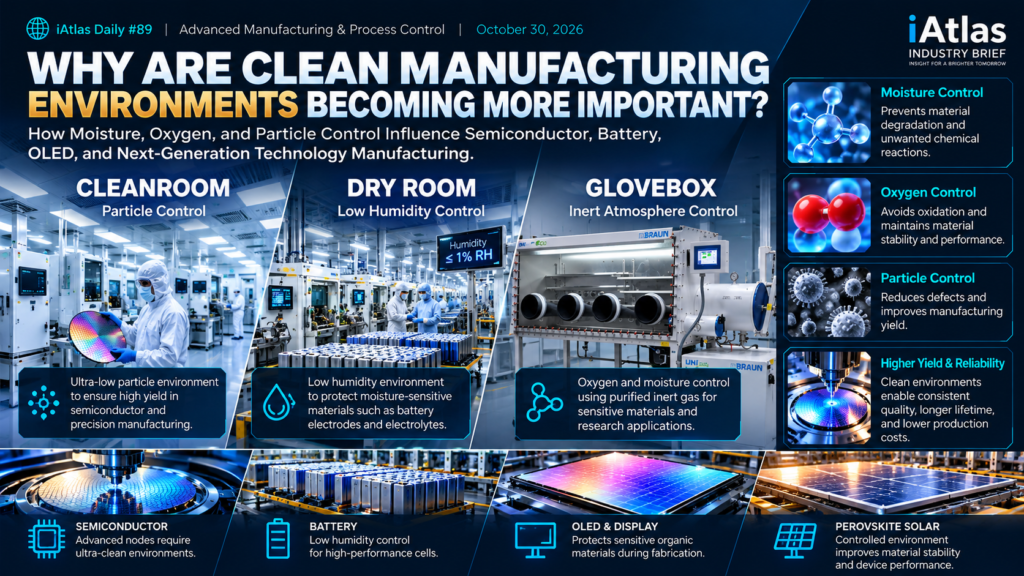
7. Cleanrooms, Dry Rooms, and Gloveboxes: What Is the Difference?
These three technologies are sometimes discussed as though they perform the same function.
In reality, they address different manufacturing requirements.
| Technology | Primary Purpose | Typical Applications |
|---|---|---|
| Cleanroom | Control airborne particles and, where specified, other contamination | Semiconductor fabrication, precision electronics |
| Dry Room | Maintain low atmospheric moisture across a production area | Battery cell assembly, electrolyte-related operations |
| Glovebox | Provide a sealed, controlled atmosphere for sensitive materials | Battery R&D, OLED materials, chemical synthesis, perovskite research |
These technologies can also be combined.
A glovebox may be installed inside a cleanroom.
A battery production facility may use both dry-room infrastructure and specialized inert-atmosphere enclosures.
The correct solution depends on what must be controlled.
Cleanliness Is Not the Same as Dryness
A cleanroom can have extremely low particle concentrations while still containing moisture and oxygen.
A dry room can maintain very low humidity without necessarily meeting the particle requirements of an advanced semiconductor cleanroom.
A glovebox can maintain extremely low oxygen and moisture concentrations without automatically meeting a particular cleanroom particle classification.
Understanding these distinctions is essential for selecting appropriate manufacturing infrastructure.
8. How Inert Gas Purification Systems Work
For materials that require protection from atmospheric oxygen and moisture, inert gas purification is an important technology.
A typical recirculating glovebox system includes several components.
Sealed Enclosure
The enclosure separates sensitive materials from the surrounding atmosphere.
Gloves, windows, seals, and transfer chambers allow operators to handle materials while limiting atmospheric exposure.
Inert Gas
Argon or nitrogen is commonly used to establish the controlled atmosphere.
The appropriate gas depends on the materials and process.
Some highly reactive materials may require a specific gas composition.
Gas Purification
A circulation system moves gas through purification components that remove oxygen and moisture.
The purified gas returns to the enclosure.
This closed-loop approach can reduce the amount of fresh inert gas required compared with continuous once-through purging.
Monitoring and Control
Oxygen and moisture analyzers measure atmospheric conditions.
Control systems can manage circulation, pressure, purging, and regeneration functions.
Regeneration
Over time, purification media accumulate contaminants.
Regeneration restores purification capacity according to the system’s design and operating requirements.
The goal is to maintain a stable environment during normal operations.
9. Industrial Example: MBRAUN Inert Gas Purification
MBRAUN is one example of an equipment manufacturer supplying controlled-atmosphere systems for research and industrial applications.
Its glovebox workstations and gas purification technologies are used in application areas including batteries, organic electronics, and advanced materials research.
According to MBRAUN’s published technical information, its inert gas purification systems are designed to reduce oxygen and moisture concentrations to below 1 ppm under specified operating conditions.
The company offers compact glovebox systems as well as larger industrial gas purification platforms.
Why Closed-Loop Purification Matters
A closed-loop system continuously recirculates gas through purification components.
This helps maintain atmospheric purity without relying entirely on a continuous supply of fresh inert gas.
Monitoring and Regeneration
Oxygen and moisture analyzers provide information about the enclosure atmosphere.
Automated regeneration functions can restore purifier performance.
Certain dual-purifier configurations can support continuous purification while one purification line undergoes regeneration.
Integration with Manufacturing Equipment
Controlled-atmosphere systems can be configured around specialized process equipment.
This can support applications where materials must remain protected during preparation, transfer, testing, or processing.
However, an equipment specification alone does not establish the actual operating conditions achieved in every application.
Performance depends on enclosure integrity, material loading, process emissions, operating procedures, gas quality, and maintenance.
The broader industrial lesson is that atmosphere-control equipment must be engineered around the process rather than selected solely by its nominal purity specification.
10. The Economics of Environmental Control
More stringent environmental control generally requires additional investment.
Manufacturers may need specialized air-handling systems, gas purification equipment, monitoring instruments, sealed enclosures, and maintenance procedures.
These systems also consume energy and operating resources.
So why invest in them?
Because contamination can be expensive.
A defective semiconductor wafer, degraded battery material, or unreliable OLED panel may create costs far greater than the expense of preventing the underlying problem.
The Total Manufacturing Perspective
Environmental control should be evaluated through several factors.
Product Yield: Does better contamination control reduce defects and rejected products?
Process Stability: Can the system maintain consistent conditions during production?
Equipment Availability: How much downtime is required for maintenance and regeneration?
Energy Consumption: What is the operating cost of maintaining the required atmosphere?
Material Protection: Does the environment reduce degradation or unwanted reactions?
Scalability: Can the control strategy support larger production volumes?
The ideal system is not necessarily the most technically sophisticated.
It is the one that achieves the required process conditions with acceptable cost, reliability, and productivity.
Industry Implications | Environmental Control Is Becoming Part of Manufacturing Strategy
The growing importance of controlled manufacturing environments creates opportunities across several industries.
Equipment Manufacturers
Demand may increase for advanced gas purification, dehumidification, filtration, monitoring, and process-integration technologies.
Materials Suppliers
Companies developing sensitive chemicals and functional materials must understand how environmental exposure affects product quality.
Battery and Display Manufacturers
Production yield and product reliability increasingly depend on coordinated control of materials, processes, and manufacturing environments.
Semiconductor Companies
Continued miniaturization and complex device architectures reinforce the importance of contamination control and process consistency.
Research Institutions
Controlled environments help researchers produce reproducible results and investigate sensitive materials.
Industrial Facility Developers
Cleanrooms, dry rooms, gas systems, and production equipment must be integrated into a coherent facility design.
Environmental control is therefore becoming a cross-disciplinary engineering challenge involving materials science, equipment design, automation, facility management, and manufacturing economics.
iAtlas Insight | The Manufacturing Environment Is Becoming a Competitive Technology
Advanced manufacturing is often discussed in terms of better materials, faster equipment, and more sophisticated device architectures.
But these innovations depend on another capability.
The ability to create and maintain the right manufacturing environment.
As materials become more sensitive and production processes become more precise, environmental conditions increasingly influence whether a technology can be manufactured consistently.
Three factors will become particularly important.
1. Process-Specific Control
Manufacturers must understand which contaminants affect each process and establish appropriate environmental specifications.
2. Integrated Manufacturing Systems
Atmosphere control, material handling, monitoring, and production equipment must work together.
3. Economic Optimization
Environmental protection must deliver measurable improvements in quality, yield, reliability, or production efficiency.
The future of advanced manufacturing will not necessarily require every facility to become cleaner or drier.
Instead, manufacturers will need increasingly precise control over the specific conditions that matter.
For semiconductor, battery, OLED, and emerging technology companies, this creates an important competitive distinction.
Manufacturing excellence is not only about controlling the product. It is also about controlling the environment in which the product is made.
Related Articles
Semiconductor Manufacturing
How Thin Film Deposition Builds Semiconductor Devices Layer by Layer
Understand how precise material deposition enables advanced electronic devices and why manufacturing consistency matters.
Battery Fundamentals
Explore the fundamental components of lithium-ion batteries and the materials that influence their performance and reliability.
Industrial Strategy
The Next Industrial Advantage Is Flexibility
Learn why flexible production systems and adaptable manufacturing infrastructure are becoming increasingly important.
References
1. Argonne National Laboratory — Cell Analysis, Modeling, and Prototyping Facility
Overview of battery cell prototyping and pilot-scale manufacturing in a controlled dry-room environment.
2. MBRAUN — Inert Gas Purification
Official technical information on oxygen and moisture removal, closed-loop gas purification, regeneration, and industrial atmosphere-control systems.
3. MBRAUN — Glovebox Workstations
Overview of controlled-atmosphere equipment used in battery research, OLED materials, and other sensitive applications.
Peer-reviewed review discussing OLED degradation mechanisms, environmental sensitivity, and encapsulation approaches.
5. MBRAUN — Laboratory and Chemistry Applications
Technical discussion of glovebox atmosphere monitoring, oxygen and moisture control, and controlled-environment research applications.
6. Argonne National Laboratory — Taking Battery Manufacturing to the Next Level (2025)
Research and manufacturing perspective on transferring advanced battery technologies from laboratory development toward industrial production.
ℹ️ About iAtlas
iAtlas is an independent publication covering batteries, semiconductors, OLED, advanced materials, AI, and global industrial trends.
We transform complex industrial developments into clear, reliable, and easy-to-understand insights.
Whether you’re following today’s industry news or building long-term expertise, iAtlas helps you understand not only what happened, but why it matters.
Technology creates change.
Insight creates opportunity.
— iAtlas