Cathode Materials Explained: Understanding NCM, LFP, NCA, and LMFP
🔋 iAtlas Battery #4 | 🧪 Materials → 🔴 Cathode
Introduction
The cathode is often considered the heart of a lithium-ion battery. While every component inside a battery plays an important role, the cathode has the greatest influence on energy density, operating voltage, cycle life, safety, and overall cost.
Different battery applications require different cathode chemistries. Electric vehicles often prioritize driving range, while energy storage systems focus on safety and long-term durability. As a result, battery manufacturers select cathode materials based on the intended application rather than relying on a single solution.
In this article, we’ll explore the four most widely used cathode materials—NCM, LFP, NCA, and LMFP—and compare their characteristics, advantages, and limitations.
What Is a Cathode?
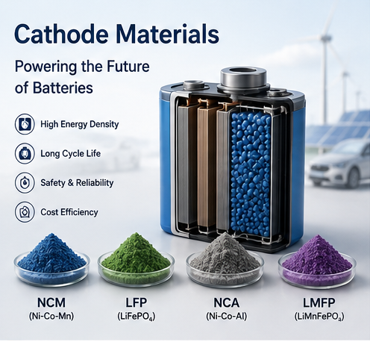
The cathode is the positive electrode of a lithium-ion battery.
During discharge, lithium ions move from the anode back to the cathode through the electrolyte, generating electrical energy that powers external devices.
Because the cathode contains lithium and transition metals, it accounts for a significant portion of a battery’s material cost.
1. NCM (Nickel Cobalt Manganese)
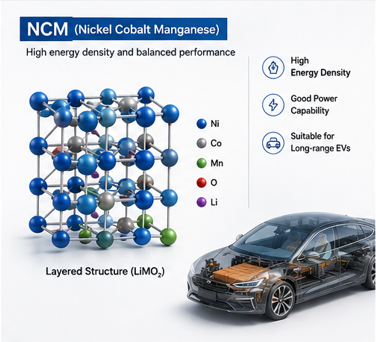
NCM is one of the most widely used cathode materials for electric vehicles.
Advantages
- High energy density
- Good balance between power and lifespan
- Suitable for long driving range
Limitations
- Higher cost
- Uses cobalt, which has supply chain concerns
- Requires advanced thermal management
NCM batteries are commonly found in premium electric vehicles.
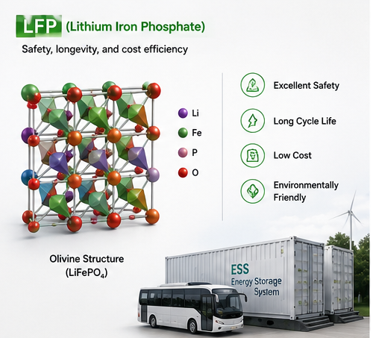
2. LFP (Lithium Iron Phosphate)
LFP batteries have gained significant popularity due to their excellent safety and long cycle life.
Advantages
- Outstanding thermal stability
- Long lifespan
- Lower material cost
- No cobalt or nickel
Limitations
- Lower energy density
- Reduced driving range compared to NCM
LFP is widely used in entry-level EVs, buses, and energy storage systems (ESS).
3. NCA (Nickel Cobalt Aluminum)
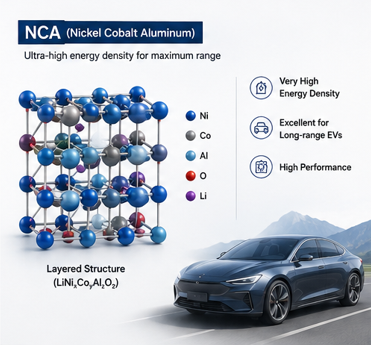
NCA offers one of the highest energy densities among commercial lithium-ion batteries.
Advantages
- Very high energy density
- Excellent performance for long-range EVs
Limitations
- Expensive
- More demanding thermal management
- Lower safety margin than LFP
NCA has been widely adopted in high-performance electric vehicles.
4. LMFP (Lithium Manganese Iron Phosphate)
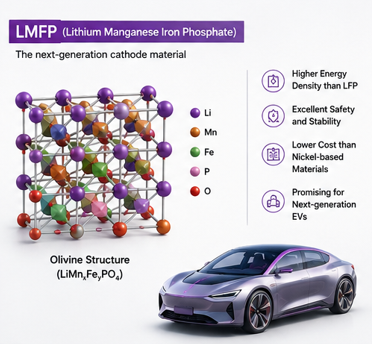
LMFP is an emerging cathode chemistry that builds upon LFP by adding manganese.
Advantages
- Higher energy density than LFP
- Excellent safety
- Lower cost than nickel-rich chemistries
Limitations
- Still being commercialized
- Manufacturing processes continue to evolve
Many experts consider LMFP a promising next-generation cathode for cost-effective electric vehicles.
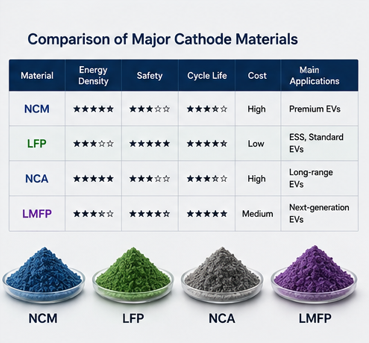
Comparison of Major Cathode Materials
Which Cathode Material Is Best?
There is no universally “best” cathode material.
Instead, manufacturers select materials based on application requirements.
- Long driving range → NCM or NCA
- Maximum safety → LFP
- Cost-effective next-generation EVs → LMFP
- Energy storage systems → LFP
The future of battery technology will likely involve multiple cathode chemistries coexisting rather than one replacing all others.
Key Takeaways
- The cathode has the greatest influence on battery performance and cost.
- NCM and NCA provide high energy density for long-range EVs.
- LFP offers superior safety and long cycle life.
- LMFP is an emerging material that combines safety with improved energy density.
- Different applications require different cathode materials.
🎓 Battery Learning Path
🧪 Materials
📍🔋 iAtlas Battery #4 — Cathode (Current)
▶ 🔋 iAtlas Battery #5 — Anode
▶ 🔋 iAtlas Battery #6 — Electrolyte
▶ 🔋 iAtlas Battery #7 — Separator
Next Learning Path: 🔋 Cell Design
📖 Continue Reading
⬅ Previous Article
🔋 iAtlas Battery #3
Battery Materials Overview: The Four Core Components of Lithium-ion Batteries
Understand how the four core battery materials work together inside a lithium-ion battery.
➡ Next Article
🔋 iAtlas Battery #5
Anode Materials Explained: Graphite, Silicon, and Beyond
Learn why graphite remains the dominant anode material and how silicon is enabling the next generation of high-energy batteries.
References
- International Energy Agency (IEA)
- U.S. Department of Energy – Vehicle Technologies Office
- Battery University
- Nature Energy (Battery Manufacturing Research)
About iAtlas
iAtlas is an independent publication covering batteries, semiconductors, OLED, advanced materials, AI, and global industrial trends.
We transform complex industrial developments into clear, reliable, and easy-to-understand insights.
Whether you’re following today’s industry news or building long-term expertise, iAtlas helps you understand not only what happened, but why it matters.
Technology creates change.
Insight creates opportunity.
— iAtlas