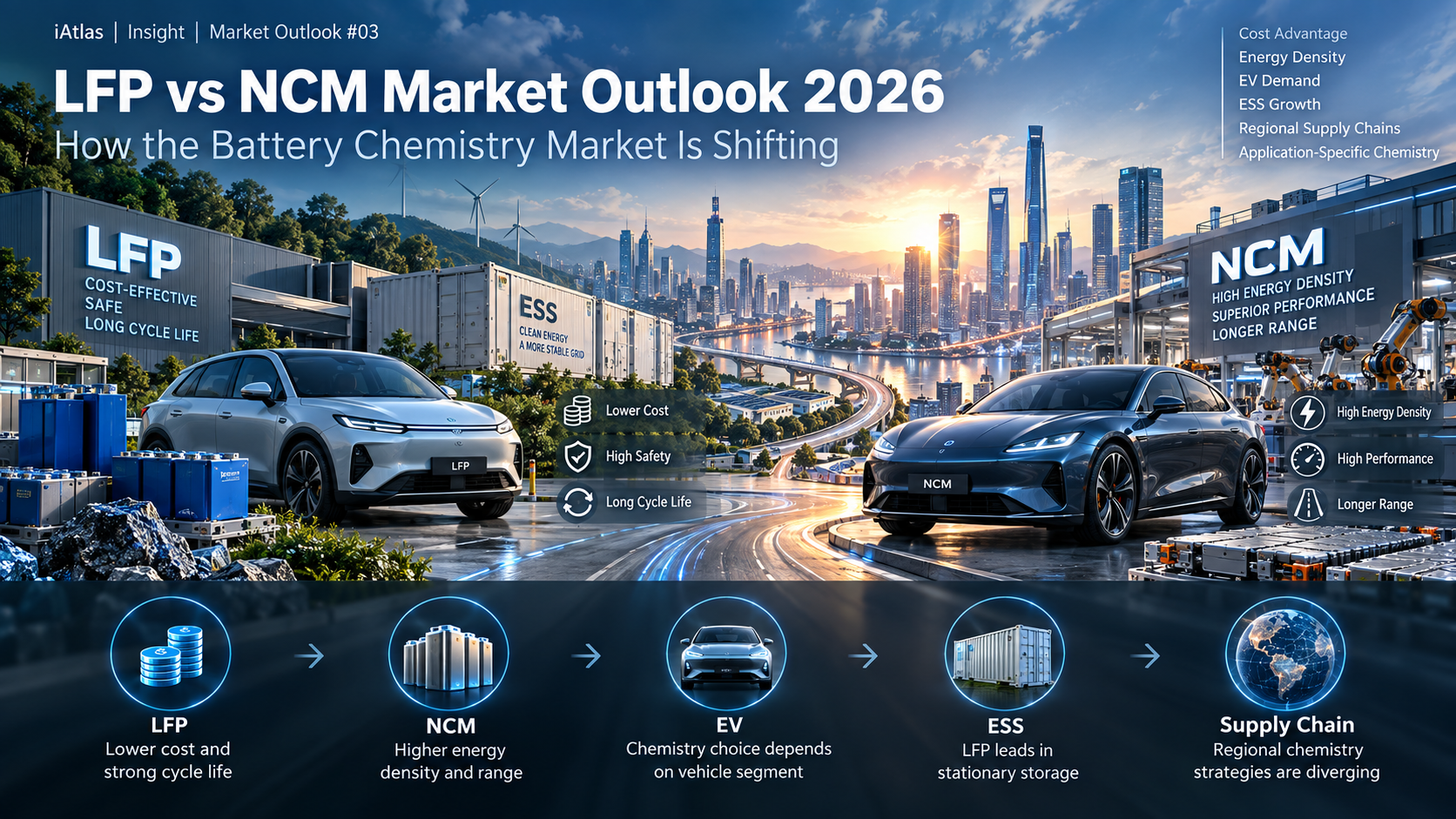
LFP vs NCM Market Outlook 2026
How the Battery Chemistry Market Is Shifting
iAtlas | Insight | Market Outlook #03
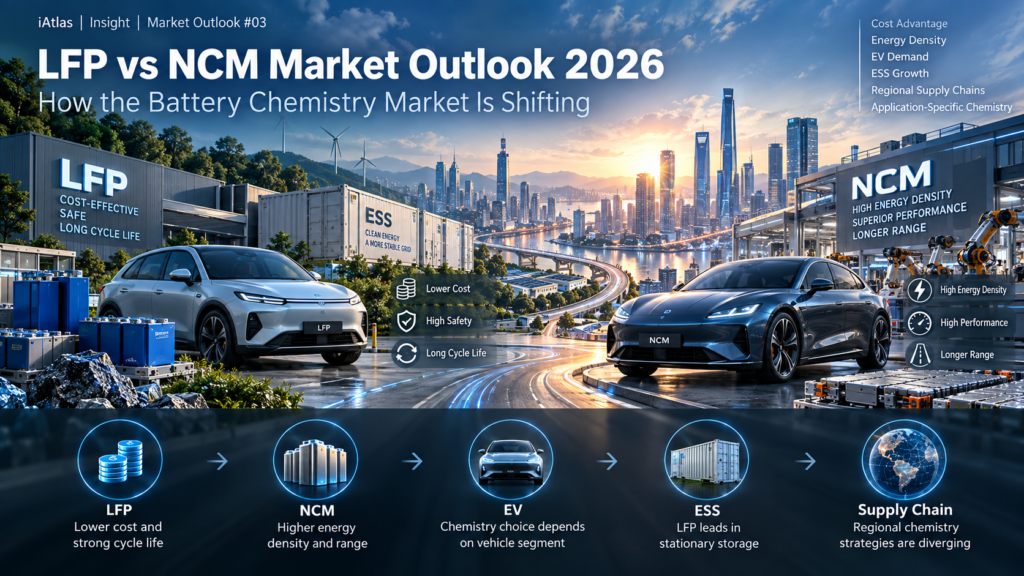
The LFP vs NCM market outlook for 2026 reveals one of the most important structural changes taking place in the global battery industry.
For years, nickel-based chemistries such as NCM were the preferred choice for electric vehicles because they offered higher energy density and longer driving range.
That hierarchy is changing.
Lithium iron phosphate, or LFP, has rapidly expanded from a lower-cost alternative into the world’s most widely deployed EV battery chemistry. In 2025, LFP accounted for more than 55% of global EV battery deployment, up from nearly 50% in 2024. IEA
The shift does not mean that NCM is disappearing.
Instead, the battery market is becoming increasingly segmented by application.
LFP is winning where cost, cycle life and safety matter most.
NCM remains important where energy density, weight and driving range remain critical.
The future battery market may therefore be defined not by one chemistry replacing another, but by manufacturers selecting the chemistry that best fits each application.
Key Takeaways
- LFP represented more than 55% of global EV battery deployment in 2025, becoming the dominant chemistry worldwide. IEA
- LFP battery packs were more than 40% cheaper per kWh on average than NMC alternatives in 2025, although application mix contributes to that difference. IEA
- LFP has become overwhelmingly dominant in stationary energy storage, accounting for around 90% of global battery-storage deployments. IEA
- NCM and other nickel-based chemistries retain an important advantage in energy density and weight-sensitive applications.
- The chemistry split remains highly regional: China strongly favors LFP, while batteries deployed outside China remain much more dependent on nickel-containing chemistries. IEA
- LFP’s rise strengthens China’s position in the battery supply chain because LFP materials and manufacturing expertise remain heavily concentrated there.
- The long-term market is moving toward application-specific battery chemistry, rather than a single universal technology.
1. LFP Has Moved From Alternative to Mainstream
The battery market looked very different only a few years ago.
NCM-based batteries were widely viewed as the preferred solution for passenger EVs because higher nickel content enabled greater energy density and longer driving range.
LFP was often associated with lower-cost vehicles and applications where performance requirements were less demanding.
That distinction has weakened considerably.
According to the International Energy Agency, LFP accounted for more than 55% of global EV battery deployment in 2025, compared with nearly 50% in 2024. IEA
The change has been especially dramatic in China.
LFP adoption there has been supported by strong domestic manufacturing capacity, lower production costs and continued improvements in cell and pack design.
Innovations such as cell-to-pack and cell-to-chassis architectures have also helped manufacturers offset some of LFP’s lower cell-level energy density by reducing structural components inside the battery pack. IEA
As a result, LFP is no longer simply the inexpensive chemistry.
It has become a mainstream battery platform.
2. Cost Is LFP’s Biggest Competitive Advantage
One of the strongest forces behind LFP growth is economics.
LFP cathodes do not require nickel or cobalt.
Instead, they rely primarily on lithium, iron and phosphate — materials that are generally less expensive and exposed to fewer supply-chain constraints than nickel- and cobalt-intensive cathodes.
In 2025, average LFP battery-pack prices were more than 40% lower per kWh than NMC alternatives, according to the IEA. IEA
Part of that difference reflects the applications in which LFP is used, particularly stationary storage, where energy-density requirements are lower.
But the underlying material structure still gives LFP a significant cost advantage.
This matters because battery cost remains one of the largest components of EV manufacturing cost.
A lower-cost chemistry can help automakers:
- Reduce vehicle prices
- Improve margins
- Enter lower-cost EV segments
- Compete more aggressively in emerging markets
This is one reason LFP is closely connected to the expansion of affordable EVs.
3. NCM Still Has an Energy-Density Advantage
If LFP is cheaper, why has NCM not disappeared?
The answer is energy density.
Nickel-based cathodes can store more energy for a given amount of battery mass and volume.
The latest NMC cells can reach approximately 265 Wh/kg, compared with around 205 Wh/kg for the latest generation of LFP cells, according to the IEA’s 2026 analysis. IEA
That difference matters when space and weight are limited.
For example:
Long-Range EVs
Higher energy density can deliver additional driving range without increasing battery-pack size as much.
Premium Vehicles
Performance-oriented vehicles may prioritize range, weight and acceleration over minimum battery cost.
Weight-Sensitive Applications
Commercial applications where battery weight directly reduces payload can benefit from higher-energy-density chemistry.
NCM therefore retains a meaningful role.
The market is not simply moving from NCM to LFP.
It is moving toward a more nuanced question:
How much energy density does the application actually need — and how much is the customer willing to pay for it?
4. LFP Is Particularly Strong in ESS
The chemistry shift becomes even clearer in stationary energy storage.
For an ESS installation, battery weight is generally much less important than it is in a vehicle.
A battery container installed next to a solar farm does not need to travel hundreds of kilometers.
Instead, developers prioritize:
- Low cost
- Long cycle life
- Frequent charge/discharge capability
- Safety
- Predictable degradation
- System economics
These characteristics strongly favor LFP.
The IEA estimates that LFP accounted for around 90% of global battery-storage deployments in 2025, compared with well below half only five years earlier. IEA
This means ESS growth could reinforce LFP demand even further.
As discussed in Market Outlook #02, battery storage is becoming an increasingly important part of electricity infrastructure.
The combination of growing EV adoption and rapidly expanding ESS demand creates a powerful market position for LFP.
5. China Is Driving the LFP Shift
The rise of LFP cannot be separated from China’s battery industry.
Chinese manufacturers lead not only in LFP battery-cell production, but also across large parts of the LFP materials supply chain.
China already accounted for more than 80% of total global battery-cell production in 2025, and Chinese companies have developed especially deep expertise in LFP technology. IEA
The chemistry is also extremely popular in China’s domestic EV market.
That scale creates several reinforcing advantages:
Large Domestic EV Market
↓
High LFP Production Volume
↓
Manufacturing Learning
↓
Lower Costs
↓
Greater Adoption
↓
Further Investment
This is difficult for competitors to replicate quickly.
And as Chinese EV manufacturers expand internationally, LFP technology is spreading with them.
6. Europe Is Beginning to Adopt More LFP
Europe historically relied much more heavily on nickel-based batteries.
That is beginning to change.
LFP represented more than 10% of European Union EV battery demand in 2025, broadly similar to its 2024 share. IEA
But there is an important supply-chain issue.
Nearly all of those LFP batteries depended on China.
According to the IEA, around 30% were directly imported as batteries, while nearly 70% entered the European market embedded inside LFP-equipped electric vehicles imported from China. IEA
This presents Europe with a strategic dilemma.
LFP can help reduce EV manufacturing costs.
But greater reliance on LFP can simultaneously increase exposure to Chinese battery and material supply chains.
Europe therefore faces two competing objectives:
Lower-Cost Batteries
versus
Supply-Chain Localization
How European battery policy balances those objectives could significantly influence future chemistry adoption.
7. The United States Shows a Different Pattern
The United States has followed a different chemistry path.
LFP’s share of EV batteries remained relatively small and declined further in 2025.
Tariffs on Chinese products and sourcing requirements linked to EV incentives limited the ability of Chinese LFP batteries to penetrate the market. IEA
However, this does not mean the United States is abandoning LFP.
In 2025, more than 50 GWh of US battery manufacturing capacity associated with companies including LG Energy Solution and Ford was redirected toward LFP production. IEA
Much of that shift has focused on ESS.
This distinction is important.
The chemistry competition in the United States may develop differently by application:
Passenger EVs → Greater NCM / nickel-chemistry presence
ESS → Increasing LFP localization
This is another example of why battery chemistry should increasingly be analyzed by application rather than as one global market.
8. Outside China, NCM Remains Highly Relevant
Global market-share figures can sometimes hide important regional differences.
LFP may represent more than half of global EV battery deployment, but China accounts for a large portion of that demand.
Outside China, the picture is very different.
Among EV batteries deployed outside China in 2025, almost 80% used nickel-containing chemistries, while the remainder used LFP. IEA
These nickel-containing chemistries include NMC as well as related technologies such as NCA and NMCA.
This distinction matters when evaluating the future of NCM.
Global LFP leadership does not mean nickel-based chemistry has lost relevance.
Instead, the market currently resembles two different ecosystems:
China and LFP-Oriented Markets
Cost-focused
High LFP penetration
Large Chinese supply-chain presence
Europe, North America and Some Premium Segments
Greater nickel-chemistry penetration
Higher emphasis on energy density
Strong Korean and Japanese supplier positions
Over time, those ecosystems may begin to converge.
But the transition will likely take years.
9. Battery Chemistry Is Becoming a Supply-Chain Strategy
Choosing between LFP and NCM is no longer only an engineering decision.
It is increasingly a strategic supply-chain decision.
NCM requires nickel, manganese and cobalt, with different grades using different proportions of each material.
LFP avoids nickel and cobalt but depends heavily on a manufacturing ecosystem concentrated in China.
This creates different forms of risk.
NCM Risk
- Nickel-price exposure
- Cobalt supply concentration
- More complex precursor supply chains
- Higher material cost
LFP Risk
- Heavy concentration of materials and production expertise in China
- Dependence on Chinese cathode and precursor technology
- Potential trade and export-control exposure
The IEA identifies LFP batteries and materials, NMC precursors and graphite anodes among the most geographically concentrated parts of today’s battery supply chain. IEA
Chemistry strategy therefore increasingly intersects with:
Cost
Performance
Industrial Policy
Supply Security
10. NCM Is Also Changing
It would be a mistake to treat NCM as a static technology.
Nickel-based cathodes have continued evolving.
Higher-nickel formulations reduce cobalt usage while increasing energy density.
NMC811 and related high-nickel chemistries have become important in applications where manufacturers seek to maximize range while controlling cobalt exposure.
The IEA notes that NMC721 and NMC811, together with NCA, accounted for roughly 80% of 2025 EV battery deployment among cobalt-containing chemistries. IEA
This means the future competition is not simply:
Old NCM vs New LFP
Both chemistry families continue to evolve.
LFP is improving energy density.
Nickel-based batteries are reducing cobalt intensity.
Pack architecture is improving.
Battery-management systems are becoming more sophisticated.
The technology gap therefore continues to move.
11. A Third Chemistry Could Change the Competition
There is another important factor.
The battery market may not remain a two-way competition between LFP and NCM.
Sodium-ion batteries are beginning to scale.
Leading Chinese manufacturers including CATL and BYD are expanding the technology.
The latest sodium-ion cells can reach energy density of around 175 Wh/kg, compared with approximately 205 Wh/kg for advanced LFP and 265 Wh/kg for NMC. IEA
That still leaves sodium-ion at a disadvantage for long-range vehicles.
But it could become competitive in:
- Small EVs
- Urban commercial vehicles
- Two- and three-wheelers
- Industrial vehicles
- Stationary energy storage
- Cold-climate applications
If sodium-ion achieves sufficient scale and cost reduction, the battery chemistry landscape could eventually become:
NCM → High-performance applications
LFP → Mass-market EVs + ESS
Sodium-ion → Cost-sensitive and selected stationary applications
Rather than replacing LFP, sodium-ion may create another layer of market segmentation.
12. The Battery Market Is Moving Toward Application-Specific Chemistry
For much of the battery industry’s development, technological competition was often framed around finding the “best battery.”
That is becoming less useful.
Different applications require different characteristics.
| Application | Likely Priority |
|---|---|
| Affordable EV | Cost + adequate range |
| Long-range EV | Energy density + range |
| Premium EV | Performance + weight |
| Commercial Vehicle | Cost + durability + payload |
| ESS | Cost + safety + cycle life |
| Cold Climate | Temperature performance |
| Long-Duration Storage | Cost per stored kWh + lifetime |
This makes battery chemistry increasingly application-specific.
The winning chemistry may therefore differ by market.
There may be no single battery chemistry that dominates every segment.
iAtlas Outlook
The LFP vs NCM market outlook is no longer simply a competition between a cheaper battery and a higher-performance battery.
The market is evolving into a broader chemistry portfolio.
Battery Chemistry 1.0
NCM
↓
Higher Energy Density
↓
Longer EV Range
↓
Premium Position
Battery Chemistry 2.0
LFP + NCM + Emerging Chemistries
↓
Application-Specific Design
↓
Cost vs Energy Density
↓
Regional Supply Chains
↓
EV + ESS Segmentation
LFP has already transformed the global battery market.
Its combination of lower cost, long cycle life and improving pack-level performance has allowed it to expand far beyond its original market position.
ESS growth should reinforce that advantage.
But NCM is unlikely to disappear.
Energy density still matters, particularly for vehicles where range, space and weight are critical.
The more likely outcome is a segmented market.
LFP will continue expanding where economics dominate.
NCM will remain important where performance justifies higher cost.
And emerging technologies such as sodium-ion could create entirely new competitive boundaries.
The next stage of battery chemistry competition will therefore not be about identifying one universal winner.
It will be about identifying which chemistry creates the greatest value for each application.
That is how the global battery chemistry market is shifting.
Continue Reading
Previous Market Outlook
ESS Market Outlook 2026
Why Energy Storage Is Entering a New Growth Phase
Next Market Outlook
Solid-State Battery Market Outlook
From R&D to Commercialization
References
- International Energy Agency (IEA) — Global EV Outlook 2026: Electric Vehicle Batteries
- International Energy Agency (IEA) — EV Battery Sales Share by Chemistry and Region, 2023–2025
- International Energy Agency (IEA) — Global Energy Review 2026: Battery Storage
ℹ️ About iAtlas
iAtlas is an independent publication covering batteries, semiconductors, OLED, advanced materials, AI, and global industrial trends.
We transform complex industrial developments into clear, reliable, and easy-to-understand insights.
Whether you’re following today’s industry news or building long-term expertise, iAtlas helps you understand not only what happened, but why it matters.
Technology creates change.
Insight creates opportunity.
— iAtlas