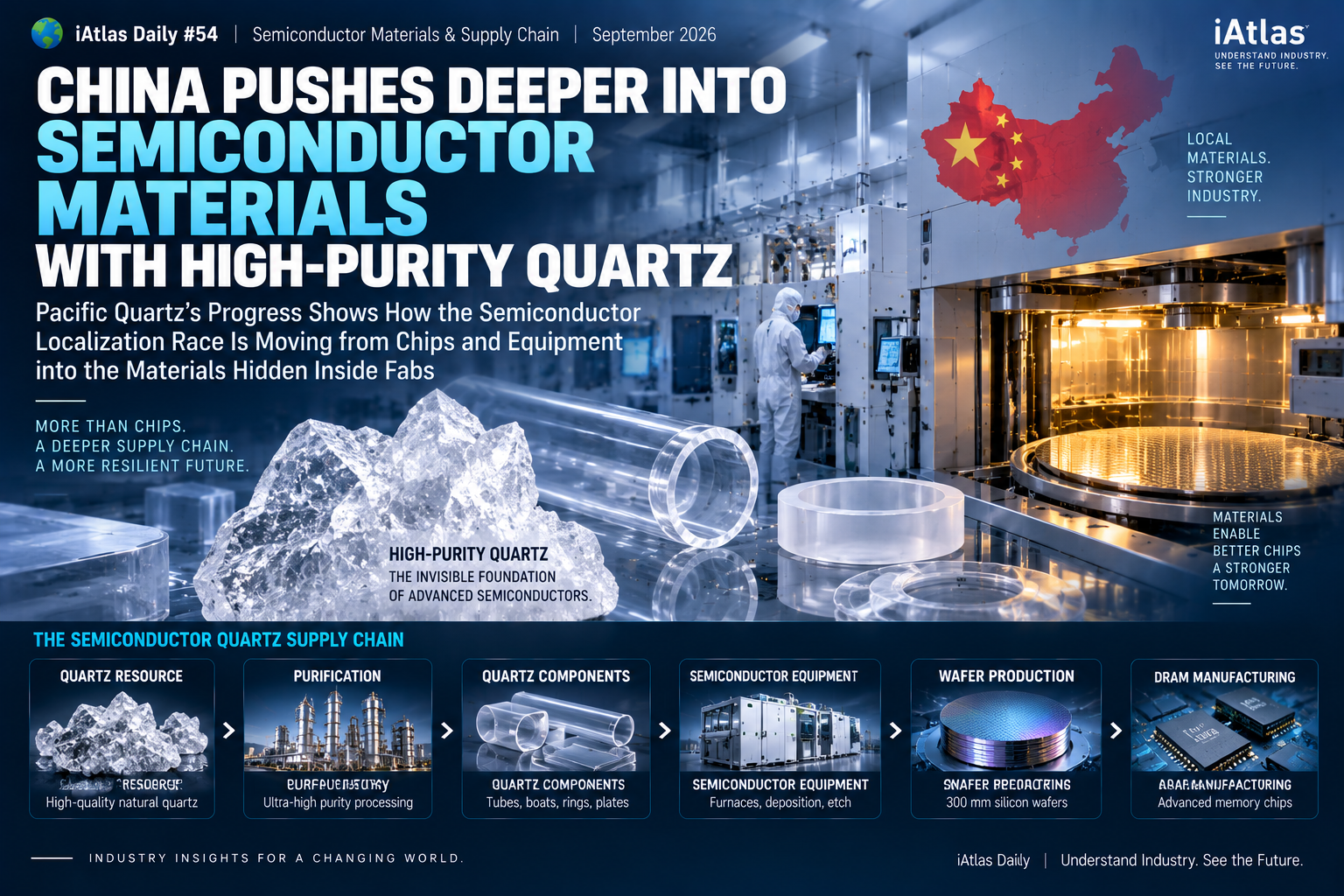
China Pushes Deeper into Semiconductor Materials with High-Purity Quartz
Pacific Quartz’s Progress Shows How the Semiconductor Localization Race Is Moving from Chips and Equipment into the Materials Hidden Inside Fabs
🧪 iAtlas Daily #54 | Semiconductor Materials & Supply Chain | September 2026
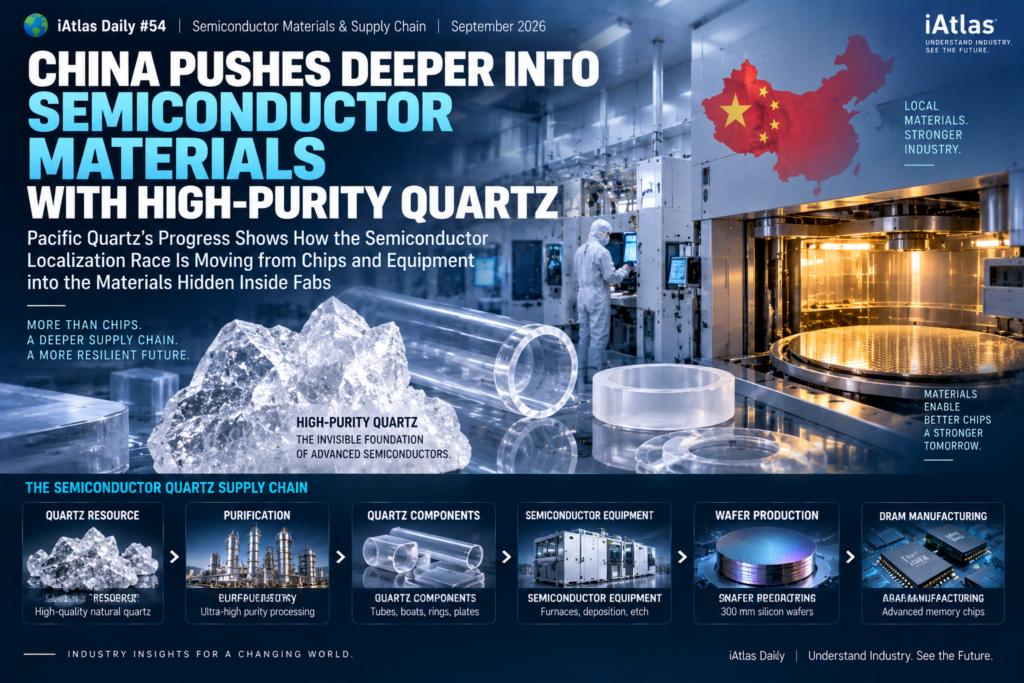
The Semiconductor High Purity Quartz supply chain is becoming another front in China’s push for greater semiconductor self-sufficiency.
China’s semiconductor strategy has traditionally attracted attention around the most visible technologies:
Advanced Chips
Lithography
Semiconductor Equipment
Memory
EDA Software
But modern semiconductor manufacturing depends on hundreds of less visible materials and components.
One of them is high-purity quartz — HPQ.
Chinese producer Jiangsu Pacific Quartz has reportedly secured qualification for high-purity quartz products at a domestic DRAM manufacturer capable of 300 mm wafer production. The company has also supplied quartz materials and consumables used with semiconductor equipment from companies including Lam Research and Tokyo Electron.
The development represents meaningful progress for China’s semiconductor-material supply chain.
But it also reveals something equally important:
China still depends on foreign sources for some of the highest-purity quartz required earlier in semiconductor manufacturing, particularly the material used for crucibles in silicon ingot growth.
The semiconductor localization race is therefore moving deeper:
Chip
↓
Equipment
↓
Components
↓
Process Materials
↓
Raw Materials
The deeper the semiconductor supply chain goes, the harder complete localization becomes.
🧪 The Big Story
Jiangsu Pacific Quartz is not a new entrant to semiconductor quartz.
The company has supplied high-purity quartz products for semiconductor applications for several years, including products associated with major semiconductor-equipment suppliers.
Its semiconductor quartz products include items such as:
- LPCVD diffusion tubes
- quartz boats
- quartz ingots
- quartz plates
- high-purity quartz tubes
Semiconductor-process quartz typically requires extremely high purity because even tiny levels of contamination can affect wafer manufacturing. Reports place quartz used in many semiconductor process-equipment applications around 4N5–5N purity, or approximately 99.995–99.999% SiO₂.
The latest qualification matters because it potentially extends China’s domestic supply chain further into DRAM manufacturing.
The chain increasingly looks like:
Chinese Quartz Resource
↓
Purification
↓
High-Purity Quartz
↓
Quartz Components
↓
Semiconductor Equipment
↓
300 mm DRAM Manufacturing
That is another piece of semiconductor manufacturing moving closer to domestic sourcing.
🔬 1. Why Is Quartz Used in Semiconductor Manufacturing?
Quartz may sound like an ordinary mineral.
Semiconductor-grade quartz is anything but ordinary.
Silicon wafers undergo processes involving:
- extremely high temperatures
- reactive chemicals
- plasma
- vacuum
- aggressive cleaning
- strict contamination control
Quartz is useful because high-purity fused silica offers several valuable characteristics.
High Thermal Resistance
Quartz can withstand the high temperatures used in semiconductor furnaces.
Chemical Stability
It performs well in demanding process environments.
Low Contamination
When sufficiently purified, quartz introduces very low levels of unwanted metallic impurities.
Optical Properties
Quartz also has useful optical characteristics for specialized semiconductor applications.
This makes it useful across equipment and process components.
🏭 2. Quartz Can Be Hidden Inside Semiconductor Equipment
When discussing semiconductor equipment, attention normally goes to the machine itself.
For example:
Lam Research
Tokyo Electron
Applied Materials
But inside semiconductor production systems are numerous components that must survive extremely demanding environments.
Quartz components can include:
Process Tubes
Wafer Boats
Rings
Chambers
Plates
Furnace Components
A simplified furnace process might look like:
Quartz Process Tube
↓
Quartz Wafer Boat
↓
Silicon Wafers
↓
High-Temperature Process
The semiconductor supply chain therefore extends deeper than the equipment manufacturer’s logo on the machine.
⚙️ 3. Pacific Quartz Has Already Entered the Equipment Supply Chain
Pacific Quartz’s progress did not begin with the latest DRAM qualification.
According to recent reports, the company has supplied high-purity quartz consumables associated with semiconductor-equipment manufacturers including Lam Research and Tokyo Electron since around 2019–2020.
That is important.
Qualifying a material for semiconductor manufacturing is not simply a matter of reaching a certain nominal purity.
Suppliers must demonstrate:
Purity
Consistency
Thermal Performance
Contamination Control
Mechanical Reliability
Batch Stability
And ultimately:
Process Qualification
This is one reason semiconductor-material supply chains can be difficult to replace quickly.
💾 4. The Next Step Is DRAM Manufacturing
The latest development takes the story further.
Pacific Quartz’s quartz material or components have reportedly passed qualification at a domestic Chinese DRAM manufacturer.
The customer has not been officially identified in the reporting reviewed for this article.
Analyst TP Huang has suggested that the manufacturer is CXMT — ChangXin Memory Technologies — but that identification should be treated as an analyst assessment rather than a confirmed customer disclosure.
That distinction matters.
What is confirmed by the reports is the broader development:
Chinese high-purity quartz has progressed into domestic DRAM manufacturing qualification.
This represents another step in China’s semiconductor localization strategy.
🇨🇳 5. China’s Semiconductor Localization Is Moving Upstream
China’s semiconductor strategy initially focused heavily on the most obvious bottlenecks.
For example:
Chip Design
↓
Foundry
↓
Memory
↓
Semiconductor Equipment
But equipment localization alone is not enough.
Equipment itself requires:
- vacuum components
- pumps
- valves
- quartz
- ceramics
- specialty metals
- seals
- sensors
- process gases
And the process requires:
- photoresists
- specialty chemicals
- ultra-high-purity gases
- wafers
- CMP materials
So semiconductor independence becomes a much larger problem.
The real chain is:
Raw Material
↓
High-Purity Material
↓
Component
↓
Equipment
↓
Process
↓
Wafer
↓
Chip
Every layer can contain another dependency.
⛏️ 6. But There Is Another Quartz Problem
This is where the story becomes more interesting.
The quartz used inside semiconductor process equipment is not necessarily the same challenge as the quartz required to produce the silicon wafer itself.
Before a semiconductor wafer exists, semiconductor-grade silicon must first be produced.
One common route involves growing a large single-crystal silicon ingot.
That process requires a crucible capable of holding molten silicon at extremely high temperatures.
The crucible is made from extremely pure fused quartz.
The chain is:
High-Purity Quartz
↓
Quartz Crucible
↓
Molten Silicon
↓
Single-Crystal Silicon Ingot
↓
Wafer
↓
Semiconductor Fab
This quartz can require purity and contaminant control beyond many downstream quartz components.
And here, China’s dependency has not disappeared.
🇺🇸 7. Spruce Pine Remains a Critical Node
One location repeatedly appears in discussions about semiconductor-grade high-purity quartz:
Spruce Pine, North Carolina
The region contains exceptionally pure quartz deposits.
Operations associated with Sibelco and The Quartz Corp are important suppliers of high-grade quartz used in applications including semiconductor crucibles. Russian supply exists as well, but at smaller scale according to recent industry reporting.
For the most demanding silicon-ingot applications, the supply chain therefore still looks roughly like:
Ultra-High-Purity Quartz
↓
Limited Global Sources
↓
Quartz Crucible
↓
Silicon Ingot
↓
300 mm Wafer
↓
Advanced Semiconductor
This creates an unusual situation.
One of the world’s most sophisticated industries can depend on a highly specialized mineral resource.
8. Not All High-Purity Quartz Is the Same
The term high-purity quartz can be misleading because purity requirements vary dramatically by application.
Consider two simplified categories.
Semiconductor Equipment Quartz
Used for:
- furnace tubes
- wafer boats
- process components
- plates
Purity may typically be around the high-4N to 5N range depending on the application.
Silicon Ingot Crucible Material
Used directly around molten silicon during crystal growth.
Here, contamination requirements can become much more demanding, with semiconductor-grade silicon ultimately requiring extraordinarily high purity.
Recent reporting describes crucible-related material requirements reaching the equivalent of 9N–11N-class silicon manufacturing environments, with extremely tight limits on individual contaminants.
The important lesson is:
Purity is not just a number. The acceptable impurity profile depends on where the material is used.
🔎 9. China May Be Searching for Its Own Spruce Pine
Another development makes the story even more interesting.
Chinese researchers recently reported a high-purity quartz deposit at Xiaohuaguo in Hubei Province whose characteristics were described as highly similar to benchmark material associated with Spruce Pine.
The scientific work forms part of broader Chinese efforts to identify and evaluate domestic high-purity quartz resources.
A September 2026 research paper also describes HPQ as a critical raw material for next-generation information technology, new energy and advanced manufacturing.
However, discovering promising geological material is not the same as immediately establishing a semiconductor-grade industrial supply chain.
The progression requires:
Resource Discovery
↓
Mining
↓
Beneficiation
↓
Purification
↓
Industrial Production
↓
Customer Qualification
↓
Mass Production
That can take years.
🧫 10. Purity Creates a Different Type of Technology Barrier
High-purity materials illustrate a fundamental feature of advanced manufacturing.
Sometimes the barrier is not creating the material.
It is removing almost everything else.
For quartz:
SiO₂
is the desired material.
The problem is controlling impurities such as:
- aluminum
- iron
- lithium
- sodium
- potassium
- titanium
- calcium
at extremely low concentrations.
As semiconductor processes become more advanced, even trace contamination becomes increasingly important.
This transforms purification itself into a technology.
🔗 11. Semiconductor Supply Chains Are Deeper Than They Look
Consider an advanced memory chip.
At first glance:
DRAM Chip
But behind it sits:
DRAM
↓
Wafer Processing
↓
Semiconductor Equipment
↓
Quartz Components
↓
High-Purity Quartz
↓
Mining & Purification
And quartz is only one example.
The same structure exists for:
Specialty Gases
Photoresists
CMP Slurries
Ceramics
Silicon Carbide Components
Fluorochemicals
Rare Metals
This is why semiconductor supply-chain localization is extraordinarily difficult.
Replacing one imported machine does not eliminate upstream dependencies.
💡 12. Small Markets Can Have Enormous Strategic Importance
High-purity quartz demonstrates another important industrial principle.
Market size does not necessarily determine strategic importance.
A material may represent only a small fraction of the cost of producing a semiconductor.
But if there is no qualified substitute:
No Quartz Component
↓
Equipment Cannot Operate
↓
Wafer Process Stops
↓
Chip Production Stops
This creates what might be called a:
Small-Market, High-Impact Bottleneck
The semiconductor industry contains many such materials.
🏗️ 13. Localization Is Really an Ecosystem Problem
China’s progress in quartz shows why semiconductor self-sufficiency cannot be measured simply by domestic chip-production capacity.
A complete ecosystem requires:
Materials
Quartz
Chemicals
Gases
Wafers
Components
Vacuum parts
Ceramics
Valves
Sensors
Equipment
Deposition
Etch
Lithography
Cleaning
Manufacturing
Foundry
Memory
Packaging
Advanced Packaging
Substrates
Testing
Localization must move through all of these layers.
That is a much longer industrial project than building a semiconductor fab.
🌍 14. This Is Not Only a China Story
The same logic is changing industrial policy around the world.
United States
Semiconductor incentives increasingly emphasize domestic manufacturing and supply-chain resilience.
Europe
The region is attempting to strengthen semiconductor manufacturing and strategic-material security.
Japan
Government support is encouraging semiconductor production while leveraging Japan’s strong materials and equipment ecosystem.
Korea
The country’s semiconductor competitiveness depends not only on Samsung Electronics and SK hynix but also on extensive domestic materials, parts and equipment suppliers.
The competitive unit is increasingly becoming:
The Semiconductor Ecosystem
not merely the semiconductor company.
🧩 Why This Matters
The Semiconductor High Purity Quartz story reveals four important changes.
China’s localization strategy is moving deeper.
The focus is expanding from chips and equipment into materials and components.
Qualification matters.
Producing a material is not enough. Semiconductor customers must trust it inside highly sensitive processes.
China’s dependency has not disappeared.
Ultra-high-purity quartz used in critical upstream wafer-production applications remains a difficult bottleneck.
Hidden materials can be strategically important.
Quartz demonstrates how seemingly small components can influence an enormous semiconductor industry.
🔭 What to Watch
Pacific Quartz
Watch whether domestic DRAM qualification leads to meaningful volume adoption.
Customer Confirmation
The reported DRAM customer has not been publicly confirmed as CXMT.
Chinese HPQ Resources
The Hubei deposit could become strategically important if industrial-scale purification proves viable.
Quartz Crucibles
This remains the more difficult upstream dependency.
Semiconductor Materials Localization
Watch ceramics, process gases, CMP materials and specialty chemicals for similar developments.
China Memory
As Chinese DRAM and NAND production expands, demand for locally qualified semiconductor materials should increase.
🧭 iAtlas Insight
The semiconductor industry is often described through its most sophisticated technologies:
EUV
2 nm
HBM
Advanced Packaging
But the industry is only as resilient as the deepest layer of its supply chain.
A billion-dollar fab can still depend on a comparatively inexpensive component made from an exceptionally pure material.
That changes how semiconductor competition should be understood.
The race is no longer simply:
Who can manufacture the most advanced chip?
It is increasingly:
Who controls the materials, equipment and industrial capabilities required to manufacture that chip repeatedly and at scale?
China’s progress in high-purity quartz shows that localization is moving deeper.
Its remaining dependence on ultra-high-grade quartz shows how much deeper the supply chain still goes.
The next semiconductor bottleneck may not always be a machine. Sometimes, it can begin with a mineral.
📚 Related Articles
📰 iAtlas Daily #34: Korea Semiconductor Fund Targets the Supply Chain
Why Korea is strengthening the materials, components and equipment surrounding semiconductor manufacturing.
📰 iAtlas Daily #10: TSMC Advanced Packaging Expansion Signals the Next AI Boom
How semiconductor competition is expanding beyond wafer fabrication into another critical manufacturing layer.
🔗 References
ScienceDirect — High-Purity Quartz Resource Assessment Research
Pacific Quartz — Semiconductor Quartz Products
About iAtlas
iAtlas is an independent publication covering batteries, semiconductors, OLED, advanced materials, AI, and global industrial trends.
We transform complex industrial developments into clear, reliable, and easy-to-understand insights.
Whether you’re following today’s industry news or building long-term expertise, iAtlas helps you understand not only what happened, but why it matters.
Technology creates change.
Insight creates opportunity.
— iAtlas