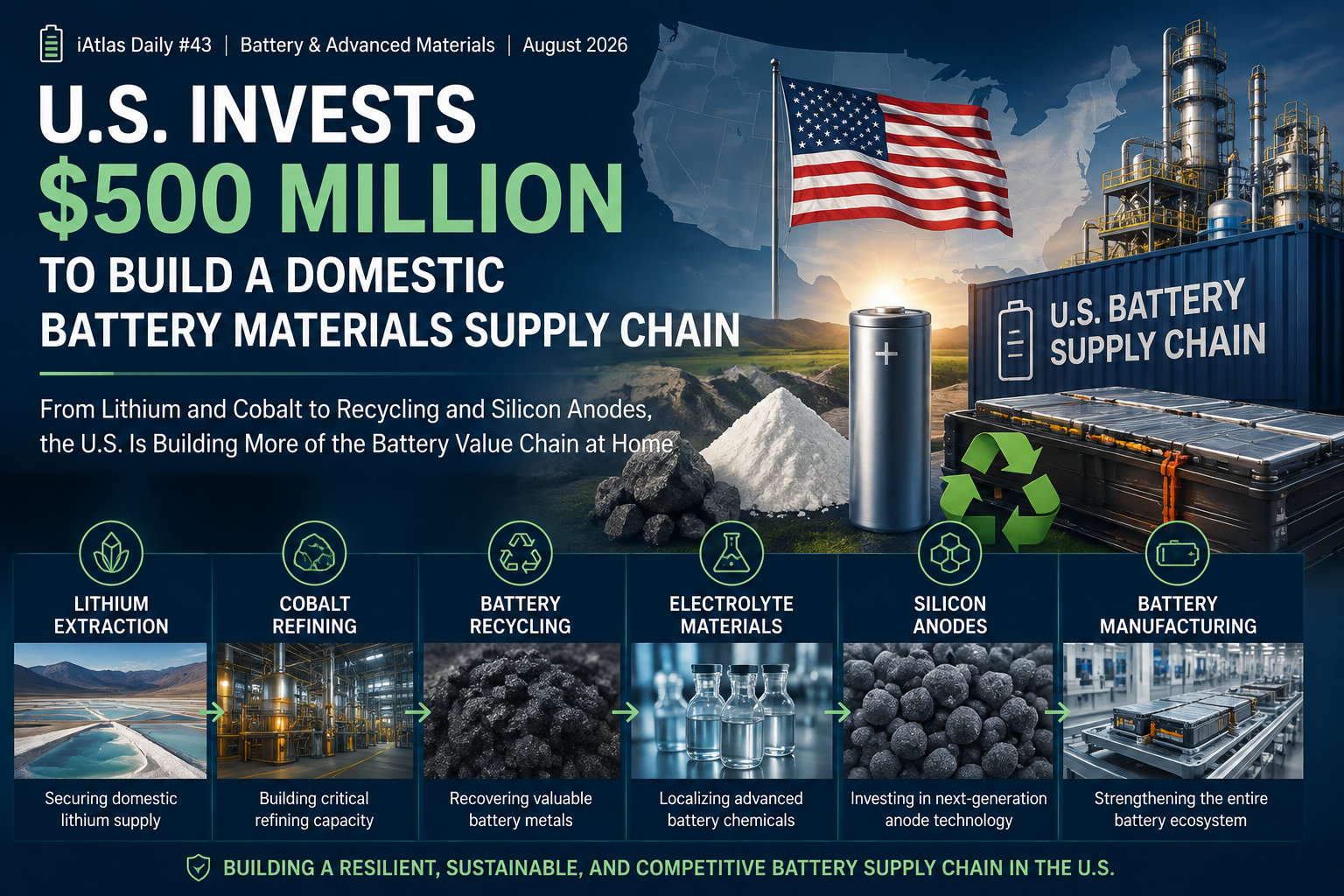
U.S. Invests $500 Million to Build a Domestic Battery Materials Supply Chain
From Lithium and Cobalt to Recycling and Silicon Anodes, the U.S. Is Building More of the Battery Value Chain at Home
📊 iAtlas Daily #43 | Battery & Advanced Materials | August 2026
🌍 The Big Story
The U.S. battery materials supply chain is receiving another major push toward domestic production.
The U.S. Department of Energy is providing approximately $500 million in grants to seven companies working across critical minerals and battery materials, according to Reuters. The projects span lithium extraction, cobalt refining, battery recycling, electrolyte chemicals and silicon-based anode technologies.
The significance goes beyond the size of the funding.
The projects illustrate how battery industrial policy is moving from simply encouraging domestic cell manufacturing toward building the upstream materials ecosystem required to support those factories.
🔋 Battery Manufacturing Starts Before the Gigafactory
When discussing battery localization, attention often focuses on cell factories.
But the actual supply chain begins much earlier.
Critical Minerals -> Material Processing -> Cathode / Anode / Electrolyte ->
Battery Cell Manufacturing -> Battery Pack -> EV / ESS
Building cell factories without securing these upstream stages can leave manufacturers dependent on imported materials.
The latest U.S. projects therefore target several different points in this chain simultaneously.
⚒️ 1. Lithium: Building Domestic Supply
Lithium remains one of the most strategically important materials in lithium-ion batteries.
According to Reuters, Lilac Solutions is set to receive $100 million for a lithium extraction project at Utah’s Great Salt Lake.
The planned facility is expected to have capacity of approximately 5,000 metric tons per year by 2028.
The project is particularly notable because new lithium supply does not necessarily have to come only from conventional hard-rock mines or evaporation ponds.
New extraction technologies are increasingly being developed to recover lithium from brines and other resources.
That could broaden the geographic base of lithium production.
⚙️ 2. Cobalt: Refining Is Just as Important as Mining
Another $100 million is expected to support Jervois and its planned cobalt refinery in Idaho.
This highlights an often-overlooked part of critical-mineral supply chains.
Having access to mineral deposits is not enough.
Raw materials must also be:
extracted → refined → converted into battery-grade materials
before they can enter battery manufacturing.
Processing and refining capacity can therefore be just as strategically important as mining itself.
♻️ 3. Battery Recycling Becomes Part of the Supply Strategy
The funding also includes battery recycling projects.
Nth Cycle is among the companies receiving support for a facility designed to process battery-metal scrap, including black mass.
Black mass is the material obtained after spent batteries and manufacturing scrap are mechanically processed.
It can contain valuable materials such as:
- lithium
- nickel
- cobalt
- manganese
Recovering these materials creates a second source of battery raw materials.
As EV batteries eventually reach end of life—and as battery manufacturing itself generates increasing amounts of scrap—recycling could become an important part of domestic supply.
🧪 4. Electrolytes: Localization Moves Deeper into Materials
Another interesting part of the program is support for electrolyte-related materials.
Reuters reports that Arcanum Ventures is among the recipients, with its project focused on electrolyte chemicals.
This matters because electrolyte manufacturing is considerably further downstream than mining.
A localized battery ecosystem ultimately requires more than lithium, nickel and cobalt.
It also requires:
- Cathode materials
- Anode materials
- Electrolytes
- Separators
- Conductive materials
- Binders
and the chemicals required to manufacture them.
The closer industrial policy moves toward these specialized materials, the more complete the domestic battery ecosystem becomes.
🔬 5. Silicon Anodes Enter the Supply-Chain Strategy
Perhaps one of the most interesting projects involves Coreshell Technologies, which Reuters says is receiving funding related to silicon-based anode development.
Silicon has attracted considerable attention as a next-generation anode material because of its much higher theoretical lithium-storage capacity than graphite.
The challenge is that silicon expands substantially during charging.
That can cause:
- particle cracking
- electrode degradation
- unstable interfaces
- shortened cycle life
The industry is therefore developing silicon-carbon composites, advanced binders, coatings and other approaches to control these problems.
Government support for silicon-anode technology shows that supply-chain policy is beginning to include next-generation battery materials, not merely today’s commodities.
🏭 A Battery Ecosystem, Not Just Battery Factories
Put the projects together and an interesting picture emerges.
Lithium Extraction
↓
Cobalt Refining
↓
Battery Chemicals
↓
Advanced Anode Materials
↓
Cell Manufacturing
↓
Battery Recycling
↺
This is essentially a circular industrial ecosystem.
Mining and extraction provide virgin materials.
Chemical processing converts them into usable inputs.
Advanced-material companies improve battery performance.
Cell manufacturers turn those materials into batteries.
Recycling eventually brings part of the material back into the supply chain.
That is much more difficult to build than a single gigafactory—but also much harder for competitors to replicate once established.
🌏 Why China Remains Central to the Story
The broader strategic objective is reducing U.S. dependence on overseas—and particularly Chinese—critical-mineral processing and battery supply chains.
China’s competitive advantage in batteries is not based solely on having large battery manufacturers.
It has developed extensive capabilities across:
mineral processing → battery materials → cells → manufacturing equipment → EVs and ESS
That vertically connected ecosystem creates scale, cost and supply-chain advantages.
The U.S. challenge is therefore not simply to build more battery factories.
It is to recreate enough of the surrounding industrial network to make those factories competitive and resilient.
📊 Why This Matters for the Battery Industry
The latest funding reinforces three important trends.
1. Battery competition is becoming supply-chain competition
Countries increasingly view control over materials and processing as strategically important.
2. Recycling is becoming an upstream resource
Spent batteries and manufacturing scrap can increasingly serve as domestic sources of critical materials.
3. Next-generation materials are entering industrial policy
Silicon anodes and advanced electrolyte technologies show that governments are beginning to support not only capacity but also technological differentiation.
🔎 What to Watch
The next questions are whether these projects successfully move from grant announcements into commercial-scale production, whether U.S.-made materials can become cost competitive with established Asian supply chains, and how quickly domestic recycling volumes grow as more EV batteries reach end of life.
Another important area will be silicon anodes. If silicon-rich anodes move into broader commercial adoption, they could create a new materials and manufacturing-equipment market alongside conventional graphite.
💡 iAtlas Insight
The battery industry’s next competitive battlefield may not be the gigafactory itself.
It may be everything that feeds the gigafactory.
Lithium extraction, refining, electrolyte chemicals, advanced anodes and recycling determine where battery manufacturers obtain their materials—and ultimately how resilient and competitive their production networks become.
The latest U.S. investment therefore represents something larger than seven individual projects:
The battery race is evolving from a competition over cell factories into a competition over entire industrial ecosystems.
🔗 Related Articles
iAtlas Battery Library — Cathode Materials
iAtlas Battery Library — Anode Materials
iAtlas Battery Library — Electrolyte
🔗 Sources
About iAtlas
iAtlas is an independent publication covering batteries, semiconductors, OLED, advanced materials, AI, and global industrial trends.
We transform complex industrial developments into clear, reliable, and easy-to-understand insights.
Whether you’re following today’s industry news or building long-term expertise, iAtlas helps you understand not only what happened, but why it matters.
Technology creates change.
Insight creates opportunity.
— iAtlas