YMTC Targets $4.9 Billion IPO to Expand China’s Memory Chip Industry
Why China Is Investing Heavily in NAND Manufacturing and Domestic Semiconductor Equipment
📰 iAtlas Daily #41 | August 2026
📰 What Happened?
China’s semiconductor industry is preparing for another major capital expansion.
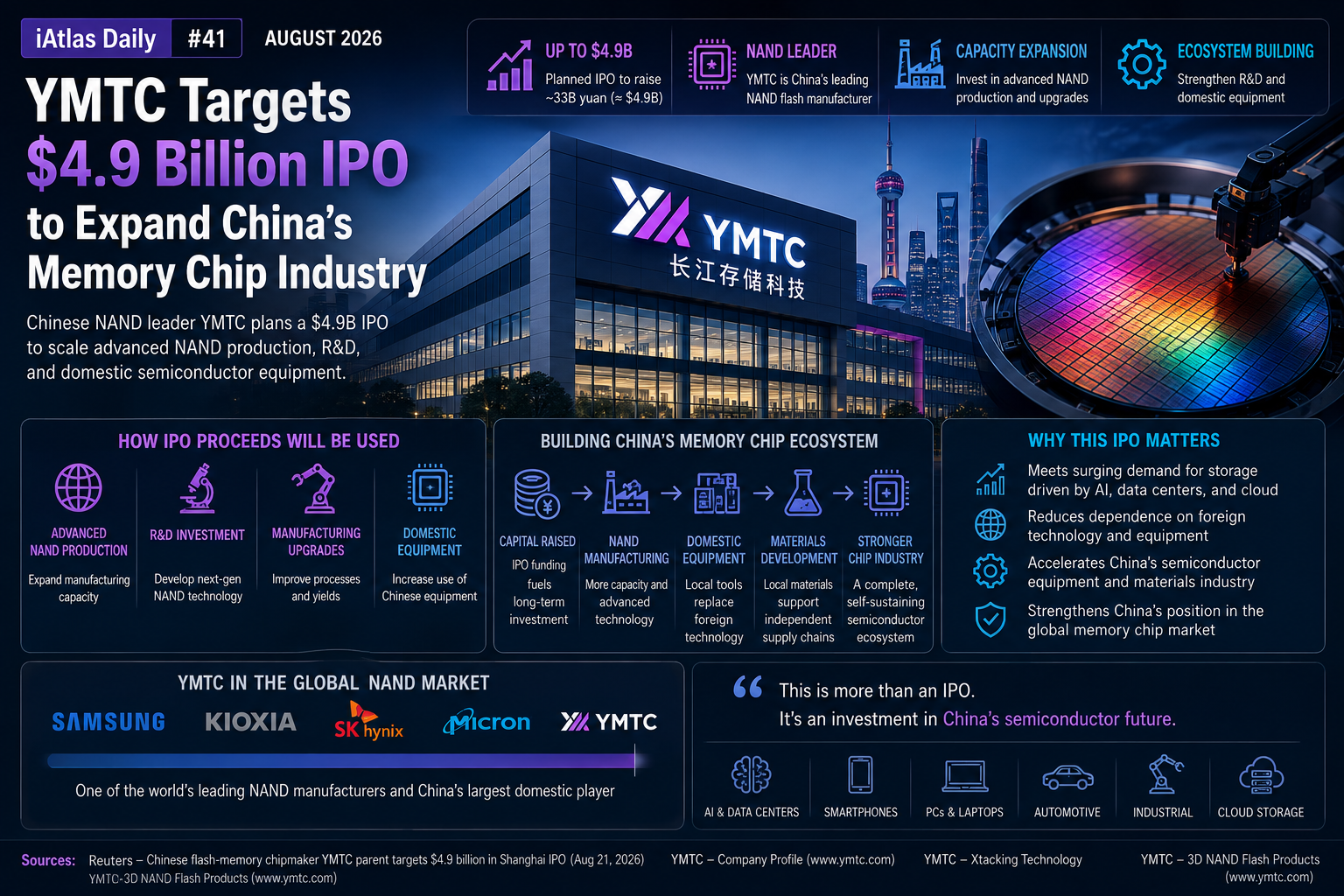
CCSH Corporation, the parent company of Yangtze Memory Technologies Co. (YMTC), is seeking to raise approximately 33 billion yuan, or $4.9 billion, through an initial public offering on Shanghai’s STAR Market.
The proposed IPO could value the company at as much as 330 billion yuan, approximately $49 billion.
YMTC is one of China’s most strategically important semiconductor manufacturers and has emerged as the country’s leading producer of NAND flash memory.
The new capital is expected to support:
- Advanced NAND production
- Manufacturing upgrades
- Semiconductor R&D
- Domestic equipment adoption
- China’s semiconductor supply-chain localization
The IPO therefore represents much more than a financing event.
It shows how China is using capital markets to build a more independent semiconductor manufacturing ecosystem.
💾 Why NAND Matters
NAND flash is one of the fundamental building blocks of the digital economy.
Unlike DRAM, which temporarily stores data while systems are operating, NAND provides non-volatile storage.
It is found across:
- Smartphones
- PCs
- Enterprise SSDs
- Data centers
- Automotive systems
- Industrial equipment
AI is making storage increasingly important.
Training and operating large AI models requires enormous datasets.
Those datasets must ultimately be stored somewhere.
The AI infrastructure stack therefore extends beyond:
GPU + HBM
to include:
High-Capacity, High-Speed Storage
This is helping bring NAND back into the semiconductor investment story.
🤖 AI Is Creating a New Memory Cycle
Most discussion around AI memory has focused on HBM.
And for good reason.
HBM is critical for feeding enormous quantities of data into AI accelerators.
But AI infrastructure requires several layers of memory and storage.
A simplified architecture looks like:
GPU / AI Accelerator -> HBM -> DRAM -> Enterprise SSD -> NAND Flash
The further data moves away from the processor, the larger the required storage capacity can become.
This means AI growth can eventually benefit multiple layers of the memory hierarchy.
YMTC is positioned primarily at the NAND layer.
🏭 YMTC Has Become a Serious NAND Competitor
YMTC was founded in 2016 and has rapidly developed its NAND manufacturing capabilities.
The company is best known for its proprietary Xtacking architecture, which separates memory-array manufacturing from peripheral circuitry before connecting the two.
This approach has allowed YMTC to improve NAND performance while developing increasingly advanced products.
The company has grown from a domestic Chinese challenger into a meaningful global NAND supplier.
According to the IPO information reported by Reuters, YMTC now ranks among the world’s leading NAND manufacturers and is China’s largest domestic player.
That makes its next manufacturing expansion important for the global memory market.
💰 Why a $4.9 Billion IPO Matters
Semiconductor manufacturing consumes enormous amounts of capital.
New memory technology requires continual investment in:
- Fabrication facilities
- Process equipment
- Cleanrooms
- R&D
- Materials
- Yield improvement
- Packaging
- Testing
The proposed IPO gives YMTC another potential source of capital to fund that cycle.
The mechanism is straightforward:
IPO Capital
↓
R&D + Manufacturing Investment
↓
More Advanced NAND
↓
Higher Production Capacity
↓
Greater Global Competition
This is why semiconductor financing can eventually affect global chip pricing and supply.
But There Is a Bigger Story: Semiconductor Self-Sufficiency
YMTC faces a challenge that Samsung, SK hynix and some other global memory manufacturers do not face to the same extent.
Technology restrictions.
The United States has imposed export restrictions limiting China’s access to certain advanced semiconductor technologies and manufacturing equipment.
YMTC itself has been affected by U.S. trade restrictions.
That makes manufacturing expansion more complicated.
China cannot simply expand factories.
It must increasingly build a semiconductor ecosystem capable of operating with less dependence on foreign technology.
⚙️ Domestic Semiconductor Equipment Is Becoming Critical
This may be the most important part of the YMTC story.
According to Reuters, YMTC has been increasing its use of domestically produced semiconductor equipment while modifying manufacturing processes to reduce dependence on restricted foreign technology.
That creates a second investment cycle underneath the memory expansion.
YMTC needs more NAND capacity.
But to build that capacity sustainably, China also needs:
- Deposition equipment
- Etching equipment
- Cleaning equipment
- CMP equipment
- Metrology
- Inspection
- Semiconductor materials
This creates a powerful industrial feedback loop.
Chinese Chip Expansion
↓
Demand for Semiconductor Equipment
↓
Domestic Equipment Development
↓
Lower Foreign Dependence
↓
More Chinese Chip Capacity
China’s semiconductor strategy is therefore increasingly about building the entire manufacturing stack.
🧪 Materials Are Part of the Same Strategy
Equipment is only one side of semiconductor manufacturing.
Every wafer also consumes highly specialized materials.
These include:
- Silicon wafers
- Photoresists
- Specialty gases
- Wet chemicals
- Deposition precursors
- CMP slurry
- Cleaning chemicals
Historically, many of these technologies have been supplied by companies in Japan, the United States, Europe, South Korea and Taiwan.
China is increasingly attempting to localize these supply chains as well.
That means YMTC’s expansion can create opportunities not only for Chinese equipment manufacturers but also for domestic semiconductor-material companies.
⚔️ The Global NAND Competition Could Intensify
The global NAND market already includes several powerful manufacturers:
Samsung Electronics
SK hynix / Solidigm
Kioxia
SanDisk
Micron
YMTC
Memory markets are highly sensitive to supply.
When too much production enters the market, prices can fall rapidly.
When manufacturers cut production, shortages can push prices higher.
YMTC’s ability to expand capacity therefore matters beyond China.
If Chinese NAND production grows significantly, global competitors may eventually face greater pressure on:
- Pricing
- Market share
- Technology investment
- Production efficiency
🔬 NAND Is Also Becoming More Complex
Modern NAND scaling is increasingly three-dimensional.
Rather than simply shrinking memory cells horizontally, manufacturers stack more memory layers vertically.
That creates structures with hundreds of layers.
As layer counts increase, manufacturing becomes more difficult.
Processes must create extremely deep and narrow structures while maintaining precise control across the wafer.
That increases the importance of:
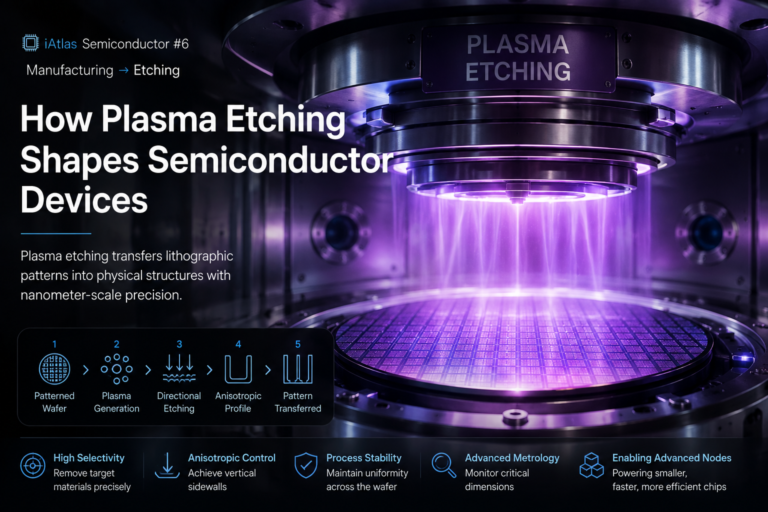
Etching + Deposition + Metrology + Process Control
This is another reason semiconductor equipment has become strategically important.
🔗 The Same Pattern Appears Again
#41 also connects strongly with what we have seen in recent Daily articles.
#36 Applied Materials
AI demand increases semiconductor equipment requirements.
↓
#40 Samsung Foundry
AI demand tightens advanced foundry capacity.
↓
#41 YMTC
Memory demand and geopolitics drive new manufacturing investment and equipment localization.
Different companies.
Different countries.
But the same underlying trend:
Semiconductor manufacturing capacity itself is becoming strategically valuable.
🌏 Why This Matters for Korea
YMTC’s expansion is particularly relevant to South Korea.
Samsung Electronics and SK hynix are two of the world’s largest memory manufacturers.
Historically, Korea’s memory leadership has been built around enormous manufacturing scale and continuous technology investment.
China is now attempting to build similar capabilities.
The competitive structure is therefore evolving from:
Korea + U.S. + Japan
toward a market in which China increasingly possesses its own:
Memory Manufacturers
+
Equipment Suppliers
+
Materials Suppliers
+
Capital
For Korean semiconductor companies, maintaining technological leadership may become even more important.
📈 Industry Impact
💾 Memory Manufacturers
Additional YMTC investment could intensify competition in global NAND.
⚙️ Semiconductor Equipment
China’s localization strategy could accelerate development of domestic equipment suppliers.
🧪 Semiconductor Materials
Chinese materials companies could benefit from efforts to reduce foreign supply-chain dependence.
💻 AI Infrastructure
Growing storage requirements create another potential source of long-term NAND demand.
🌏 Global Semiconductor Supply Chain
The industry could become increasingly divided into parallel manufacturing ecosystems.
👀 What to Watch
Several developments now deserve attention:
- CCSH IPO approval
- Final IPO valuation
- YMTC NAND capacity
- Next-generation Xtacking products
- Chinese semiconductor equipment adoption
- NAND pricing
- Enterprise SSD demand
- AI storage growth
- U.S. export restrictions
- Samsung and SK hynix NAND investment
But perhaps the most important question is:
How quickly can China replace foreign semiconductor manufacturing equipment?
That will determine how independently companies such as YMTC can expand.
🎯 Atlas Insight
The semiconductor race is changing.
For years, competition focused primarily on who could design or manufacture the most advanced chip.
Today, the strategic question is broader.
Can a country control enough of the ecosystem to manufacture those chips independently?
That requires:
Capital -> Fabs -> Equipment -> Materials -> Technology -> Customers
YMTC’s proposed $4.9 billion IPO provides capital at the top of that chain.
But its long-term significance depends on everything underneath it.
China is no longer trying simply to build another memory company.
It is attempting to build a self-sustaining semiconductor manufacturing ecosystem.
The next semiconductor competition may be fought not company against company, but supply chain against supply chain.
📚 Related Articles
📰 iAtlas Daily #36 | Applied Materials Expands for the AI Chip Boom
📰 iAtlas Daily #40 | Samsung Foundry Raises Chip Prices as AI Demand Tightens Capacity
📊 iAtlas Weekly #7 | Technology Demand Is Becoming Factory Demand
Sources
About iAtlas
iAtlas is an independent publication covering batteries, semiconductors, OLED, advanced materials, AI, and global industrial trends.
We transform complex industrial developments into clear, reliable, and easy-to-understand insights.
Whether you’re following today’s industry news or building long-term expertise, iAtlas helps you understand not only what happened, but why it matters.
Technology creates change.
Insight creates opportunity.
— iAtlas