The Gen 8.6 OLED Race Is Heating Up
Why Samsung Display and BOE Are Betting on Larger OLED Fabs
📰 iAtlas Daily #35 | August 2026
📰 What Happened?
The global OLED industry is entering a new manufacturing cycle.
After years of OLED growth being driven primarily by smartphones, display manufacturers are now investing heavily in Gen 8.6 OLED production lines designed for larger IT devices such as notebooks and tablets.
Two companies are at the center of this transition:
Samsung Display and BOE.
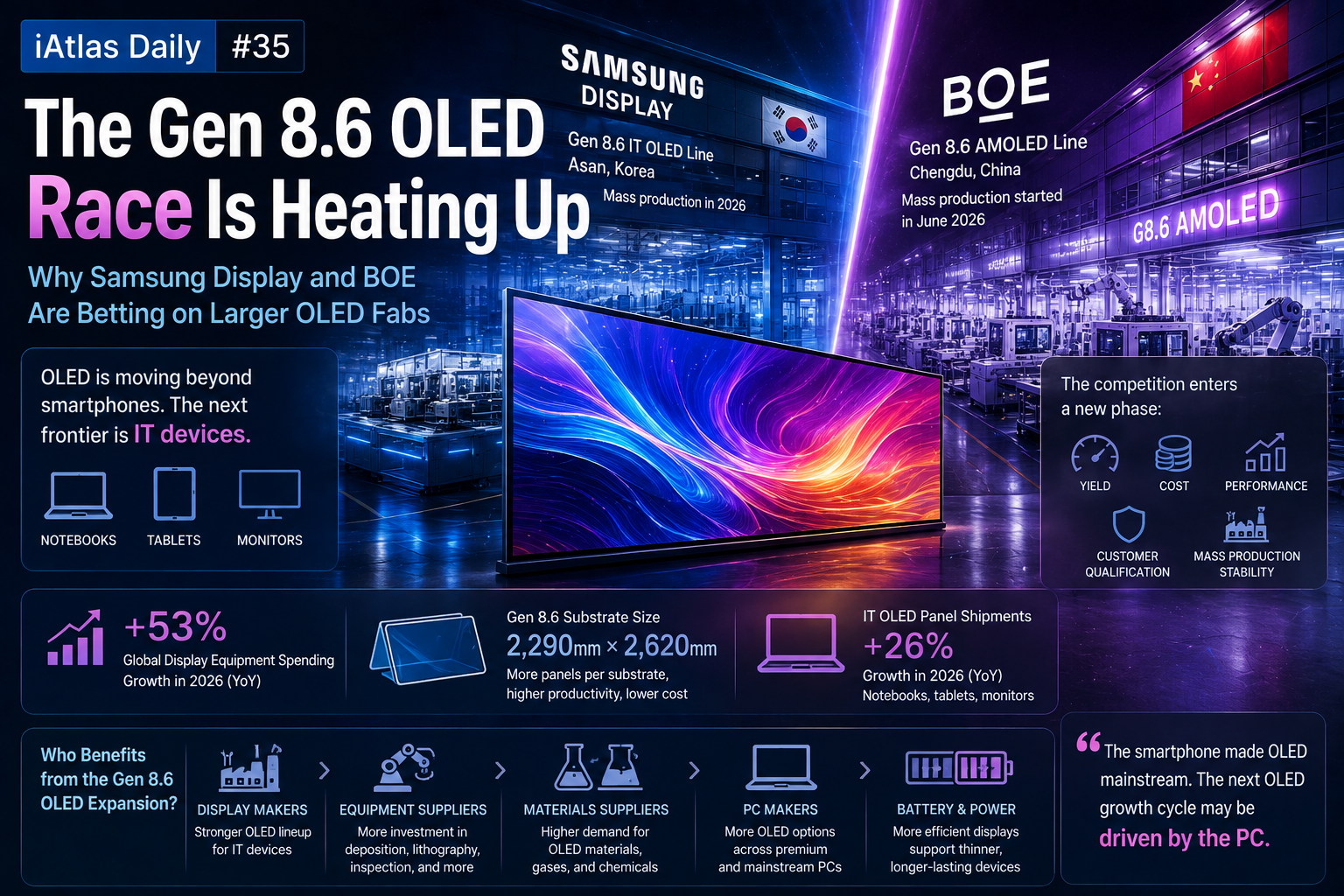
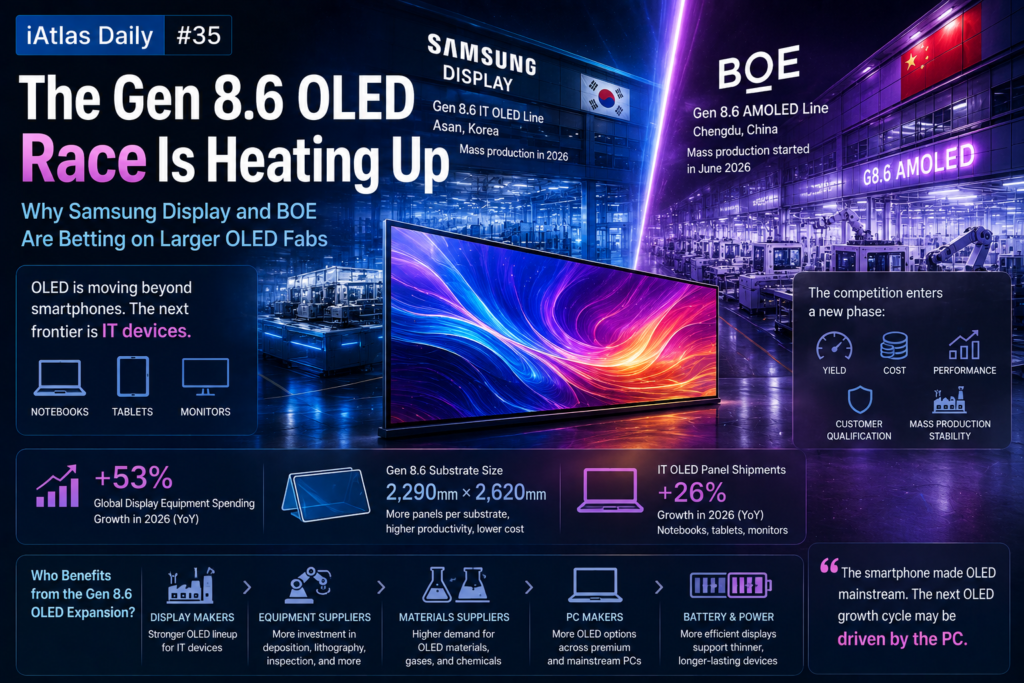
BOE began mass production and customer deliveries from its Gen 8.6 AMOLED line in Chengdu in June 2026.
Samsung Display, meanwhile, is preparing its Gen 8.6 IT OLED line in Asan for mass production in 2026.
The competition represents an important shift in the display industry.
OLED is moving beyond smartphones.
The next major battleground is becoming the IT display market.
💡 Why Gen 8.6 OLED Matters
OLED technology is already widely used in premium smartphones.
But producing larger OLED panels for notebooks, tablets, and monitors presents a different economic challenge.
One of the biggest issues is substrate efficiency.
Display panels are manufactured by cutting multiple panels from large sheets of glass.
Larger-generation production lines use larger mother glass substrates, allowing manufacturers to produce larger IT panels more efficiently.
Samsung Display’s Gen 8.6 line uses substrates measuring approximately:
2,290 mm × 2,620 mm
This allows significantly more notebook and tablet panels to be produced from each substrate compared with existing Gen 6 lines.
The result could be:
- Higher productivity
- Lower manufacturing cost per panel
- Better utilization for larger displays
- Greater OLED competitiveness against LCD
That is why Gen 8.6 is not simply a larger factory.
It is an attempt to change the economics of IT OLED manufacturing.
🏭 Samsung Display Prepares for IT OLED Expansion
Samsung Display has committed approximately ₩4.1 trillion to its Gen 8.6 IT OLED production project in Asan.
The A6 production line is being built by converting an existing LCD facility into a dedicated IT OLED manufacturing line.
Samsung Display expects the new production system to significantly improve productivity compared with existing Gen 6 OLED manufacturing.
The company has been preparing the line for mass production in 2026, targeting applications including:
- Notebook PCs
- Tablets
- Premium IT devices
This represents a strategic expansion beyond Samsung Display’s traditional strength in smartphone OLED.
The company is effectively betting that OLED adoption in IT devices will accelerate during the second half of the decade.
🇨🇳 BOE Has Already Entered Mass Production
Samsung Display is not alone.
BOE officially began mass production and customer delivery from its Gen 8.6 AMOLED production line in Chengdu on June 17, 2026.
The facility is China’s first Gen 8.6 AMOLED production line.
BOE is targeting the high-end mid-size display market, including notebooks and other premium IT devices.
Its technology roadmap includes:
- LTPO backplanes
- Tandem OLED
- Lower power consumption
- Longer display lifetime
BOE’s rapid production ramp is significant because it increases competitive pressure in a market that has historically been dominated by Korean OLED manufacturers.
The OLED competition between Korea and China is therefore moving into a new phase.
💻 Why IT Devices Are the Next Target
The smartphone OLED market is already relatively mature.
IT devices offer a much larger opportunity for OLED penetration.
Notebook PCs and monitors have traditionally relied heavily on LCD technology because LCD offers attractive manufacturing economics for larger panels.
But the market is changing.
Premium notebooks increasingly compete on:
- Display quality
- Battery efficiency
- Thin design
- High refresh rates
- HDR performance
- AI PC user experience
OLED can provide several advantages in these areas.
Counterpoint Research expects OLED IT panel shipments—including notebooks, monitors, and tablets—to grow approximately 26% year over year in 2026.
AI PCs may also contribute to the transition as manufacturers look for premium hardware features that differentiate higher-value devices.
⚙️ The Bigger Opportunity May Be Display Equipment
The transition also matters for equipment suppliers.
According to Counterpoint Research, global display equipment spending is expected to increase 53% year over year in 2026.
OLED investment is the primary growth driver.
New high-generation OLED fabs require equipment across multiple manufacturing processes:
🧪 Deposition
OLED organic materials must be deposited precisely onto the substrate.
🔬 TFT Manufacturing
Backplane technologies such as oxide TFT and LTPO control individual OLED pixels.
📐 Lithography
High-resolution patterning is required throughout the manufacturing process.
🧼 Cleaning
Large substrates require extremely clean processing environments.
🔍 Inspection & Metrology
Defects must be detected before expensive downstream processes are completed.
📦 Encapsulation
OLED materials are sensitive to oxygen and moisture, making reliable encapsulation essential.
As Gen 8.x OLED investment expands, equipment and materials companies throughout the supply chain could benefit.
🧪 Materials Will Matter Too
OLED manufacturing also depends on a complex materials ecosystem.
Key materials include:
- OLED emitting materials
- Electron and hole transport materials
- Fine Metal Masks
- Photoresists
- Specialty gases
- Process chemicals
- Encapsulation materials
- Glass substrates
Larger substrates create new manufacturing challenges.
Uniformity becomes more difficult.
Material utilization becomes increasingly important.
Yield becomes critical.
That means the Gen 8.6 competition is not only a race between panel manufacturers.
It is also a technology race across the equipment and materials supply chain.
🌏 Korea vs. China Enters a New OLED Phase
For years, South Korea maintained a strong technological lead in OLED displays.
China rapidly expanded OLED capacity, particularly in smartphone panels.
Gen 8.6 changes the competitive landscape again.
Samsung Display brings deep OLED manufacturing experience and relationships with global premium device manufacturers.
BOE brings massive manufacturing scale and China’s rapidly developing display supply chain.
The next competition will therefore focus on more than production capacity.
Manufacturers must compete on:
Yield
↓
Cost
↓
Panel Performance
↓
Customer Qualification
↓
Mass Production Stability
The company that solves all five most effectively could gain an important advantage in the next IT OLED market.
🌍 Industry Impact
🖥️ Display Manufacturers
Gen 8.6 production could accelerate OLED adoption beyond smartphones and into notebooks, tablets, and monitors.
⚙️ Display Equipment
Large-scale OLED investment creates opportunities across deposition, lithography, cleaning, inspection, and automation equipment.
🧪 Advanced Materials
Higher production volumes could increase demand for OLED materials, gases, chemicals, masks, and encapsulation technologies.
💻 PC Manufacturers
More competitive OLED production costs could make OLED displays available across a broader range of notebook products.
🔋 Battery & Power Management
More efficient displays could become increasingly important as AI PCs require additional computing power while still needing competitive battery life.
👀 What to Watch
Several developments will determine how quickly the IT OLED market expands:
- Samsung Display Gen 8.6 production ramp
- BOE Gen 8.6 production yield
- Notebook OLED adoption
- AI PC demand
- OLED panel pricing
- Tandem OLED adoption
- New Gen 8.x investments
- Equipment orders from panel manufacturers
But one indicator may matter more than all the others:
Can Gen 8.6 bring IT OLED costs close enough to LCD to accelerate mass-market adoption?
🎯 Atlas Insight
The OLED industry’s next major challenge is no longer proving that OLED is a better display technology.
Consumers already understand the benefits of OLED in smartphones and premium televisions.
The challenge is industrialization.
Can manufacturers produce larger OLED panels with sufficient yield, productivity, and cost competitiveness to transform the notebook and monitor markets?
Samsung Display and BOE are now attempting to answer that question with Gen 8.6 manufacturing.
If they succeed, the consequences could extend far beyond the two companies.
It could create another investment cycle across:
Display Equipment → Materials → Components → IT Devices
The smartphone made OLED mainstream.
The next OLED growth cycle may be driven by the PC.
📚 Related Articles
📰 iAtlas Daily #21 | Samsung Display Expands OLED Investment to Strengthen IT Display Leadership
📰 iAtlas Daily #29 | Micro OLED Is Powering the Next Generation of AR Devices
📊 iAtlas Weekly #6 | Scale Is Becoming the New Industrial Advantage
Sources
Samsung Display — Gen 8.6 IT OLED Production Line
Counterpoint Research — AI Reshaping IT Market and Accelerating the Shift to OLED
About iAtlas
iAtlas is an independent publication covering batteries, semiconductors, OLED, advanced materials, AI, and global industrial trends.
We transform complex industrial developments into clear, reliable, and easy-to-understand insights.
Whether you’re following today’s industry news or building long-term expertise, iAtlas helps you understand not only what happened, but why it matters.
Technology creates change.
Insight creates opportunity.
— iAtlas