SK hynix Invests ₩54 Trillion in New Memory Fabs
Why the AI Memory Boom Is Turning Into a Long-Term Manufacturing Race
📰 iAtlas Daily #30 | August 2026
📰 What Happened?
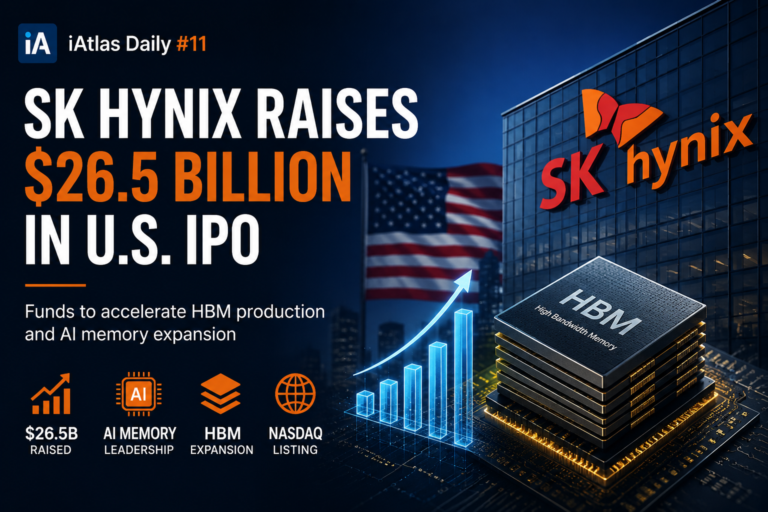
SK hynix has approved one of its largest semiconductor manufacturing investments to date.
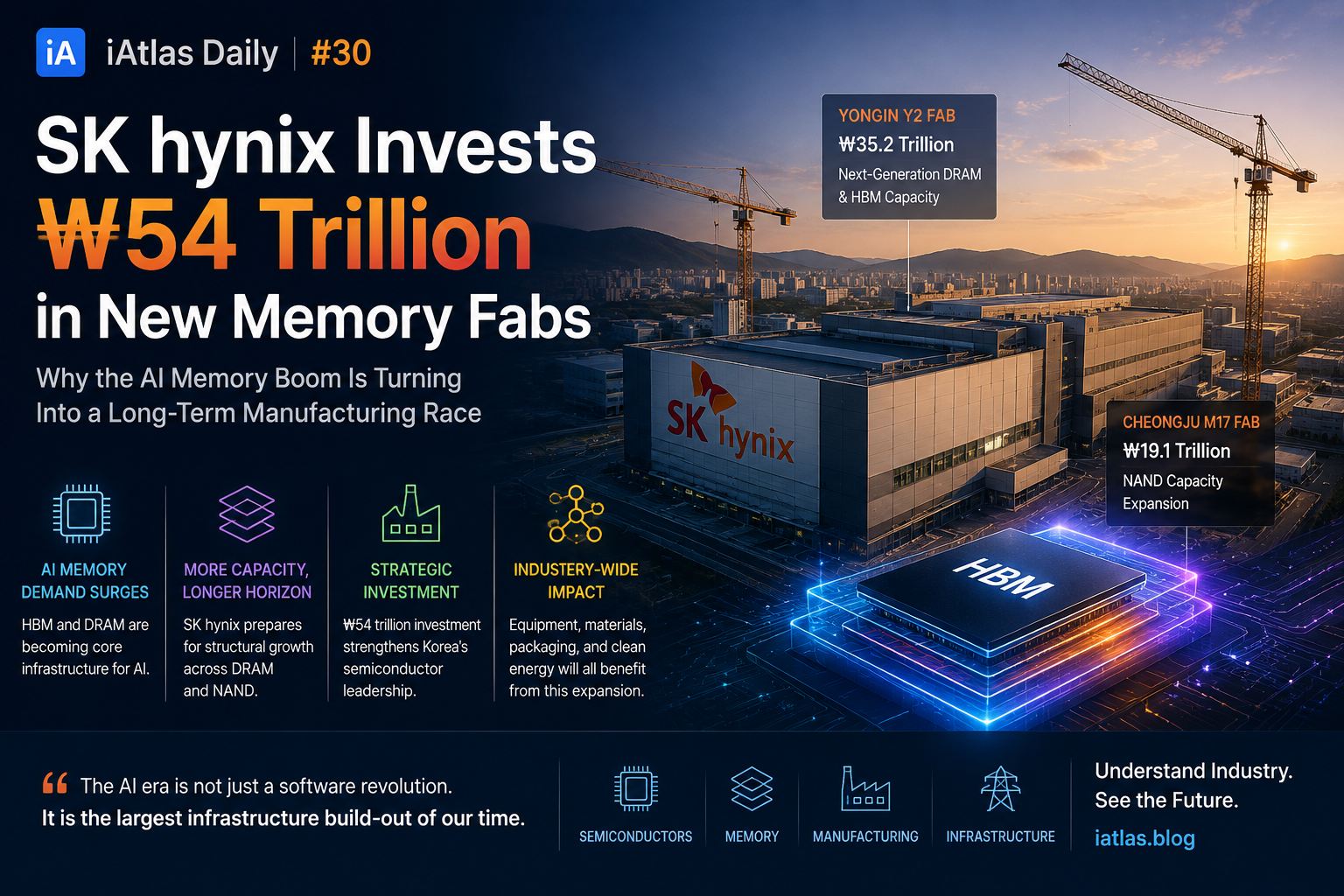
On August 7, the company announced plans to invest approximately ₩54 trillion in two new semiconductor fabrication facilities in South Korea.
The investment includes approximately:
- ₩35.2 trillion for the Y2 fab in the Yongin Semiconductor Cluster
- ₩19.1 trillion for the M17 fab in Cheongju
Y2 will strengthen SK hynix’s capacity for next-generation DRAM, including HBM, while M17 will establish additional capacity to respond to future NAND demand.
This is not simply an expansion for today’s memory market.
It is a bet on what global AI infrastructure demand could look like several years from now.
💡 Why This Matters
AI Is Changing the Role of Memory
For decades, memory was often viewed as a supporting component of computing systems.
AI is changing that relationship.
Large AI accelerators require enormous amounts of data to move between processors and memory at extremely high speeds.
That has made High Bandwidth Memory (HBM) one of the most strategically important components in AI computing.
SK hynix describes the current shift as a structural transformation in which memory is becoming core infrastructure that directly affects AI performance.
The company’s latest investment suggests that it expects this transformation to continue well beyond the current AI investment cycle.
🏭 Two Fabs, Two Strategic Roles
Yongin Y2 — Preparing for the Next Generation of AI Memory
The Y2 fab will be constructed at the Yongin Semiconductor Cluster.
SK hynix plans to use the facility for next-generation DRAM products, including HBM, positioning Yongin as a major future production base for AI memory.
The significance goes beyond additional wafer capacity.
As HBM generations advance, manufacturers must simultaneously improve:
- DRAM performance
- wafer processing
- packaging
- thermal management
- production yield
This means future AI memory competition will increasingly depend on manufacturing capability as much as memory design.
Cheongju M17 — Preparing for the Next NAND Cycle
The second investment targets the M17 fab in Cheongju.
While AI attention has largely focused on HBM, AI infrastructure also requires enormous amounts of storage.
Training data, model checkpoints, inference workloads, and data-center infrastructure all create demand for high-capacity storage.
SK hynix is therefore preparing additional NAND manufacturing capacity for the longer-term market.
🌍 Industry Impact
Memory Manufacturers
The investment increases pressure on other major memory manufacturers to continue developing next-generation DRAM, HBM, and NAND capacity.
Semiconductor Equipment
New fabs eventually translate into demand across lithography, deposition, etching, cleaning, inspection, and metrology equipment.
Semiconductor Materials
Additional wafer capacity also increases long-term demand for silicon wafers, specialty gases, chemicals, photoresists, and other semiconductor materials.
Advanced Packaging
HBM expansion cannot be separated from packaging.
As AI accelerators integrate increasingly complex HBM stacks, advanced packaging capacity becomes another critical part of the supply chain.
📈 The Bigger Picture
The most important part of this announcement may actually be its time horizon.
These facilities are not being built simply to satisfy today’s HBM demand.
Semiconductor fabs require years of construction, equipment installation, qualification, and production ramp-up.
SK hynix is therefore making a massive capital commitment based on expectations for the memory market several years into the future.
That sends an important signal:
AI memory demand is increasingly being treated as a structural manufacturing trend rather than a short-term semiconductor cycle.
And that changes the nature of competition.
The race is no longer simply about who can develop the best HBM today.
It is also about who can build enough advanced manufacturing capacity for the AI economy of the late 2020s.
👀 What to Watch
Several developments are now worth following closely:
- Yongin Y2 construction progress
- M17 construction and production schedule
- Next-generation HBM development
- AI server memory demand
- NAND market recovery
- Advanced packaging investment
- Semiconductor equipment orders
These indicators will show how quickly the current AI memory boom translates into physical manufacturing infrastructure.
🎯 Atlas Insight
AI competition is moving deeper into the industrial supply chain.
First came GPUs.
Then HBM became critical.
Next came advanced packaging and semiconductor equipment.
Now the competition is increasingly about something even more fundamental:
manufacturing capacity.
SK hynix’s ₩54 trillion investment illustrates how semiconductor companies are preparing for an AI market that could be much larger several years from now than it is today.
The AI race is therefore becoming not only a technology race, but also a fab construction, equipment, materials, and manufacturing race.
That may ultimately be one of the biggest industrial consequences of the AI boom.
📚 Related Articles
📰 iAtlas Daily #23 | TSMC Expands Advanced Packaging Capacity
📰 iAtlas Daily #26 | ASML Sees Strong EUV Demand Despite Market Uncertainty
📊 iAtlas Weekly #5 | Building the AI Infrastructure Era
Sources
SK hynix — ₩54 Trillion Yongin Y2 and Cheongju M17 Investment Announcement
Yonhap — SK hynix to Invest ₩54.3 Trillion in Yongin and Cheongju Fabs
SK hynix officially announced the investment on August 7, 2026, so this is genuinely a very fresh Daily topic rather than a general industry explainer.
About iAtlas
iAtlas is an independent publication covering batteries, semiconductors, OLED, advanced materials, AI, and global industrial trends.
We transform complex industrial developments into clear, reliable, and easy-to-understand insights.
Whether you’re following today’s industry news or building long-term expertise, iAtlas helps you understand not only what happened, but why it matters.
Technology creates change.
Insight creates opportunity.
— iAtlas