Micro OLED Is Powering the Next Generation of AR Devices
Why Display Technology Is Becoming a Critical AI Hardware Component
📰 iAtlas Daily #29 | August 7, 2026
What Happened?
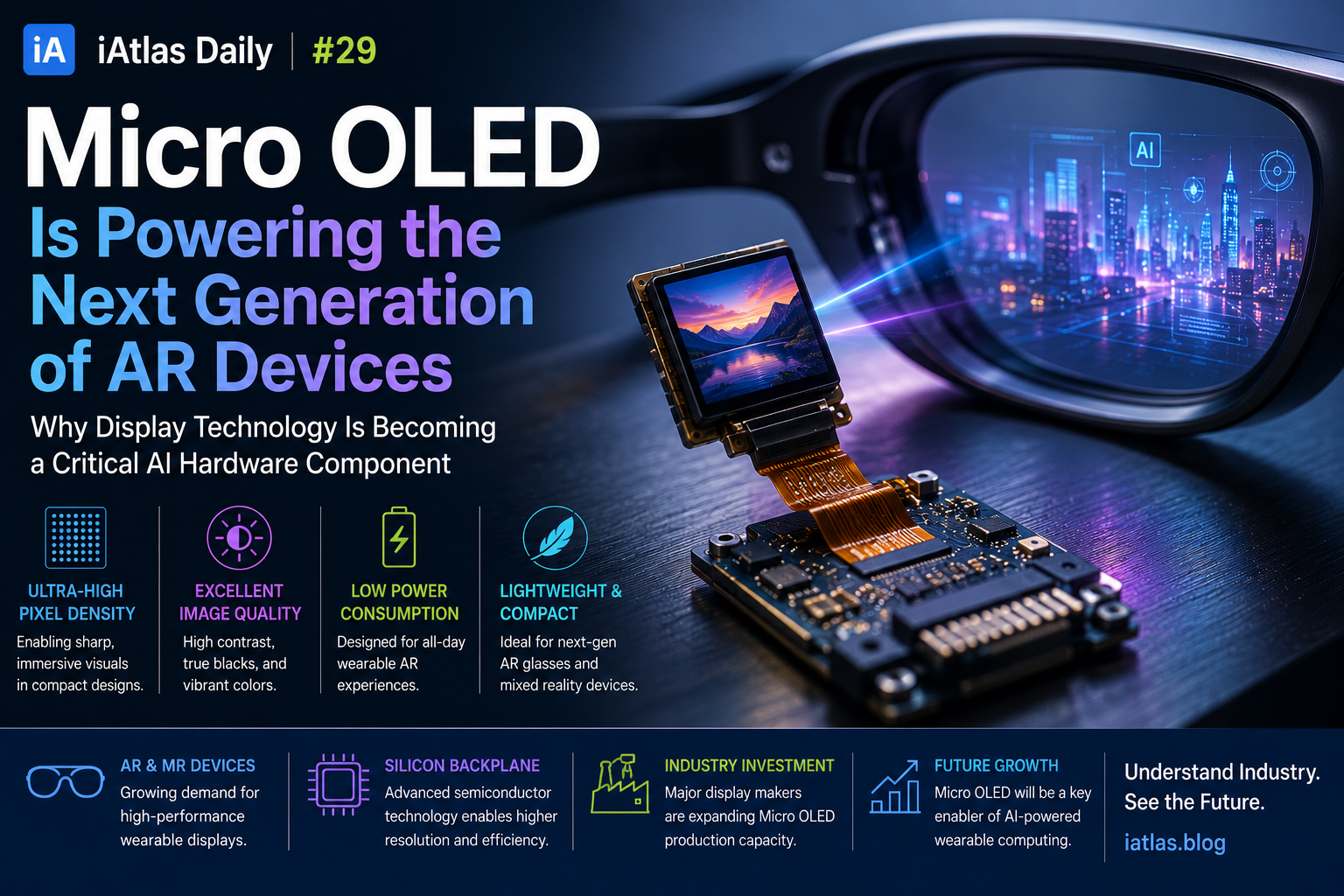
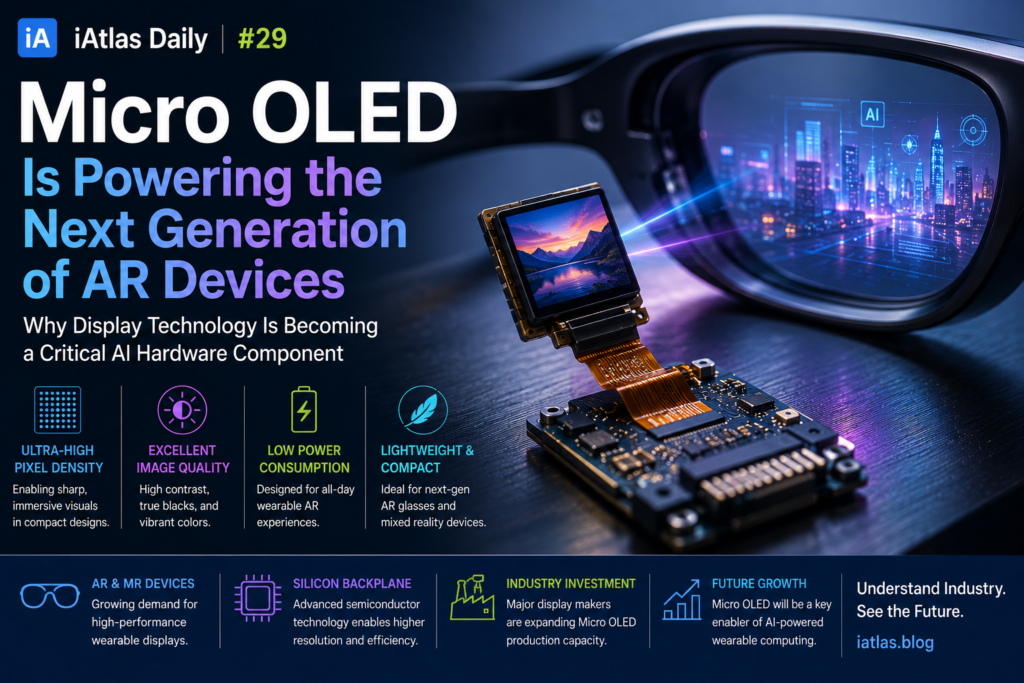
As augmented reality (AR) and mixed reality (MR) devices continue to evolve, display technology has become one of the industry’s biggest competitive differentiators.
Unlike smartphones or televisions, wearable devices require displays that are extremely compact while delivering ultra-high resolution, high brightness, low power consumption, and fast response times.
Micro OLED technology is increasingly viewed as one of the most promising solutions because it combines OLED image quality with silicon backplane technology, enabling displays with exceptionally high pixel density.
Major technology companies and display manufacturers continue investing in Micro OLED development as demand for next-generation wearable devices grows.
💡 Why This Matters
The success of future AR glasses will depend not only on processors and AI software, but also on display technology.
Micro OLED offers several important advantages:
- Ultra-high pixel density
- Excellent contrast ratio
- Low power consumption
- Compact module size
- Lightweight optical systems
These characteristics make Micro OLED particularly suitable for AI-powered wearable computing.
🌍 Industry Impact
Display Manufacturers
Samsung Display, Sony Semiconductor Solutions, and eMagin continue investing in Micro OLED technologies to support future XR devices.
Device Manufacturers
Companies developing AR and MR headsets require increasingly compact, high-resolution displays to improve user experience.
Semiconductor Industry
Micro OLED panels rely on silicon backplanes, strengthening collaboration between display and semiconductor manufacturers.
Materials & Equipment
Higher-resolution OLED fabrication requires continued innovation in deposition equipment, encapsulation, and advanced materials.
👀 What to Watch
Key developments to follow include:
- Next-generation Apple Vision devices
- Lightweight AR glasses
- Micro OLED production expansion
- Higher brightness OLED technology
- AI-powered wearable computing
These trends are expected to define the future display industry.
🎯 Atlas Insight
For years, display competition focused on making televisions and smartphones larger and brighter.
Today, the industry’s challenge is becoming the opposite.
Manufacturers must create displays that are smaller, lighter, and more efficient without sacrificing image quality.
Micro OLED represents this transition.
As AI moves from data centers into wearable devices, advanced display technologies will become just as important as processors and batteries in enabling the next generation of computing.
📚 Related Articles
- 📰 iAtlas Daily #21 | Samsung Display Expands OLED Investment
- 📘 Display Library (Coming Soon) | What Is OLED?
- 📘 Display Library (Coming Soon) | What Is Micro OLED?
- 📊 iAtlas Weekly #4 | The New Industrial Race
Sources
- Sony Semiconductor Solutions. OLED Microdisplay.
- Sony Semiconductor Solutions. High-resolution Technology for OLED Microdisplays.
- Samsung Display.
- Society for Information Display (SID).
- Display Supply Chain Consultants (DSCC).
About iAtlas
iAtlas is an independent publication covering batteries, semiconductors, OLED, advanced materials, AI, and global industrial trends.
We transform complex industrial developments into clear, reliable, and easy-to-understand insights.
Whether you’re following today’s industry news or building long-term expertise, iAtlas helps you understand not only what happened, but why it matters.
Technology creates change.
Insight creates opportunity.
— iAtlas