Battery Separator Explained: The Safety Barrier Inside Lithium-ion Batteries
🔋 iAtlas Battery #7 | 🧪 Materials → 🛡️ Separator
Battery Separator at a Glance
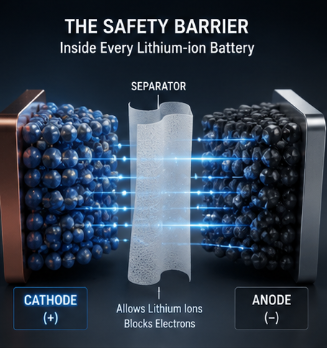
A battery separator is a thin porous membrane positioned between the cathode and anode. It prevents direct electrical contact while allowing lithium ions to pass through, making it one of the most critical safety components in every lithium-ion battery.
Table of Contents
- What Is a Battery Separator?
- How Separators Work
- Main Types of Battery Separators
- Why Separator Quality Matters
- Future Separator Technologies
- Key Figures
- Frequently Asked Questions
Introduction
Inside every lithium-ion battery lies a component that is rarely seen but absolutely essential: the battery separator.
Although extremely thin, the separator performs two critical tasks simultaneously. It physically separates the positive and negative electrodes to prevent short circuits while allowing lithium ions to move freely between them during charging and discharging.
As battery energy density continues to increase, separator technology has become one of the most important factors affecting battery safety, durability, and fast-charging performance.
What Is a Battery Separator?
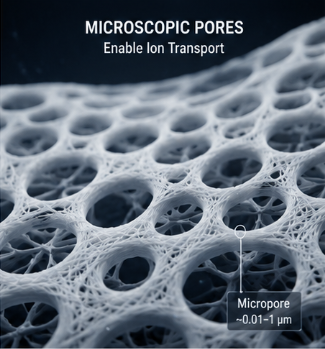
A battery separator is a porous polymer membrane installed between the cathode and anode.
Its microscopic pores allow lithium ions to pass through while blocking electrical contact between the electrodes.
Without a separator, the electrodes would touch each other directly, causing an internal short circuit that could lead to battery failure or thermal runaway.
How Battery Separators Work
The separator performs two functions at the same time.
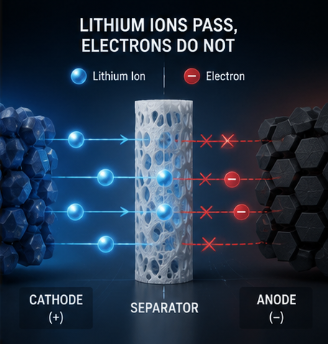
Physical Isolation
It keeps the cathode and anode apart, preventing electrical short circuits.
Ion Transport
Its porous structure allows lithium ions to travel through the electrolyte during charging and discharging.
The separator therefore acts as both a safety barrier and an ion transport pathway.
Main Types of Battery Separators
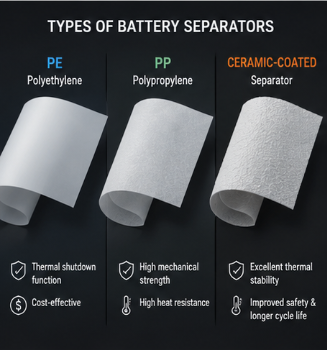
Polyethylene (PE)
PE separators feature a thermal shutdown function.
When battery temperature rises excessively, the pores close to stop ion movement and reduce the risk of thermal runaway.
Advantages
- Thermal shutdown capability
- Widely used
- Cost-effective
Polypropylene (PP)
PP separators offer better mechanical strength and higher heat resistance than PE.
They are commonly used in combination with PE.
Ceramic-Coated Separators
Ceramic coatings significantly improve thermal stability and puncture resistance.
Advantages include:
- Improved safety
- Better high-temperature performance
- Longer battery life
They are increasingly adopted in electric vehicle batteries.
Why Separator Quality Matters
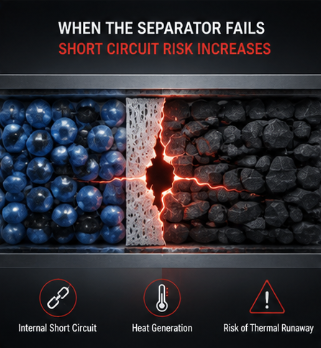
A separator directly affects:
- Battery safety
- Cycle life
- Fast charging
- Internal resistance
- Thermal stability
As EV batteries become larger and more energy-dense, separator quality becomes increasingly important.
Even tiny defects can increase the risk of internal short circuits.
Future Separator Technologies
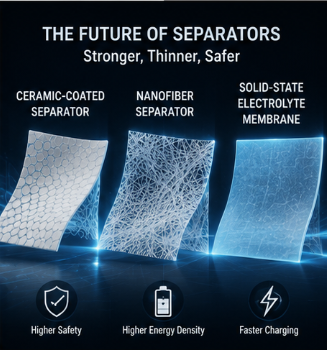
Researchers continue developing advanced separator technologies.
Examples include:
- Ceramic-coated separators
- Nanofiber separators
- Solid-state electrolyte membranes
- Ultra-thin high-strength separators
These innovations aim to improve both safety and energy density.
Key Figures
| Property | Typical Separator |
|---|---|
| Material | PE / PP |
| Thickness | 10–25 μm |
| Structure | Microporous |
| Main Function | Prevent Short Circuit |
| Ion Transport | Yes |
| Electron Transport | No |
Frequently Asked Questions
What does a battery separator do?
A battery separator prevents direct contact between the cathode and anode while allowing lithium ions to move through its microscopic pores.
Why are separator pores important?
The pores enable lithium-ion transport while maintaining electrical insulation between the electrodes.
What happens if the separator fails?
Separator failure can cause an internal short circuit, potentially leading to thermal runaway and battery failure.
Why are ceramic-coated separators becoming popular?
Ceramic coatings improve thermal stability, puncture resistance, and battery safety, making them suitable for modern EV batteries.
Key Takeaways
- Battery separators prevent internal short circuits.
- They allow lithium ions to pass while blocking electron flow.
- PE and PP are the most common separator materials.
- Ceramic-coated separators provide improved safety.
- Separator technology is becoming increasingly important as battery energy density increases.
🎓 Battery Learning Path
🧪 Materials
✅ 🔋 iAtlas Battery #4 — Cathode
✅ 🔋 iAtlas Battery #5 — Anode
✅ 🔋 iAtlas Battery #6 — Electrolyte
📍 🔋 iAtlas Battery #7 — Separator (Current)
Next Learning Path: 🔋 Cell Design
📖 Continue Reading
⬅ Previous Article
🔋 iAtlas Battery #6
Battery Electrolyte Explained: The Medium That Powers Lithium-ion Batteries
Learn how electrolytes transport lithium ions and why moisture control is essential for battery performance and safety.
➡ Next Article
🔋 iAtlas Battery #8
Cylindrical vs. Prismatic vs. Pouch Cells: Understanding Battery Cell Formats
Compare the three major battery cell formats and discover how each design affects performance, packaging efficiency, and electric vehicle applications.
References
- International Energy Agency (IEA)
- U.S. Department of Energy – Vehicle Technologies Office
- Battery University
- Nature Energy (Battery Manufacturing Research)
About iAtlas
iAtlas is an independent publication covering batteries, semiconductors, OLED, advanced materials, AI, and global industrial trends.
We transform complex industrial developments into clear, reliable, and easy-to-understand insights.
Whether you’re following today’s industry news or building long-term expertise, iAtlas helps you understand not only what happened, but why it matters.
Technology creates change.
Insight creates opportunity.
— iAtlas