HBM Market Outlook 2026
Why AI Is Reshaping the Memory Market
iAtlas | Insight | Market Outlook #06
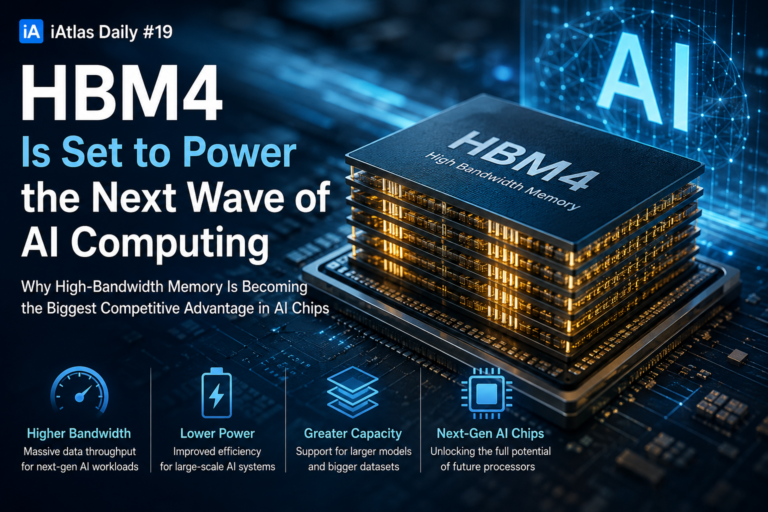
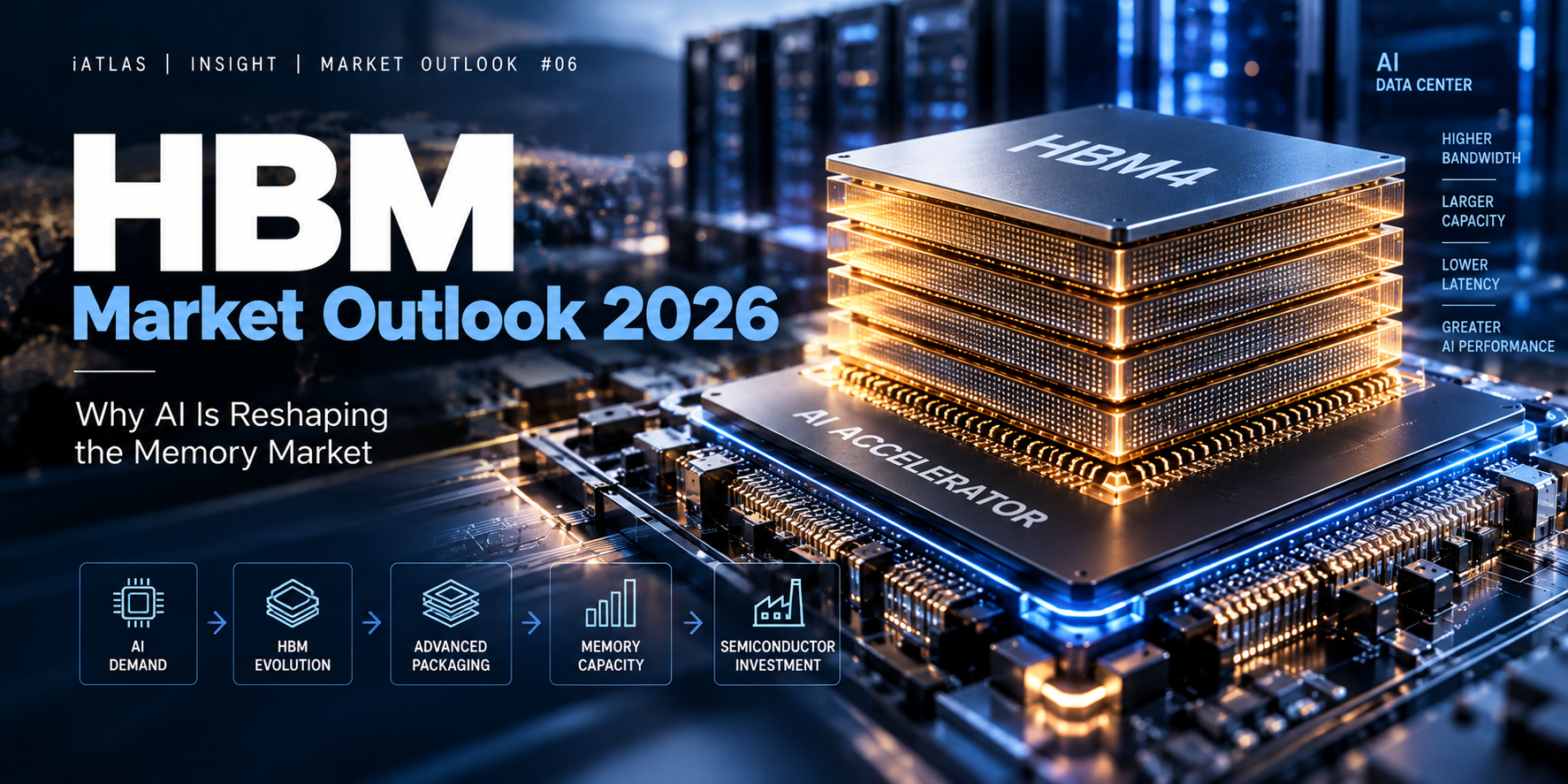
The HBM market outlook for 2026 shows how artificial intelligence is transforming memory from a supporting component into one of the most strategic parts of the semiconductor industry.
AI accelerators can perform enormous numbers of calculations.
But computing power alone is not enough.
Those processors must continuously access and move massive amounts of data. If memory cannot supply that data quickly enough, even the most powerful GPU or AI accelerator cannot operate at its full potential.
That challenge has made high-bandwidth memory, or HBM, one of the most important technologies in the AI infrastructure boom.
HBM demand is now influencing not only memory manufacturers, but also DRAM capacity, advanced packaging, foundry technology, semiconductor equipment investment and the architecture of next-generation AI systems.
The transition to HBM4 in 2026 marks another important step.
Samsung Electronics, SK hynix and Micron have all moved HBM4 into commercial production or volume ramp during the year, while development has already shifted toward HBM4E. Samsung Global Newsroom
The HBM market is therefore moving faster than a traditional memory cycle.
It is becoming part of the architecture of AI computing itself.
Key Takeaways
- AI infrastructure is creating structural demand for HBM, rather than a typical short-lived memory replacement cycle.
- HBM4 substantially increases memory bandwidth through a 2,048-bit interface, twice the interface width of the previous generation. Micron Technology
- Samsung, SK hynix and Micron are all ramping HBM4 in 2026, while HBM4E development is already underway. Samsung Global Newsroom
- HBM demand is competing with conventional DRAM for advanced-process and wafer capacity, contributing to tighter memory supply. TrendForce
- Global 300mm memory-equipment investment is projected to reach approximately $52 billion in 2026, up 29% year over year. SEMI
- HBM competition is increasingly about yield, packaging, base-die design, power efficiency and customer qualification, not simply DRAM manufacturing.
- HBM4 is creating a stronger connection between memory + foundry + advanced packaging.
- Supply tightness is expected to remain an important issue through 2027 as next-generation products ramp. TrendForce
1. Why AI Needs HBM
Traditional computing systems separate processors and memory.
The processor performs calculations.
Memory stores and supplies the data required for those calculations.
The problem is that AI workloads require an extraordinary amount of data to move between the two.
Large-language models and other AI systems involve billions — and increasingly trillions — of parameters.
If data transfer becomes too slow, processor performance is limited by memory bandwidth.
This is often described as the memory bottleneck.
HBM addresses that problem by stacking multiple DRAM dies vertically and placing the memory extremely close to the AI processor.
Instead of spreading memory modules across a conventional circuit board, HBM creates a compact, extremely high-bandwidth memory system.
The result is significantly higher data throughput.
This makes HBM especially valuable for:
- AI training
- AI inference
- High-performance computing
- Large language models
- Scientific computing
- Advanced accelerators
AI is therefore changing the role of memory.
Memory is no longer simply storage located next to computing.
It is becoming a critical part of compute performance itself.
2. HBM Has Changed the Memory Business
The conventional DRAM industry has historically been highly cyclical.
Manufacturers expand capacity when prices are strong.
Supply eventually catches demand.
Prices decline.
Investment slows.
And another cycle begins.
HBM introduces a different market dynamic.
Producing HBM requires more than manufacturing standard DRAM dies.
The process involves:
Advanced DRAM
↓
Through-Silicon Via Processing
↓
Wafer Thinning
↓
Die Stacking
↓
Bonding / Packaging
↓
Testing
↓
Integration with AI Processor
This makes HBM considerably more complex to manufacture than conventional DRAM.
It also consumes more manufacturing capacity.
TrendForce notes that strong HBM demand is competing with conventional DRAM for limited advanced-process and wafer capacity, contributing to increasingly tight memory supply conditions. TrendForce
That creates an unusual situation.
Growth in one premium memory product can influence pricing and supply conditions across the broader DRAM market.
In other words:
AI Demand
↓
More HBM
↓
More Advanced DRAM Capacity Required
↓
Less Capacity Available Elsewhere
↓
Tighter Memory Supply
HBM is therefore changing the economics of the entire DRAM industry.
3. HBM4 Marks a Major Technology Transition
2026 is particularly important because the industry is transitioning from HBM3E toward HBM4.
The change is much more significant than a simple increase in memory speed.
HBM4 expands the interface from 1,024 I/O connections to 2,048, effectively doubling the width of the memory interface. TrendForce
Micron’s 12-high HBM4, for example, delivers more than 2.8 TB/s of bandwidth per stack, more than twice that of the previous generation, while also improving power efficiency. Micron Technology
That bandwidth matters because next-generation AI accelerators are becoming dramatically more powerful.
More compute creates more memory traffic.
Without corresponding improvements in bandwidth, processors could spend increasing amounts of time waiting for data.
HBM4 therefore addresses one of the central challenges of AI architecture:
Keeping increasingly powerful processors continuously supplied with data.
4. HBM4 Is Also Changing the Base Die
One of the most important technical changes in HBM4 happens at the bottom of the memory stack.
Previous HBM generations typically used relatively simple base dies primarily to route signals.
HBM4 is moving toward more sophisticated logic-based base dies.
TrendForce notes that this architecture allows closer integration between the HBM stack and the system-on-chip, improving data-path efficiency, latency and high-speed signal transmission. TrendForce
This has major strategic implications.
HBM production begins to require expertise not only in:
Memory
but increasingly in:
Memory + Logic + Foundry + Packaging
The boundaries between traditional semiconductor segments are becoming less clear.
That could change how memory manufacturers compete.
5. Samsung Is Using Vertical Integration to Compete in HBM4
Samsung Electronics began mass production and commercial shipments of HBM4 in February 2026.
Its HBM4 combines sixth-generation 10nm-class DRAM with a 4nm logic base die, using Samsung’s internal memory, foundry and packaging capabilities. Samsung Global Newsroom
Samsung says the product delivers a consistent 11.7 Gbps transfer speed, with capability extending up to 13 Gbps.
The company also expects its HBM sales in 2026 to more than triple compared with 2025 and is expanding HBM4 capacity accordingly. Samsung Global Newsroom
This illustrates one potential competitive advantage in the HBM4 era.
Samsung can combine:
DRAM
Logic Design
Foundry
Advanced Packaging
inside a single semiconductor organization.
Whether that integration translates into sustainable market-share gains will depend on yield, customer qualification and delivery execution.
But HBM4 makes that integrated structure strategically more relevant than it was in previous HBM generations.
Samsung has already moved to the next stage as well.
In May 2026, the company began shipping 12-layer HBM4E samples, targeting speeds of up to 16 Gbps. Samsung Global Newsroom
6. SK hynix Is Defending Its HBM Leadership
SK hynix entered the current AI-memory cycle from a strong position.
The company was an early leader in HBM3 and HBM3E and has built deep relationships with major AI-computing customers.
Its HBM4 began mass shipments during the second quarter of 2026, with production ramping during the second half. SK hynix Newsroom
SK hynix has emphasized not only raw speed but also:
- Power efficiency
- High yield
- Cost competitiveness
- Stable supply
These are increasingly important because HBM is moving from relatively limited volumes into large-scale AI infrastructure.
The company has also shipped HBM4E samples to major customers.
Its 12-layer HBM4E reaches up to 16 Gbps per pin and improves power efficiency by more than 20% compared with the previous product generation. SK hynix Newsroom
This rapid transition illustrates how quickly the HBM roadmap is moving.
Before one generation is fully mature, customers and suppliers are already preparing the next.
7. Micron Has Become a Stronger Third Competitor
Micron is also becoming increasingly important in the HBM market.
The company moved its 36GB 12-high HBM4 into high-volume production for NVIDIA’s Vera Rubin platform in early 2026. Micron Investors
By June, Micron said its HBM4 ramp was progressing approximately twice as fast as its previous HBM3E 12-high ramp and that it had already generated more than $1 billion in HBM4 revenue. Micron Investors
Micron has also sampled a 16-high HBM4 product offering 48GB per HBM stack and is developing HBM4E for volume production in 2027. Micron Technology
This is important for the market structure.
HBM has effectively become a competition among three major memory suppliers:
SK hynix
Samsung Electronics
Micron
But the competition is not simply about who can manufacture the most DRAM.
Each supplier must satisfy extremely demanding customer requirements involving:
- Speed
- Power consumption
- Thermals
- Yield
- Stack height
- Capacity
- Packaging compatibility
- Reliability
Customer qualification therefore becomes one of the most important competitive barriers.
8. HBM Is Becoming More Customized
Another major trend is customization.
Historically, memory was relatively standardized.
One DRAM product could be sold to many customers.
AI accelerators are changing that relationship.
Different AI chips have different:
- Compute architectures
- Bandwidth requirements
- Power targets
- Packaging designs
- Capacity requirements
This means memory suppliers are increasingly working directly with chip designers during product development.
Samsung plans to begin sampling custom HBM products in 2027, designed around customer-specific AI accelerator and GPU architectures. Samsung Global Newsroom
Micron has similarly highlighted customization opportunities for HBM4E. Micron Investors
SK hynix says competition is expanding beyond individual memory performance toward system architecture and customer co-development. SK hynix Newsroom
The memory business is therefore evolving from:
Standard Product
↓
Customer Purchase
toward:
Customer Architecture
↓
Joint Development
↓
Customized HBM
↓
AI System Integration
That could create much deeper relationships between memory manufacturers and AI-chip companies.
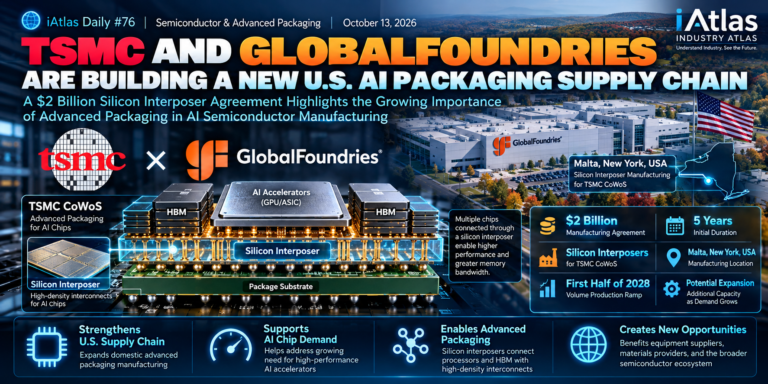
9. HBM Is Pulling Advanced Packaging Into the Center
HBM cannot operate independently.
It must be located extremely close to the GPU or AI accelerator.
That requires sophisticated packaging technologies.
A simplified AI package can look like this:
GPU / AI Accelerator
Multiple HBM Stacks
↓
Interposer / Advanced Substrate
↓
Advanced Package
↓
AI Compute Module
As AI accelerators become larger and incorporate more HBM, packaging complexity increases.
That makes technologies such as:
- 2.5D packaging
- Silicon interposers
- Hybrid bonding
- TSV
- Advanced substrates
- Thermal management
increasingly important.
HBM growth therefore creates another industrial chain:
AI Demand
↓
HBM
↓
Advanced Packaging
↓
Packaging Equipment
↓
Testing
This is why advanced packaging will be the focus of the next Market Outlook.
10. HBM Is Driving New Semiconductor Investment
The HBM boom is already affecting semiconductor capital spending.
SEMI forecasts worldwide 300mm memory equipment investment to reach approximately $52 billion in 2026, an increase of 29% year over year.
DRAM equipment investment alone is expected to reach approximately $37 billion, supported by strong demand for HBM and DDR5 used in GPUs and other AI accelerators. SEMI
This investment includes more than simple capacity expansion.
HBM production requires:
- Advanced DRAM process migration
- TSV equipment
- Wafer thinning
- Bonding
- Packaging
- Testing
- Metrology
- Thermal solutions
SEMI also expects broader semiconductor equipment investment to rise sharply as AI drives demand for advanced memory, leading-edge logic and packaging. SEMI
HBM is therefore creating value far beyond the memory chip itself.
11. Supply Remains Tight
Despite aggressive investment, HBM supply remains constrained.
One reason is the manufacturing complexity.
Yield can take time to improve as stack height increases and new processes are introduced.
Another problem is capacity competition.
HBM consumes advanced DRAM wafers that could otherwise be used for conventional server and PC memory.
TrendForce reported in September 2026 that competition for advanced memory capacity, combined with the ramp of HBM4 and future HBM4E, is expected to keep supply tight through 2027. TrendForce
The firm consequently raised its 2027 HBM pricing outlook substantially, citing:
- Tight supply
- Increasing HBM4 mix
- Higher manufacturing cost
- Initial HBM4E ramp
This highlights an unusual dynamic.
HBM demand is strong enough that customers are increasingly concerned not simply about price, but about securing supply.
That gives memory manufacturers greater strategic importance within the AI ecosystem.
12. More HBM Is Not Always Better
One interesting development is that AI-chip companies are also trying to optimize how much HBM they use.
HBM is extremely powerful.
But it is also expensive.
And every additional stack increases:
- Package size
- Cost
- Thermal complexity
- Power consumption
- Supply requirements
TrendForce reports that some GPU and ASIC developers are considering configurations that reduce HBM capacity per processor as memory costs rise. TrendForce
This means the long-term market is unlikely to be driven solely by:
More HBM per accelerator.
Instead, AI-system designers will optimize:
Bandwidth
Capacity
Cost
Power
System Architecture
This is another reason HBM development is becoming increasingly connected to the entire AI system.
13. HBM4E Is Already the Next Battlefield
HBM4 is only beginning to ramp.
But HBM4E is already moving into customer qualification.
Samsung and SK hynix both shipped HBM4E samples during the first half of 2026, with products targeting up to 16 Gbps per pin. Samsung Global Newsroom
Micron plans to ramp HBM4E in 2027. Micron Investors
The rapid roadmap shows how fast AI infrastructure requirements are changing.
A simplified evolution looks like:
HBM3
↓
HBM3E
↓
HBM4
↓
HBM4E
↓
Custom HBM
Each generation adds more than bandwidth.
Future products increasingly involve:
- More advanced base dies
- Greater customization
- Higher stack density
- Better energy efficiency
- More complex packaging
The HBM market is therefore evolving toward increasingly sophisticated semiconductor systems rather than standalone memory devices.
14. HBM Is Reshaping the Competitive Structure of Memory
The broader implication may be even more important than HBM revenue itself.
Traditional memory competition was heavily influenced by:
Bit Growth
Cost per Bit
Capacity
Commodity Pricing
Those factors remain important.
But HBM adds several new competitive dimensions:
Technology
Packaging
Yield
Customer Qualification
System Design
Foundry Integration
The result is a shift from commodity-like competition toward a more differentiated product market.
High-value products such as HBM could therefore structurally change how memory companies generate value.
That does not mean the memory cycle disappears.
But it could make the industry’s strongest suppliers increasingly differentiated from one another.
15. The AI Memory Stack Is Expanding Beyond HBM
HBM may receive most of the attention, but it is only one part of the AI-memory ecosystem.
An AI data center also requires:
HBM
for accelerator bandwidth.
DDR / LPDDR
for CPU and system memory.
SSD / NAND
for model storage and large datasets.
Emerging memory architectures
for increasingly specialized workloads.
Micron, for example, describes AI infrastructure as a tiered memory system combining HBM, conventional system memory and high-performance storage. Micron Investors
SK hynix similarly argues that agentic AI is expanding demand beyond accelerators toward broader server and storage infrastructure. SK hynix Newsroom
The AI memory opportunity may therefore be larger than HBM alone.
HBM is simply the most visible bottleneck today.
iAtlas Outlook
The HBM market outlook suggests that AI is creating a structural change in the memory industry.
HBM began as a specialized solution for high-performance computing.
It has now become a critical component of AI infrastructure.
Memory Market 1.0
PC & Smartphone Demand
↓
Standard DRAM
↓
Bit Growth
↓
Capacity Cycles
↓
Commodity Pricing
AI Memory Market 2.0
AI Accelerators
↓
HBM
↓
Advanced DRAM
↓
Advanced Packaging
↓
Logic Base Die
↓
Customer Co-Development
↓
AI System Architecture
The biggest change is not simply higher demand.
It is where value is being created.
Memory companies are increasingly competing through engineering capability, packaging expertise, process technology and integration with customer architectures.
HBM4 accelerates that transition.
Its wider interface and more sophisticated base-die architecture connect memory more closely with logic and foundry technologies.
HBM4E and custom HBM will push that relationship even further.
The next HBM winners may therefore not simply be the manufacturers capable of producing the most memory.
They will be the suppliers that can deliver:
performance
power efficiency
yield
packaging
reliable supply
deep customer integration
at the same time.
AI is not merely increasing memory demand.
It is redefining what a memory company needs to be.
That is why HBM is reshaping the memory market.
Continue Reading
Previous Market Outlook
Global Semiconductor Market Outlook 2026
What Will Drive the Next Industry Cycle?
Next Market Outlook
Advanced Packaging Market Outlook 2026
Why Packaging Is Becoming Strategic
References
SK hynix — Q2 2026 Financial Results
HBM4 mass shipments, AI-memory demand and production expansion.
SK hynix — HBM4E Sample Shipments
12-layer HBM4E performance and customer sampling.
Samsung Electronics — Commercial HBM4 Production
HBM4 mass production, 1c DRAM, 4nm logic base die and 2026 HBM roadmap.
Samsung Electronics — HBM4E
HBM4E samples and next-generation AI memory roadmap.
Micron — HBM4
HBM4 bandwidth, interface architecture and production roadmap.
SEMI — 300mm Memory Equipment Investment
Memory fab-equipment investment driven by HBM, DDR5 and AI infrastructure.
TrendForce — HBM Supply and Pricing Outlook
HBM supply constraints, HBM4 transition and 2027 pricing conditions.
ℹ️ About iAtlas
iAtlas is an independent publication covering batteries, semiconductors, OLED, advanced materials, AI, and global industrial trends.
We transform complex industrial developments into clear, reliable, and easy-to-understand insights.
Whether you’re following today’s industry news or building long-term expertise, iAtlas helps you understand not only what happened, but why it matters.
Technology creates change.
Insight creates opportunity.
— iAtlas