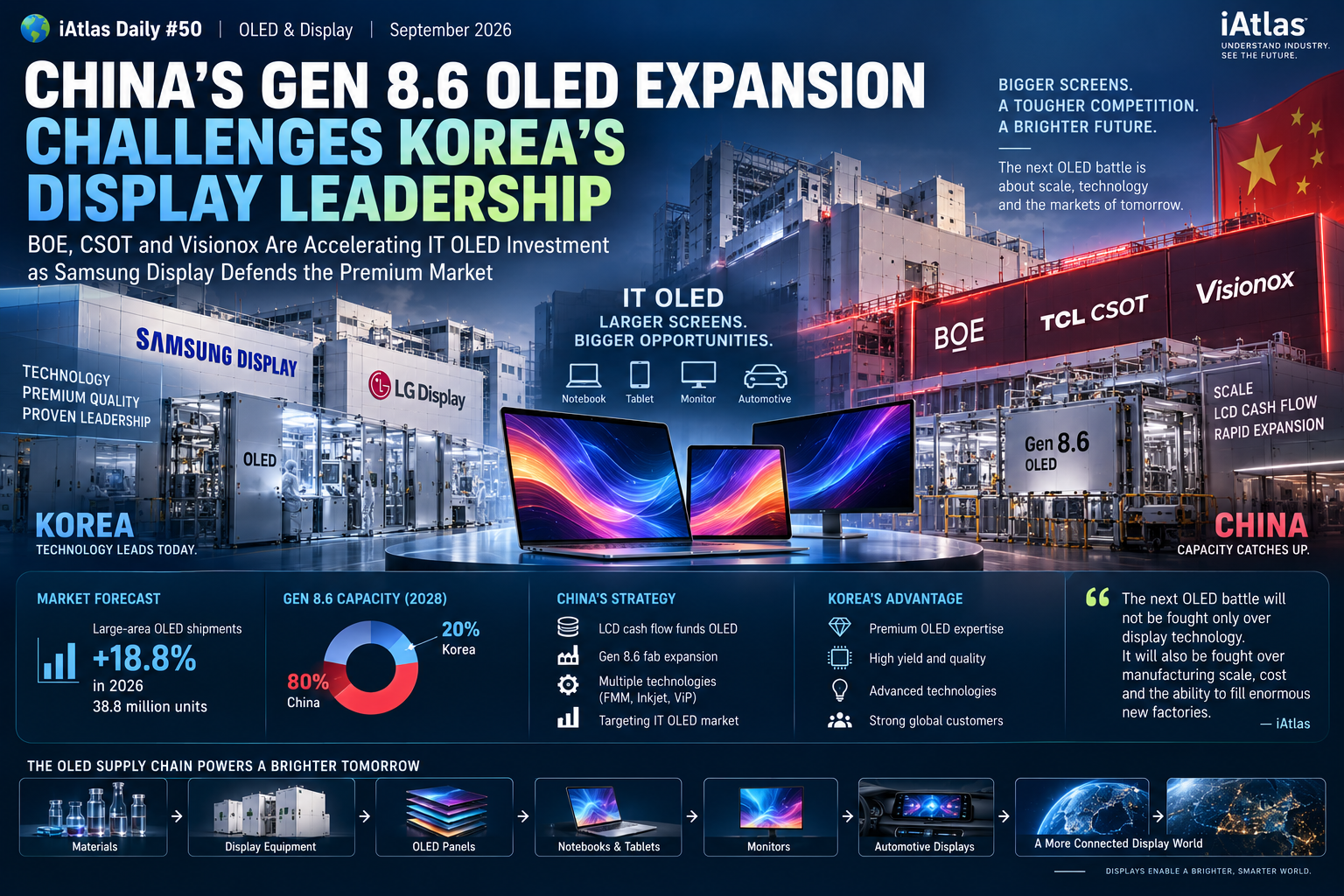
China’s Gen 8.6 OLED Expansion Challenges Korea’s Display Leadership
BOE, CSOT and Visionox Are Accelerating IT OLED Investment as Samsung Display Defends the Premium Market
🖥️ iAtlas Daily #50 | OLED & Display | September 2026
The Korea China OLED Competition is entering a new phase.
For years, South Korea maintained a commanding lead in OLED displays while Chinese manufacturers built their dominance primarily in LCD.
That boundary is beginning to disappear.
Chinese panel manufacturers are now using cash generated from their enormous LCD businesses to finance aggressive investment in OLED production — particularly Gen 8.6 OLED fabs designed for notebooks, tablets and other IT devices.
At the Omdia Korea Display Conference held in Seoul on September 3–4, analysts warned that China’s production capacity could expand rapidly enough to challenge Korea’s leadership in the next several years.
The emerging competition can be summarized simply:
Korea
Technology + Premium OLED + Manufacturing Experience
vs.
China
Scale + LCD Cash Flow + Rapid OLED Capacity Expansion
The next OLED battle will not be fought only over display technology. It will also be fought over manufacturing scale, yield, cost and the ability to fill enormous new factories.
🖥️ The Big Story
China already dominates global LCD manufacturing.
But OLED has remained different.
Samsung Display and LG Display established strong positions across smartphones, televisions, monitors and premium devices while Chinese competitors continued investing to close the technology gap.
Now China is entering the next stage.
According to Omdia, Chinese display manufacturers are using profits generated by LCD operations to absorb losses from their still-developing OLED businesses.
That allows them to continue investing even when OLED production itself is not yet highly profitable.
The strategy looks like this:
LCD Dominance -> Cash Generation -> OLED Investment -> Gen 8.6 Capacity ->
IT OLED -> Competition with Korea
The target is increasingly clear:
Notebook and tablet OLED.
🏭 1. Why Gen 8.6 OLED Matters
OLED manufacturing has historically been concentrated heavily around smaller substrates optimized for smartphone displays.
But smartphones are no longer the only major OLED opportunity.
OLED adoption is expanding toward:
Notebook PCs
Tablets
Monitors
Automotive Displays
and potentially other medium-sized applications.
Producing larger IT panels efficiently requires a different manufacturing equation.
This is where Gen 8.6 OLED becomes strategically important.
The larger mother glass allows manufacturers to produce multiple notebook or tablet panels more efficiently than smaller-generation production lines.
A simplified relationship is:
Larger Mother Glass -> More Efficient Panel Layout -> More IT Panels per Substrate ->
Lower Potential Manufacturing Cost -> Broader OLED Adoption
That is why both Korea and China are investing heavily in high-generation OLED fabs.
🇰🇷 2. Samsung Display Moved First in Korea
Samsung Display has invested heavily in its new Gen 8.6 IT OLED production capability in Asan.
Its A6 line entered mass production in 2026, targeting primarily IT OLED applications.
Samsung’s advantage comes from decades of experience in small and medium OLED manufacturing.
That includes expertise in:
- deposition
- TFT backplanes
- Fine Metal Mask processes
- encapsulation
- yield management
- materials
- device design
Samsung therefore enters the Gen 8.6 competition with a significant manufacturing knowledge base.
But that advantage is now being tested by rapidly increasing Chinese capacity.
Omdia notes that Samsung Display and BOE both moved into Gen 8.6 IT OLED mass production around the middle of 2026.
🇨🇳 3. BOE Has Entered Gen 8.6 Mass Production
China’s transition is no longer theoretical.
BOE began mass production at its B16 Gen 8.6 OLED fab in Chengdu in June 2026, according to Omdia.
The first products included LTPO tandem OLED panels targeting notebook and smartphone applications.
This is an important milestone.
BOE has already become a major supplier of smartphone OLED panels.
Gen 8.6 gives the company an opportunity to move further into larger premium IT applications.
The progression is:
Smartphone OLED -> Tablet OLED -> Notebook OLED -> Larger IT OLED Market
And BOE is only one part of China’s strategy.
🏗️ 4. CSOT and Visionox Are Building the Next Wave
Two additional Chinese manufacturers are preparing high-generation OLED capacity.
TCL CSOT
CSOT’s T8 Gen 8.6 OLED project is pursuing inkjet-printed OLED technology.
Rather than relying exclusively on traditional evaporation approaches, inkjet printing could eventually offer manufacturing advantages for larger OLED panels if yield and performance targets can be achieved.
Omdia expects the line to move toward production in 2027.
Visionox
Visionox is developing its V5 Gen 8.6 OLED line in Hefei.
The project uses the company’s ViP — Visionox intelligent Pixelization — technology, another alternative manufacturing architecture intended to address limitations associated with conventional FMM production.
The first phase of equipment installation was progressing during 2026, with mass production targeted later.
China is therefore not pursuing one single OLED technology.
It is making several bets simultaneously:
BOE → FMM / Hybrid OLED
CSOT → Inkjet Printing
Visionox → ViP
That diversification could become strategically important.
📊 5. China’s Capacity Could Change the Market
This is where the latest Omdia forecast becomes particularly significant.
For mobile-PC OLED production capacity, Korea currently retains a strong advantage.
But the gap is expected to narrow rapidly.
For Gen 8.6 OLED capacity, Omdia expects China to reach roughly:
80%
versus approximately:
20% for South Korea
by 2028.
That does not mean China automatically captures 80% of premium OLED revenue or shipments.
Capacity and market competitiveness are different.
But it does mean the manufacturing landscape could change dramatically.
2026
Korea retains a strong high-generation OLED position.
↓
2027
More Chinese Gen 8.6 capacity ramps.
↓
2028
China potentially leads Gen 8.6 OLED capacity.
↓
2029+
Oversupply and pricing pressure become larger risks.
This is similar to a pattern the display industry has seen before.
💰 6. China Is Using LCD as Its OLED Financing Engine
One of the most interesting parts of the latest industry analysis is how China is financing this expansion.
China already controls an enormous share of global LCD manufacturing.
Those factories generate cash.
Instead of treating LCD as the final destination, Chinese companies can use that cash flow to finance the next technology transition.
The model becomes:
LCD
💰
↓
Cash Flow
↓
OLED R&D
↓
New Equipment
↓
Gen 8.6 Fabs
↓
OLED Market Share
Omdia described Chinese OLED operations as still highly cash-consuming, but LCD earnings allow manufacturers to tolerate those losses while continuing expansion.
This gives Chinese manufacturers something extremely valuable:
Time.
They do not necessarily need immediate OLED profitability if their broader display businesses can support the investment cycle.
💻 7. OLED Is Expanding Beyond Smartphones
The investment race would make little sense without demand.
That demand is beginning to emerge.
Omdia expects large-area OLED shipments to increase 18.8% year over year in 2026 to 38.8 million units, with monitors and notebook PCs contributing to growth.
OLED monitor demand is also accelerating.
Industry estimates cited in Korea this week put 2026 OLED monitor panel shipments at approximately 4.8 million units, up 38.7% year over year, with annual shipments expected to exceed 10 million units by 2030.
The OLED application map is therefore expanding:
Smartphone -> Tablet -> Notebook -> Monitor -> Automotive
This matters enormously for manufacturing.
OLED is moving from a premium smartphone technology toward a broader display platform.
🖥️ 8. Samsung Display and LG Display Still Have Important Advantages
Capacity alone does not determine industry leadership.
Korean manufacturers retain several important strengths.
Samsung Display
Strong small- and medium-sized OLED experience
Premium smartphone relationships
Foldable OLED technology
Gen 8.6 IT OLED production
QD-OLED capability
LG Display
Large-area OLED manufacturing
WOLED technology
Premium TV leadership
Growing OLED monitor exposure
Automotive OLED
Omdia also notes that Korean manufacturers remain particularly strong in higher-value premium OLED segments.
This creates a more nuanced competitive picture.
China may gain:
Capacity
while Korea attempts to defend:
Technology
Yield
Premium Customers
Materials
Process Know-how
Profitability
The real competition is therefore not simply Korea versus China.
It is:
Scale vs. Value.
⚙️ 9. The Equipment Industry Is Entering Another Investment Cycle
The Gen 8.6 transition is also important for display equipment suppliers.
New OLED fabs require:
- deposition systems
- TFT equipment
- lithography
- etching
- cleaning
- encapsulation
- inspection
- laser equipment
- automation
- material handling
Counterpoint Research estimates that the Gen 8.7 OLED investment cycle is helping drive display equipment CAPEX up 57% year over year in 2026.
Across 2023–2030, it expects OLED to account for the majority of display-equipment spending, with Gen 8.7 representing a particularly large share.
That creates another supply-chain effect:
IT OLED Demand -> New OLED Fabs -> Display Equipment -> Materials ->
Components -> Factory Automation
The OLED competition therefore extends well beyond Samsung Display and BOE.
🧪 10. Materials Could Become Another Battleground
OLED manufacturing depends heavily on sophisticated materials.
Examples include:
Emission Materials
Host Materials
Dopants
Transport Layers
Encapsulation Materials
Photoresists
Fine Metal Masks
Specialty Chemicals
Chinese manufacturers are increasingly attempting to localize these supply chains as well.
Omdia research has previously shown a high degree of domestic material sourcing within some Chinese OLED structures, while Korean OLED production similarly relies heavily on Korean suppliers.
That means the competition is gradually expanding from:
Panel Company vs. Panel Company
to:
OLED Ecosystem vs. OLED Ecosystem
This is the same structural pattern seen in semiconductors and batteries.
⚠️ 11. Oversupply Could Become the Next Risk
Rapid capacity expansion creates an obvious problem.
What happens if OLED supply grows faster than OLED demand?
New Gen 8.6 fabs require enormous capital investment.
Once constructed, manufacturers have a strong incentive to keep utilization high because depreciation and fixed costs are substantial.
Omdia notes that these new Gen 8.6 RGB OLED factories will carry high fixed costs for years, encouraging manufacturers to diversify applications and maintain utilization.
That can create:
More Capacity -> Higher Utilization Pressure -> More Panels ->
Price Competition -> Lower OLED Prices
↓
Faster OLED Adoption
but potentially also:
↓
Lower Industry Margins
This could be both an opportunity and a threat.
For consumers, lower OLED prices accelerate adoption.
For manufacturers, they intensify competition.
🔄 12. The Display Industry May Be Repeating the LCD Cycle — But Not Exactly
China’s rise in LCD provides an obvious historical comparison.
The pattern was:
Korea/Japan Technology Leadership -> Chinese Investment ->
Massive Capacity Expansion -> Price Competition -> Chinese Market Dominance
The concern is that OLED could follow the same path.
But there are important differences.
OLED manufacturing is more technically complex.
Yield management remains critical.
Premium customers impose demanding quality requirements.
Materials and process integration matter greatly.
And next-generation technologies continue evolving.
Therefore, the outcome is not predetermined.
Korea’s strategic challenge is to stay ahead of the capacity curve through technology.
🧩 Why This Matters
The latest Korea China OLED Competition reveals four important structural changes.
China is moving beyond LCD.
OLED is becoming a strategic investment priority.
Gen 8.6 changes the economics of IT OLED.
Larger substrates could make notebook and tablet OLED production more efficient.
Korea’s advantage is shifting.
Future leadership may depend less on having the most capacity and more on maintaining superior yield, technology and premium products.
The entire OLED supply chain will be affected.
Equipment, materials, chemicals and automation companies will participate in the investment cycle.
🔭 What to Watch
BOE B16 Ramp
The most important question is not whether the fab can produce OLED panels, but whether BOE can achieve competitive yield, quality and cost at scale.
Samsung Display A6
Samsung’s ability to ramp Gen 8.6 IT OLED efficiently will determine how strongly Korea can defend the premium IT market.
CSOT T8
Inkjet printing remains one of the most interesting alternative manufacturing technologies to watch.
Visionox V5
ViP could provide another technical path for high-resolution OLED production.
Apple
Future OLED adoption across MacBook and other IT products could have a major impact on Gen 8.6 utilization.
OLED Pricing
Falling prices could accelerate adoption — while simultaneously putting pressure on panel-maker profitability.
🧭 iAtlas Insight
The display industry’s next competition will not look exactly like the previous LCD battle.
China is entering OLED with something it did not have during the early LCD era:
an enormous existing display manufacturing ecosystem.
That ecosystem provides capital, suppliers, engineers and manufacturing experience.
Korea still has something equally important:
a technological lead in premium OLED manufacturing.
The strategic question is therefore changing from:
Who can make OLED?
to:
Who can make advanced OLED at scale, with high yield, competitive cost and sustainable profitability?
Gen 8.6 is where that question will increasingly be answered.
China is building capacity. Korea must continue building technological distance.
The next OLED battle has already begun.
📚 Related Articles
📊 iAtlas Daily #35: Gen 8.6 OLED: Samsung Display vs. BOE
A closer look at the manufacturing race behind the next generation of IT OLED production.
🔗 References
Omdia — Large-Area OLED Shipments and Gen 8.6 IT OLED Production
Omdia — BOE B16 Gen 8.6 OLED Mass Production
Electronic Times — China’s LCD Profits Fund OLED Push
Counterpoint Research — Gen 8.7 OLED Push Lifts Display Equipment CAPEX
TrendForce — Korea-China Gen 8.6 AMOLED Competition
About iAtlas
iAtlas is an independent publication covering batteries, semiconductors, OLED, advanced materials, AI, and global industrial trends.
We transform complex industrial developments into clear, reliable, and easy-to-understand insights.
Whether you’re following today’s industry news or building long-term expertise, iAtlas helps you understand not only what happened, but why it matters.
Technology creates change.
Insight creates opportunity.
— iAtlas