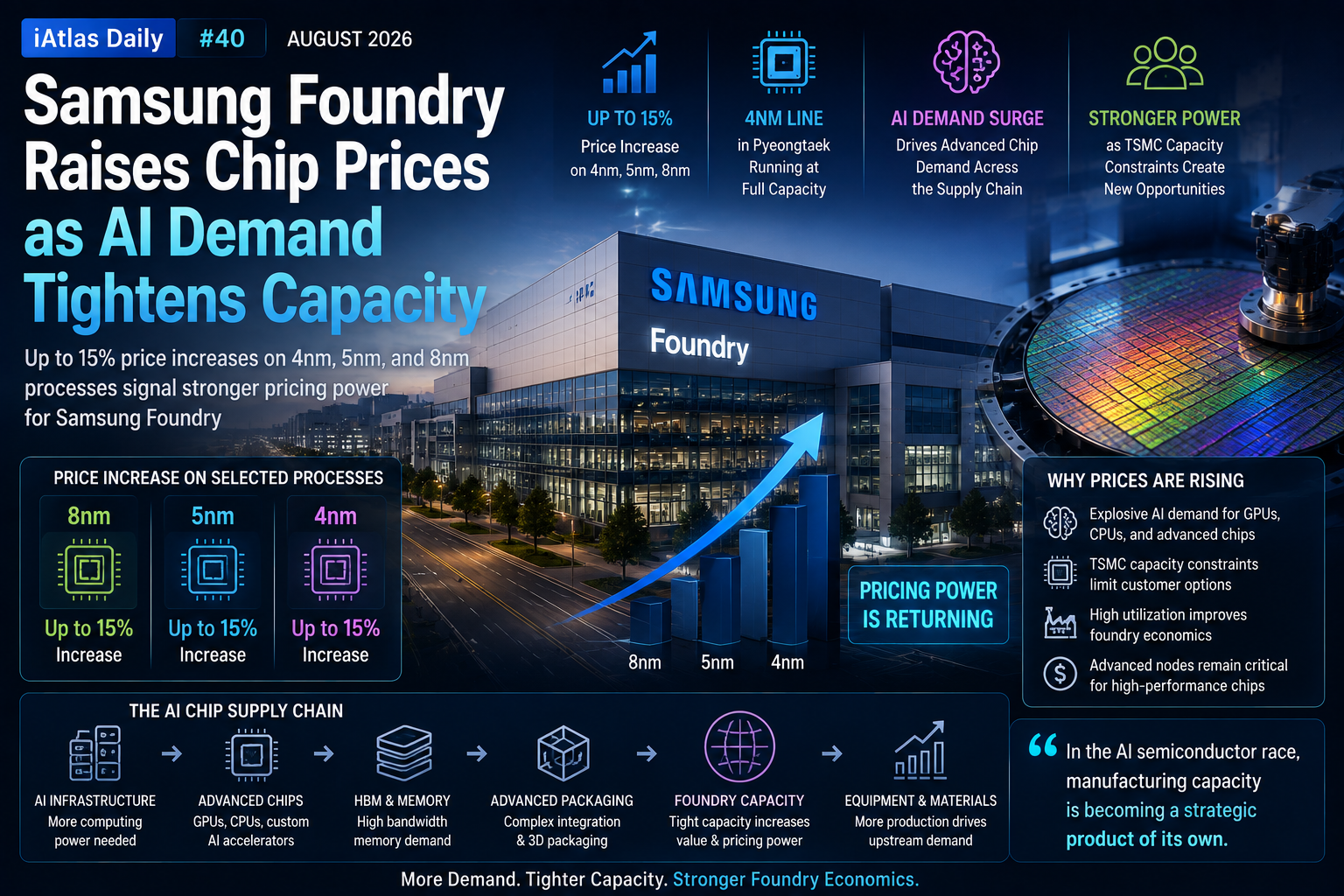
Samsung Foundry Raises Chip Prices as AI Demand Tightens Capacity
Why the AI Boom Is Beginning to Restore Pricing Power in Advanced Semiconductor Manufacturing
📰 iAtlas Daily #40 | August 2026
📰 What Happened?
Samsung Electronics is raising prices for some of its semiconductor foundry services as strong AI-related demand tightens advanced manufacturing capacity.
According to Reuters, Samsung has increased prices for selected 4nm, 5nm, and 8nm foundry processes by as much as 15% for some customers.
The increases vary depending on process technology, customer and region.
The development comes as demand for AI semiconductors continues to rise while capacity at industry leader TSMC remains constrained.
Samsung’s 4nm production line in Pyeongtaek is reportedly operating at full capacity, supported by demand from customers including Qualcomm and internal requirements related to advanced memory production.
For Samsung Foundry, which has struggled with low utilization and losses in recent years, this could mark an important change.
The AI semiconductor boom may be turning excess foundry capacity into valuable manufacturing capacity.
💡 Why This Matters
Foundry Economics Depend Heavily on Utilization
Semiconductor fabs are extraordinarily expensive.
A leading-edge fabrication facility can require tens of billions of dollars in investment before meaningful production begins.
Once the fab exists, however, many costs remain regardless of whether the production line is full.
That makes capacity utilization extremely important.
When utilization is low:
Fixed Costs -> spread across fewer wafers -> Higher Cost per Wafer -> Lower Profitability
But when utilization rises, the economics improve.
More wafers can move through the same infrastructure, allowing fixed costs to be distributed across greater production volume.
This is why Samsung’s reported full utilization at its Pyeongtaek 4nm line matters.
🤖 AI Is Changing the Foundry Market
The current semiconductor cycle is different from a traditional PC or smartphone recovery.
AI requires an unusually broad range of chips.
An AI data center needs:
- GPUs and AI accelerators
- CPUs
- Networking processors
- HBM
- Controllers
- Power-management ICs
- Connectivity chips
Many of these devices require advanced semiconductor manufacturing.
Demand therefore moves through the supply chain:
AI Infrastructure -> More Computing -> More Advanced Chips -> More Foundry Capacity
As capacity becomes harder to secure, the bargaining position of semiconductor manufacturers can improve.
🏭 TSMC Constraints Create an Opportunity
TSMC remains overwhelmingly dominant in advanced semiconductor manufacturing.
Its technological leadership and relationships with major AI-chip companies have made it the preferred manufacturing partner for many leading semiconductor designers.
But that creates another problem:
capacity concentration.
When demand rises rapidly, customers cannot necessarily obtain all the capacity they want from one supplier.
That can push customers toward alternative foundries.
Samsung is one of the few companies capable of manufacturing advanced logic chips at large scale.
This means TSMC’s capacity constraints can create an opportunity for Samsung.
The equation becomes:
AI Demand ↑
↓
TSMC Capacity Tightens
↓
Alternative Capacity Becomes More Valuable
↓
Samsung Foundry Gains Pricing Power
💰 Why a 15% Price Increase Matters
Price increases are particularly important in the foundry business.
For years, Samsung has invested aggressively to compete with TSMC.
But technology investment alone does not guarantee profitability.
A fab also needs:
Customers + Yield + Utilization + Pricing
If any one of those is weak, returns can suffer.
Reuters reports that Samsung’s foundry business has been loss-making since 2022.
Higher utilization combined with higher wafer prices could therefore significantly improve the division’s economics.
The latest price increases suggest Samsung may finally have more leverage with customers.
🔬 Why 4nm Is Still Important
Leading-edge semiconductor discussions increasingly focus on 2nm and Gate-All-Around technology.
But that does not make older advanced nodes irrelevant.
Processes such as 4nm and 5nm remain extremely important for a wide range of high-performance applications.
Not every semiconductor requires the newest node.
Customers choose manufacturing processes based on:
- Performance
- Power consumption
- Cost
- Design maturity
- Yield
- Available capacity
A mature 4nm process with strong yields and available production capacity can therefore remain highly valuable.
This becomes even more important when the newest manufacturing nodes are constrained.
🌏 Chinese Demand Adds Another Dimension
The pricing environment is also being influenced by geopolitics.
Reuters reported that some Chinese customers have accepted some of the largest Samsung price increases.
One reason is increasingly restricted access to advanced semiconductor manufacturing equipment and leading-edge production capabilities.
That can increase dependence on external foundries for certain chips.
As semiconductor trade restrictions expand, manufacturing capacity located outside China becomes strategically more valuable.
Foundry pricing is therefore being influenced by more than supply and demand.
It is also increasingly influenced by:
Technology Controls + Supply-Chain Security + Geopolitics
⚔️ Samsung vs. TSMC Is Not Only About Technology
The foundry competition is often framed around one question:
Who has the better process technology?
That matters enormously.
But it is not the only variable.
The actual competition involves:
🔬 Technology
Can the foundry manufacture leading-edge transistors?
📈 Yield
How many good chips can be produced from each wafer?
🏭 Capacity
Can customers obtain enough wafers?
💰 Price
What does each wafer cost?
📦 Packaging
Can the foundry integrate chips into increasingly complex AI systems?
🤝 Customers
Can it secure long-term relationships with major chip designers?
Samsung therefore does not necessarily need to immediately overtake TSMC in market share to benefit from the AI boom.
It first needs to make its own manufacturing assets more valuable and more profitable.
🔗 The AI Semiconductor Bottleneck Keeps Moving
The latest development also fits a pattern we’ve been following across iAtlas.
At first, the AI bottleneck was:
GPU
Then attention shifted toward:
HBM
Then:
Advanced Packaging
And now another constraint is becoming increasingly visible:
Foundry Capacity
The supply chain looks like:
AI Demand -> GPU / Accelerator -> HBM -> Advanced Packaging -> Advanced Foundry Capacity -> Semiconductor Equipment & Materials
The deeper AI demand moves into this chain, the more industries participate in the investment cycle.
🧪 Equipment and Materials Benefit Too
Higher foundry utilization can eventually create demand further upstream.
More semiconductor production requires:
- Silicon wafers
- Photoresists
- Specialty gases
- Deposition precursors
- CMP materials
- Cleaning chemicals
It also requires increasingly sophisticated equipment for:
Lithography → Deposition → Etching → Cleaning → CMP → Inspection
This connects directly with Daily #36.
Applied Materials is already seeing AI demand spread into semiconductor equipment.
Samsung’s foundry pricing provides another indication that demand is reaching the actual manufacturing floor.
Why This Matters for Korea
Samsung’s foundry business has strategic significance beyond the company itself.
South Korea is already dominant in advanced memory through Samsung Electronics and SK hynix.
A stronger foundry business would broaden Korea’s semiconductor position into advanced logic manufacturing.
That matters as AI systems increasingly require the integration of:
Logic + Memory + Packaging
Samsung has capabilities across all three.
If foundry utilization and profitability improve, that combination could become strategically more valuable.
📈 Industry Impact
🏭 Foundries
Tight capacity can support higher utilization and stronger wafer pricing.
🤖 AI Chip Designers
Manufacturing capacity becomes another strategic consideration when selecting foundry partners.
⚙️ Semiconductor Equipment
Higher utilization and future capacity expansion support equipment demand.
🧪 Materials
Increasing wafer production raises consumption of semiconductor process materials.
📦 Advanced Packaging
AI chips increasingly require logic and memory to be integrated into complex packages.
👀 What to Watch
Several indicators will show whether Samsung Foundry’s recovery is sustainable:
- 4nm utilization
- 2nm yield
- New AI-chip customers
- Google foundry discussions
- Tesla production ramp
- Foundry pricing
- TSMC capacity availability
- Samsung’s foundry profitability
- Advanced packaging capacity
But one metric may matter more than the others:
Yield
Higher prices help.
Higher utilization helps.
But sustainable foundry competitiveness ultimately depends on producing large volumes of good chips reliably.
🎯 Atlas Insight
For years, Samsung Foundry’s problem was not a lack of factories.
It was turning enormous manufacturing investment into sufficient customer demand and profitability.
AI may be changing that equation.
When semiconductor capacity is abundant, customers have leverage.
When capacity becomes scarce, factories gain leverage.
That is why a foundry price increase can tell us more than simply what customers are paying.
It can reveal a change in the balance of power across the semiconductor supply chain.
The AI cycle began with demand for computing.
It then created shortages in memory and packaging.
Now it is beginning to increase the value of the factories themselves.
In the AI semiconductor race, manufacturing capacity is becoming a strategic product of its own.
📚 Related Articles
📰 iAtlas Daily #23 | TSMC Expands Advanced Packaging Capacity
📰 iAtlas Daily #36 | Applied Materials Expands for the AI Chip Boom
📊 iAtlas Weekly #7 | Technology Demand Is Becoming Factory Demand
Sources
About iAtlas
iAtlas is an independent publication covering batteries, semiconductors, OLED, advanced materials, AI, and global industrial trends.
We transform complex industrial developments into clear, reliable, and easy-to-understand insights.
Whether you’re following today’s industry news or building long-term expertise, iAtlas helps you understand not only what happened, but why it matters.
Technology creates change.
Insight creates opportunity.
— iAtlas