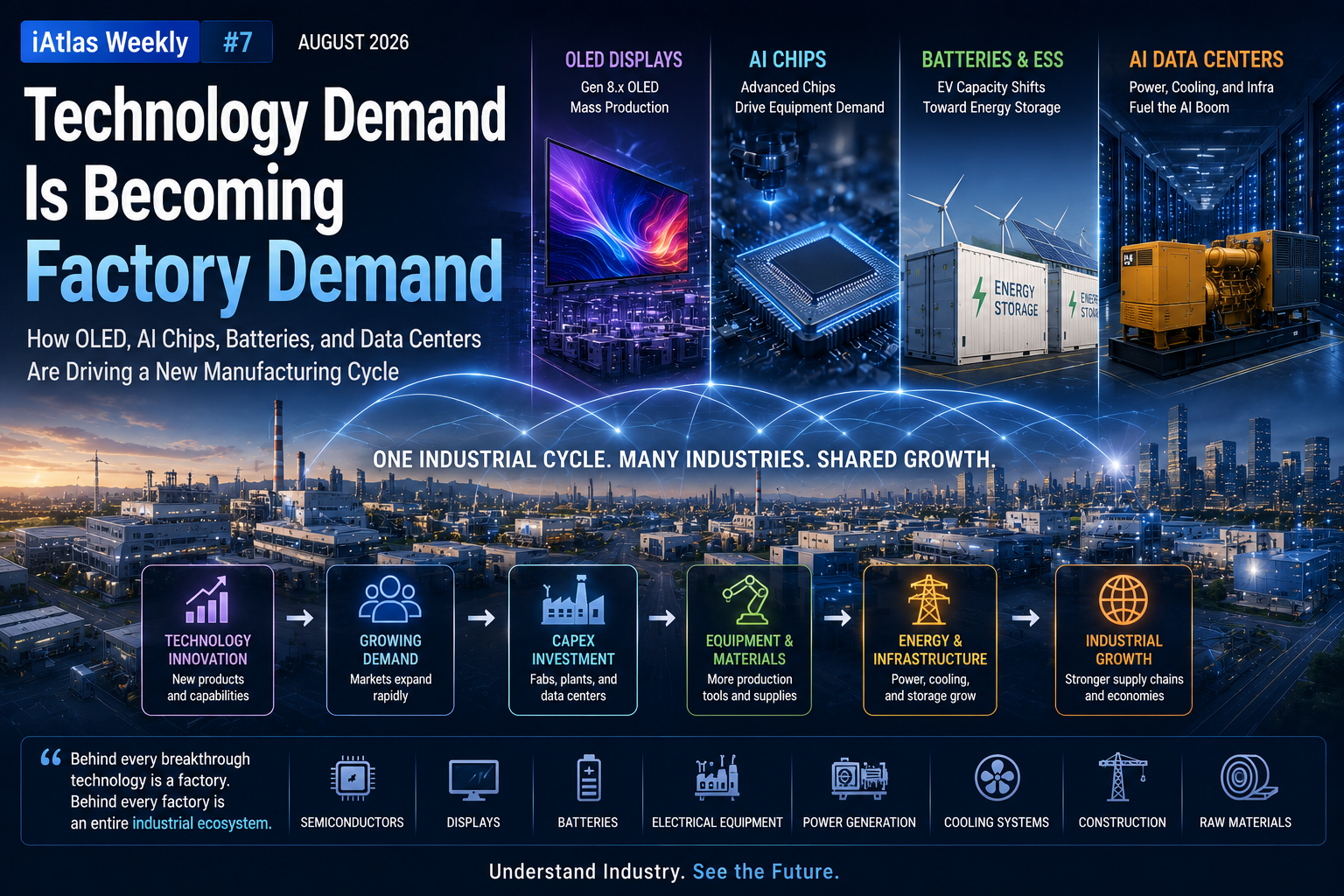
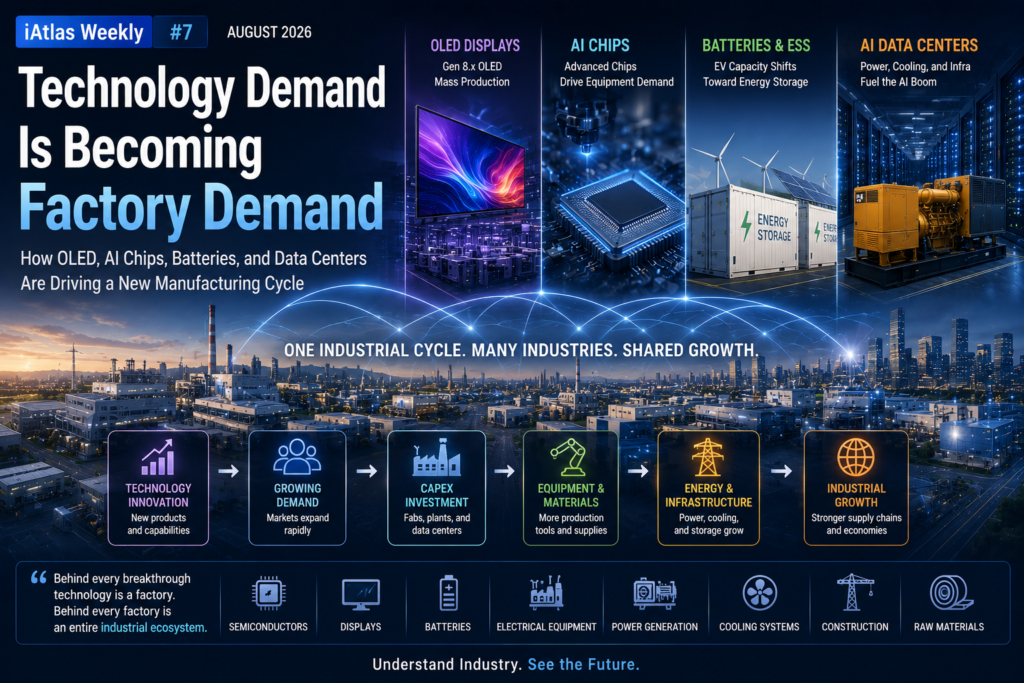
Technology Demand Is Becoming Factory Demand
Why OLED, AI Chips, Batteries, and Data Centers Are Driving a New Manufacturing Cycle
📊 iAtlas Weekly #7 | Weekly Briefing | August 2026
🌍 Editor’s Note
Technology demand is increasingly becoming factory demand.
That is the clearest message from this week’s industrial developments.
OLED is expanding from smartphones into notebooks and other IT devices, triggering a new generation of display manufacturing investment.
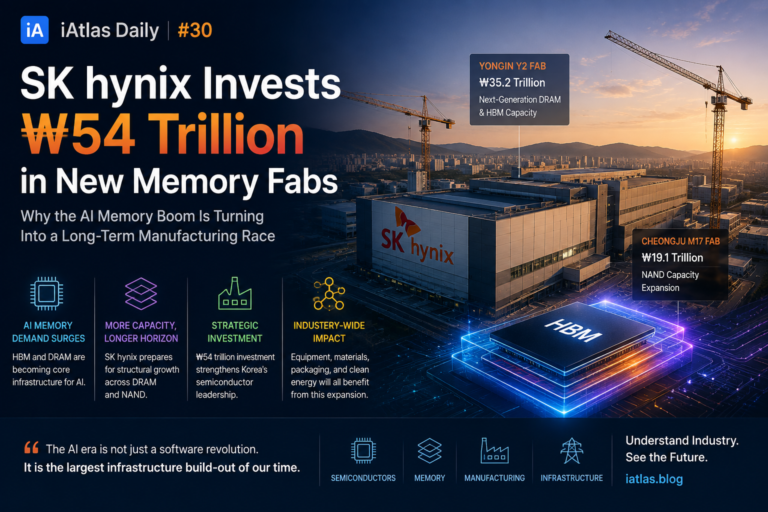
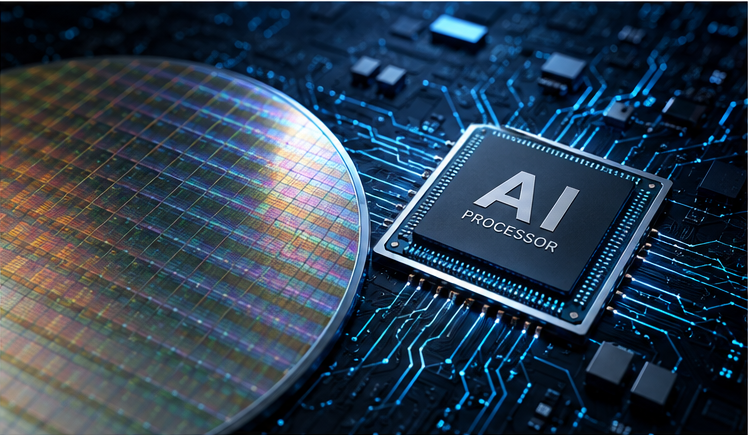
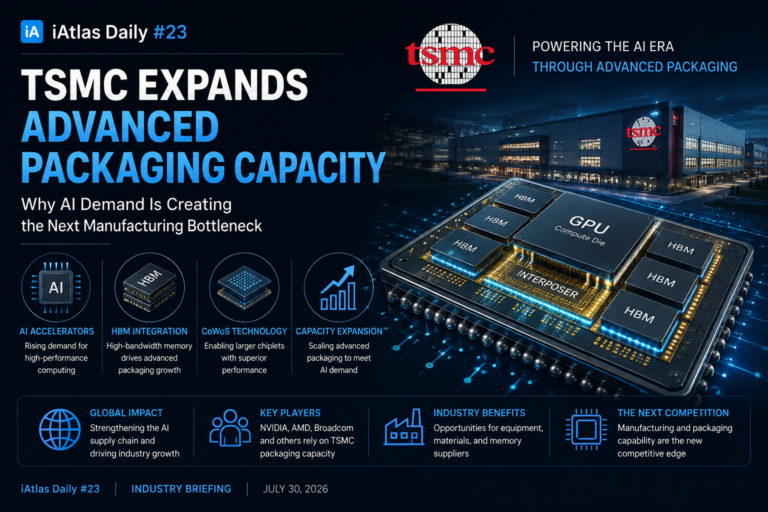
AI semiconductor demand is pushing deeper into equipment, materials, HBM, and advanced packaging.
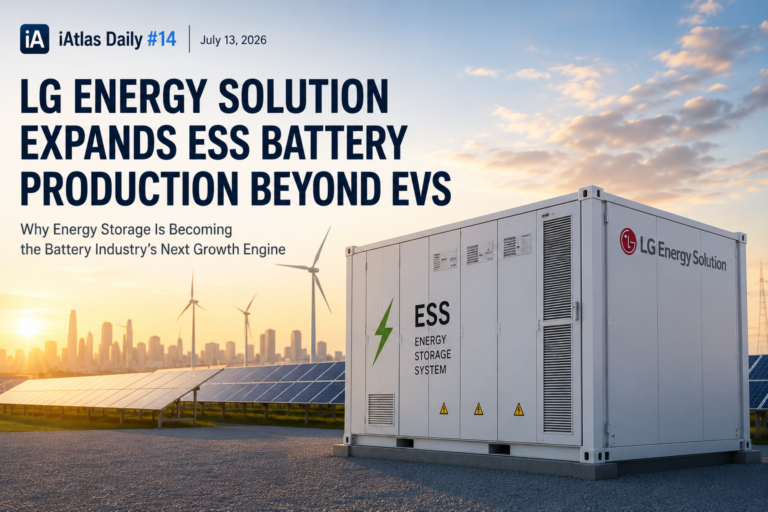
Battery manufacturers are adapting EV production capacity to serve the rapidly growing energy-storage market.
And AI data centers are creating demand far beyond GPUs—reaching generators, electrical equipment, cooling systems, batteries, and traditional manufacturing.
These developments may appear to belong to different industries.
But they are connected by the same underlying mechanism:
New Technology -> Growing Demand -> More Production Capacity -> More Equipment & Materials -> More Energy & Infrastructure
Technology growth is increasingly translating into physical industrial investment.
🖥️ Display
Gen 8.x OLED Moves Into Mass Production
For years, OLED growth was largely associated with smartphones.
That is beginning to change.
Samsung Display and BOE have started mass production from their new high-generation OLED lines as manufacturers prepare for greater OLED adoption in notebooks and other IT devices.
The significance goes beyond display technology.
Larger substrates are intended to improve the manufacturing economics of larger OLED panels.
That means the next phase of OLED competition will increasingly depend on:
- Production yield
- Equipment performance
- Material utilization
- Manufacturing cost
- Customer qualification
- Mass-production stability
Counterpoint Research expects global display equipment spending to rise 57% year over year in 2026, with Gen 8.7 investment accounting for a major share of OLED spending.
This is what happens when a technology moves from premium adoption toward industrial scale.
Demand for better displays eventually becomes demand for new factories, equipment, and materials.
Related Daily
📰 iAtlas Daily #35 | The Gen 8.6 OLED Race Is Heating Up
⚙️ Semiconductor Equipment
AI Demand Moves Upstream to the Factory Floor
The AI semiconductor boom is following a similar pattern.
Applied Materials reported record fiscal third-quarter revenue of $9.12 billion, up 25% year over year.
The company’s results illustrate how AI investment is spreading upstream from chip designers into semiconductor manufacturing.
AI systems require more than GPUs.
They increasingly depend on:
Advanced Logic + HBM + Advanced Packaging + High-Speed Networking
Producing those technologies requires increasingly sophisticated semiconductor manufacturing equipment.
Deposition.
Etching.
CMP.
Metrology.
Inspection.
Packaging.
And as semiconductor structures become increasingly three-dimensional, manufacturing complexity continues to increase.
AI demand is therefore becoming semiconductor equipment demand.
Related Daily
📰 iAtlas Daily #36 | Applied Materials Expands for the AI Chip Boom
🔋 Battery
EV Factories Are Becoming Energy Infrastructure Assets
The battery industry provides another version of the same story.
Samsung SDI acquired GM’s 49.99% stake in their Indiana battery joint venture, giving the Korean battery manufacturer full control of the facility.
But the most interesting part is what happens next.
Samsung SDI plans to use the facility to respond to changing market demand, including batteries for Energy Storage Systems.
This reflects a broader transformation in battery manufacturing.
The first major battery investment cycle was dominated by electric vehicles.
The emerging demand structure is broader:
EV + Grid Storage + Renewable Energy + Industrial Power + Data Centers
Battery factories can therefore become flexible manufacturing assets serving multiple energy markets.
A facility originally justified by EV growth can potentially become part of the wider electricity infrastructure.
Related Daily
📰 iAtlas Daily #37 | Samsung SDI Takes Full Control of GM Battery Plant
⚡ AI Infrastructure
AI Demand Reaches Traditional Manufacturing
Perhaps the clearest example of this week’s theme comes from AI data centers.
The first wave of the AI boom was dominated by semiconductor companies.
But the physical requirements of AI computing are now creating another group of beneficiaries.
Industrial manufacturers.
AI data centers require enormous amounts of:
- Electricity
- Backup power
- Transformers
- Switchgear
- Cooling
- Energy storage
- Construction equipment
- Cables
- Steel and other materials
Caterpillar and Cummins are expanding generator capacity.
Eaton is expanding its electrical infrastructure business.
Ford is redirecting underutilized EV battery capacity toward energy storage.
Generac is investing in commercial generator production.
The AI boom is moving from Silicon Valley into the factory supply chain.
Related Daily
📰 iAtlas Daily #38 | AI Data Centers Are Creating a New Industrial Boom
🏭 Trend of the Week
The Technology-to-Factory Transmission
Taken together, this week’s developments reveal an important industrial mechanism.
Step 1 — A New Technology Creates Demand
OLED improves display performance.
AI increases computing requirements.
Renewable energy increases storage requirements.
Step 2 — Existing Capacity Becomes Insufficient
More demand requires more:
Panels
Chips
Memory
Batteries
Servers
Step 3 — Manufacturers Invest
Companies build or upgrade:
Fabs
Gigafactories
Packaging facilities
Data centers
Step 4 — Investment Spreads Upstream
Factories require:
Equipment
Materials
Components
Automation
Step 5 — Infrastructure Must Expand
Industrial capacity ultimately requires:
Electricity
Water
Cooling
Buildings
Logistics
Energy Storage
This is how a technology trend becomes an industrial investment cycle.
🔗 Four Industries, One Pattern
The connection becomes clearer when we place this week’s stories together.
🖥️ OLED
More IT OLED demand
→ Gen 8.x fabs
→ Display equipment
→ OLED materials
💻 AI Semiconductors
More AI computing
→ GPU + HBM
→ Advanced packaging
→ Semiconductor equipment
🔋 Batteries
Changing EV demand + ESS growth
→ Production-line flexibility
→ LFP and ESS capacity
→ Energy infrastructure
⚡ AI Data Centers
More computing capacity
→ More electricity
→ Generators + electrical equipment
→ Cooling + ESS
Different industries.
The same industrial logic.
📈 Why Equipment and Materials Matter
This also explains why iAtlas should pay increasing attention to companies that sit behind famous technology brands.
Consumers see:
AI
OLED laptops
Electric vehicles
But the industrial economy sees something different:
Deposition equipment
Vacuum systems
Chemicals
Generators
Transformers
Battery materials
Cooling equipment
Factory automation
These businesses are often several layers removed from the final product.
Yet they are essential to scaling it.
The larger the technology investment cycle becomes, the further its economic impact spreads through the supply chain.
💰 CAPEX Is the Bridge
There is one concept connecting all of these industries:
Capital Expenditure — CAPEX
Technology companies can develop new products.
But turning those products into millions of physical units requires factories and infrastructure.
That requires capital.
The chain therefore becomes:
Technology -> Market Demand -> CAPEX -> Factories -> Equipment & Materials
-> Infrastructure -> Industrial Growth
This is why following corporate investment announcements can often reveal where industrial demand is heading before the final products reach consumers.
🌏 Why This Matters for Asia
This trend is particularly important for Asia.
South Korea, Taiwan, Japan, and China occupy critical positions across the physical technology supply chain.
The region has major capabilities in:
- Semiconductor manufacturing
- Semiconductor equipment
- Advanced materials
- Batteries
- Displays
- Electrical equipment
- Precision manufacturing
If AI, OLED, ESS, and other technologies continue expanding, a significant portion of the resulting industrial investment could flow through Asian manufacturing ecosystems.
Competition will therefore increasingly involve not just technology companies.
It will involve entire manufacturing ecosystems.
⚠️ The Risk: What If Demand Slows?
There is another side to the story.
Factories are expensive.
Data centers are expensive.
Semiconductor fabs are extremely expensive.
When companies invest based on expectations of future demand, they assume that demand will eventually justify the capacity.
If growth slows, industries can face:
- Overcapacity
- Falling utilization
- Price competition
- Lower margins
- Delayed investment
- Factory conversions
The battery industry is already demonstrating how manufacturers may respond.
Instead of abandoning existing assets, companies can redirect capacity toward new markets such as ESS.
Manufacturing flexibility could therefore become increasingly valuable.
👀 What to Watch Next
Over the coming months, several indicators can tell us whether this industrial cycle is strengthening:
Semiconductor
- HBM capacity
- Advanced packaging CAPEX
- Semiconductor equipment orders
- Leading-edge fab investment
Display
- Gen 8.x OLED yield
- Notebook OLED adoption
- New equipment orders
- Additional OLED fab announcements
Battery
- ESS contracts
- EV-to-ESS line conversions
- U.S. LFP production
- Data-center battery deployments
AI Infrastructure
- Data-center construction
- Generator orders
- Transformer supply
- Liquid cooling
- Grid connection delays
Together, these indicators reveal something broader than individual company performance.
They show how quickly the physical economy is scaling around new technology.
🎯 Atlas Insight
Technology gets the headlines.
Manufacturing determines whether it reaches the world.
A breakthrough OLED panel requires a production line.
An AI accelerator requires semiconductor equipment.
An AI data center requires electricity.
Electricity infrastructure increasingly requires energy storage.
And every one of those systems requires materials, equipment, factories, engineering, and capital.
That is why this week’s stories matter when viewed together.
They demonstrate the transition from:
Technology Innovation
to
Industrial Deployment
The next major winners of the technology cycle may therefore not always be the companies creating the most visible products.
Some may be the companies supplying the factories, materials, electricity, cooling, and equipment underneath them.
When technology demand becomes large enough, it eventually becomes factory demand.
And that is where technology trends begin to reshape the wider industrial economy.
📚 This Week on iAtlas
📰 iAtlas Daily #35 The Gen 8.6 OLED Race Is Heating Up
📰 iAtlas Daily #36 Applied Materials Expands for the AI Chip Boom
📰 iAtlas Daily #37 Samsung SDI Takes Full Control of GM Battery Plant
📰 iAtlas Daily #38 AI Data Centers Are Creating a New Industrial Boom
Sources
- Counterpoint Research — Gen.8.7 OLED Push Lifts Display Equipment CAPEX
- Samsung Display — Gen 8.6 IT OLED
- Applied Materials — Fiscal Q3 2026 Results
- Samsung SDI — GM Battery Development Agreement and Indiana Plant
- Reuters — U.S. Data-Center Boom Expands Through Manufacturing Supply Chains
- The Wall Street Journal — Big Manufacturers Find New Demand in Equipping AI Data Centers
About iAtlas
iAtlas is an independent publication covering batteries, semiconductors, OLED, advanced materials, AI, and global industrial trends.
We transform complex industrial developments into clear, reliable, and easy-to-understand insights.
Whether you’re following today’s industry news or building long-term expertise, iAtlas helps you understand not only what happened, but why it matters.
Technology creates change.
Insight creates opportunity.
— iAtlas