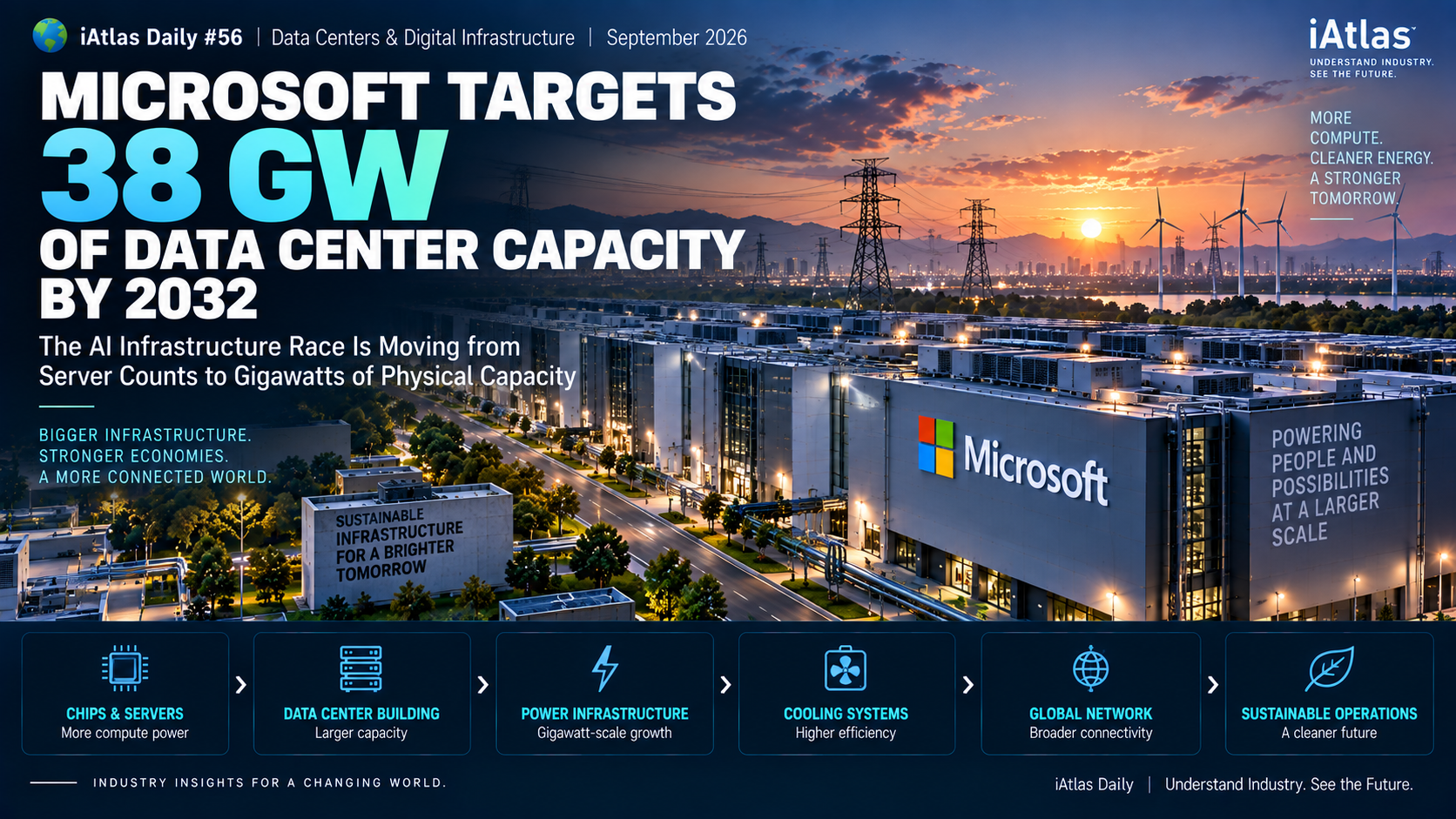
Microsoft Targets 38 GW of Data Center Capacity by 2032
The AI Infrastructure Race Is Moving from Server Counts to Gigawatts of Physical Capacity
🌐 iAtlas Daily #56 | Data Centers & Digital Infrastructure | September 2026
The scale of the global data center industry is changing.
For years, the growth of cloud computing was often measured through servers, regions, availability zones and computing capacity.
The next phase may increasingly be measured in something much more physical:
Gigawatts.
Microsoft is reportedly planning to expand its global data center capacity to approximately 38 GW by 2032, more than triple its current footprint of roughly 12 GW.
The number illustrates how dramatically digital infrastructure is becoming connected to the physical economy.
A modern data center requires much more than processors.
It requires:
Land
↓
Construction
↓
Servers
↓
Memory & Storage
↓
Networking
↓
Electricity
↓
Cooling
↓
Grid Infrastructure
The technology industry’s growth is therefore creating an enormous industrial buildout behind the digital economy.
The new unit of technology scale may no longer be the number of servers. It may be the gigawatt.
🌐 The Big Story
Microsoft currently operates roughly 12 GW of data center capacity, according to reports citing people familiar with the company’s plans.
By 2032, that figure could reach:
38 GW
That means Microsoft would add approximately:
26 GW
of additional capacity over roughly six years.
The increase would represent more than a threefold expansion of Microsoft’s physical computing infrastructure.
The company has not publicly announced the 38 GW figure as a formal target, so it should be understood as a reported internal plan that could change as projects move through development.
But even as a planning target, the scale is extraordinary.
📏 1. Why Measure Data Centers in Gigawatts?
Data centers ultimately convert electricity into computing.
Inside the facility:
Electricity
↓
Processors
↓
Computation
↓
Data / AI Services
As computing density increases, electricity becomes one of the most useful ways to describe the physical scale of a data center.
A small facility may be measured in megawatts.
A hyperscale campus may require hundreds of megawatts.
Large multi-building AI campuses are increasingly moving toward:
Gigawatt-scale infrastructure
The industry is therefore moving through a transition:
MW
→ Hundreds of MW
→ 1 GW Campus
→ Multi-GW Network
Microsoft’s reported target makes this transformation particularly visible.
🏗️ 2. 38 GW Means Building an Industrial System
A 38 GW data center network is not simply a collection of buildings filled with GPUs.
Every new campus requires an extensive physical ecosystem.
Computing
GPUs
CPUs
AI accelerators
Memory & Storage
HBM
DRAM
Enterprise SSD
Networking
Switches
Optical transceivers
Fiber
Electrical Infrastructure
Transformers
Switchgear
UPS
Substations
Thermal Infrastructure
Chillers
Cooling towers
Liquid cooling
Pumps
Construction
Steel
Concrete
Electrical systems
Mechanical systems
This is why data centers are becoming increasingly relevant to industries far outside traditional information technology.
🧠 3. AI Capacity Is Growing Faster
The reported Microsoft plan becomes even more interesting when the composition of the capacity is considered.
Reports indicate that only around 2 GW of Microsoft’s current 12 GW footprint is associated with AI-specific chips.
By 2032, AI-oriented infrastructure could account for roughly one-third of the planned 38 GW network.
That would imply roughly:
12–13 GW of AI-oriented capacity
depending on the final configuration.
The shift is therefore not simply:
More Data Centers
It is:
More Data Centers
Higher Compute Density
More AI Infrastructure
And higher-density computing tends to create additional requirements for power delivery and cooling.
🏭 4. Digital Infrastructure Is Becoming Heavy Industry
This is one of the most important structural changes.
Software businesses historically appeared asset-light compared with manufacturing industries.
But AI infrastructure is changing that perception.
The physical chain now looks increasingly industrial:
AI Model
↓
AI Accelerator
↓
Server Rack
↓
Data Center
↓
Substation
↓
Power Grid
↓
Power Generation
The further down this chain we move, the more AI begins to resemble traditional infrastructure.
Data centers require:
- industrial land
- electrical equipment
- cooling equipment
- construction
- energy contracts
- grid connections
In that sense, cloud computing is becoming increasingly dependent on heavy industrial infrastructure.
⚡ 5. The Grid Connection Can Matter as Much as the Building
A company can build a data center.
That does not necessarily mean it can immediately operate it at full capacity.
The facility also needs electricity.
Large data center projects therefore depend on:
Generation Capacity
↓
Transmission
↓
Substation
↓
Transformer
↓
Data Center
The physical bottleneck can move from the server to the electrical system.
This is particularly important when dozens of hyperscale projects attempt to connect to the same regional grid.
The challenge is no longer simply:
Can we build enough computing hardware?
It becomes:
Can we build the infrastructure required to power it?
🔌 6. Electrical Equipment Becomes Part of the Technology Supply Chain
This has major implications for industrial suppliers.
A data center expansion can create demand for:
Transformers
Move electricity between voltage levels.
Switchgear
Controls and protects electrical systems.
UPS Systems
Protect critical computing infrastructure from interruptions.
Backup Power
Provides resilience when grid power is unavailable.
Busways and Power Distribution
Deliver electricity through the facility.
Cooling Systems
Remove enormous amounts of heat generated by computing equipment.
These products historically belonged to electrical and industrial infrastructure markets.
Now they increasingly sit inside the technology supply chain.
❄️ 7. Every Gigawatt Eventually Becomes Heat
There is a basic physical reality behind computing.
Most of the electricity consumed by computing equipment ultimately becomes heat.
Therefore:
More Compute
↓
More Electricity
↓
More Heat
↓
More Cooling
As rack densities increase, conventional air cooling becomes increasingly difficult.
This is accelerating interest in:
Direct-to-Chip Liquid Cooling
Cold Plates
Coolant Distribution Units
Immersion Cooling
Advanced Heat Exchangers
The data center infrastructure opportunity therefore extends beyond electricity.
Thermal management becomes another industrial growth market.
💾 8. More Data Centers Mean More Memory and Storage
Compute infrastructure also requires enormous amounts of memory.
The hardware chain looks roughly like:
AI Accelerator
↓
HBM
↓
System Memory
↓
Enterprise SSD
↓
Storage Infrastructure
This is why the AI infrastructure boom has affected multiple semiconductor markets.
The opportunity extends beyond GPUs into:
HBM
DRAM
NAND
Enterprise SSD
Networking Semiconductors
Power Semiconductors
A larger physical data center footprint creates demand across the computing stack.
🌐 9. Microsoft Is Not Building Alone
Microsoft’s expansion is part of a broader global infrastructure cycle.
Amazon, Google, Meta, Oracle and other cloud companies are also investing heavily in data center capacity.
That means the industry is not simply dealing with:
One 38 GW Plan
It is dealing with multiple hyperscalers simultaneously expanding infrastructure.
The combined effect can create competition for:
Land
Electricity
Transformers
Construction Labor
Cooling Equipment
Semiconductors
Grid Connections
This is why the AI infrastructure boom increasingly affects industries far beyond technology companies themselves.
📈 10. The Unit of Competition Is Changing
Technology competition was once frequently described through:
CPU Performance
then:
GPU Performance
then:
Number of Accelerators
But hyperscale infrastructure introduces another metric:
Available Megawatts and Gigawatts
Consider the progression:
Model Capability
↓
GPU Count
↓
Rack Count
↓
Data Center Capacity
↓
MW
↓
GW
At sufficiently large scale, electricity capacity becomes a proxy for how much computing infrastructure can physically operate.
🗺️ 11. Location Becomes Strategic
When data centers require tens or hundreds of megawatts — and eventually gigawatts — location becomes increasingly important.
Companies must consider:
Electricity Availability
Grid Connection
Land
Water
Fiber Connectivity
Construction Costs
Regulation
Tax Incentives
Climate
The ideal data center location is therefore no longer simply:
Close to customers.
It may increasingly be:
Close to power and infrastructure.
This can change where technology investment flows geographically.
⚛️ 12. Data Centers Are Changing Energy Strategy
Large technology companies are already exploring multiple energy sources.
These include:
Renewables
Natural Gas
Nuclear Power
Energy Storage
Long-Term Power Purchase Agreements
The objective is not simply obtaining low-cost electricity.
Data centers require:
Reliable Power
Continuous Power
Scalable Power
Predictable Power
This creates a much deeper relationship between technology companies and the energy industry.
🔋 13. Batteries Become Part of the Data Center Ecosystem
Battery systems can also play several roles.
Traditionally, batteries were primarily used for:
UPS Backup
But larger storage systems can potentially support:
Peak Management
Grid Services
Renewable Integration
Backup Capacity
The infrastructure chain can therefore extend into:
Data Center
↓
Electrical System
↓
UPS
↓
ESS
↓
Battery Manufacturing
This is one reason the boundaries between the semiconductor, data center, energy and battery industries are becoming less distinct.
🏙️ 14. 38 GW Changes the Meaning of a Technology Company
A company operating tens of gigawatts of infrastructure begins to resemble more than a software company.
It becomes simultaneously:
Cloud Operator
Infrastructure Developer
Major Electricity Consumer
Construction Investor
Semiconductor Customer
Energy Buyer
This changes the economic footprint of the technology industry.
AI does not remain inside software.
It creates physical assets.
💰 15. Infrastructure Scale Creates a Massive CapEx Cycle
Building tens of gigawatts of data center capacity requires enormous capital.
That capital does not flow only to Microsoft.
It spreads through the supply chain:
Cloud Company
↓
Data Center Developer
↓
Construction
↓
Electrical Equipment
↓
Cooling
↓
Semiconductors
↓
Energy Infrastructure
One hyperscaler investment can therefore generate multiple layers of industrial demand.
This is why the current computing boom increasingly resembles a broad capital-expenditure cycle rather than a narrow semiconductor cycle.
⚠️ 16. 38 GW Is a Target, Not Guaranteed Capacity
There is an important distinction.
The reported 38 GW figure is a plan for 2032.
It is not operating capacity today.
Large infrastructure projects can face:
- permitting delays
- grid constraints
- construction delays
- community opposition
- equipment shortages
- changing technology requirements
Reuters specifically characterized the figure as a plan reported by Bloomberg rather than a formal Microsoft announcement.
Therefore, the number should not be interpreted as guaranteed future capacity.
What matters today is the direction:
Hyperscale computing is moving toward an unprecedented physical scale.
🔎 17. What the 38 GW Number Really Tells Us
The most interesting part of Microsoft’s reported plan is not Microsoft itself.
It is what the number tells us about the industry.
Cloud infrastructure is transitioning from:
Digital Service
toward:
Physical Industrial Platform
And that platform requires:
Semiconductors
Buildings
Electrical Equipment
Cooling
Energy
Grid Infrastructure
This is a very different technology economy from the software-centric model of the previous decade.
🧩 Why This Matters
Microsoft’s reported expansion highlights several structural changes.
Data center scale is moving into gigawatts.
MW is no longer sufficient to describe the largest infrastructure programs.
Computing is becoming physical infrastructure.
AI growth increasingly requires construction, electrical and thermal systems.
Industrial companies can benefit from digital growth.
Transformers, cooling systems and power equipment are becoming part of the technology supply chain.
Location is becoming strategic.
Access to electricity may increasingly influence where computing capacity is built.
AI infrastructure extends beyond semiconductors.
The opportunity moves from chips into entire industrial ecosystems.
🔭 What to Watch
Microsoft’s 38 GW Target
Watch how much of the reported capacity actually reaches construction and operation.
AI Share
AI-specific infrastructure could rise from roughly 2 GW today toward about one-third of Microsoft’s future footprint.
Power Availability
Electricity and grid connections could determine where capacity is built.
Transformer Supply
Large electrical equipment may become a critical bottleneck.
Liquid Cooling
Higher-density AI racks should continue driving advanced cooling investment.
ESS
Watch whether large battery-storage systems become more integrated into hyperscale campuses.
Geographic Expansion
Regions with abundant power, land and infrastructure could attract a larger share of future data center investment.
🧭 iAtlas Insight
The cloud was never truly weightless.
It simply hid its physical infrastructure behind software.
AI is making that infrastructure impossible to ignore.
Microsoft’s reported 38 GW target illustrates the transition clearly.
The technology stack now extends from:
AI Model
↓
GPU
↓
HBM
↓
Server
↓
Data Center
↓
Transformer
↓
Grid
↓
Power Generation
Technology competition is therefore acquiring a new dimension.
Companies still compete through software and semiconductors.
But increasingly, they must also compete through the ability to build and operate physical infrastructure at enormous scale.
The next era of computing may be measured not only in FLOPS, GPUs or parameters — but in gigawatts.
📚 Related Articles
📰 iAtlas Daily #38: AI Data Centers Are Creating a New Industrial Equipment Boom
This connects #56 directly to the industrial equipment, power and cooling demand created by data-center expansion.
📰 iAtlas Daily #10: TSMC Advanced Packaging Expansion Signals the Next AI Boom
This connects the physical infrastructure buildout back to the semiconductor manufacturing layer.
🔗 References
Reuters — Microsoft plans 38 GW of data center capacity by 2032
Reuters reported the 38 GW target on September 10, citing Bloomberg News and people familiar with Microsoft’s plans.
About iAtlas
iAtlas is an independent publication covering batteries, semiconductors, OLED, advanced materials, AI, and global industrial trends.
We transform complex industrial developments into clear, reliable, and easy-to-understand insights.
Whether you’re following today’s industry news or building long-term expertise, iAtlas helps you understand not only what happened, but why it matters.
Technology creates change.
Insight creates opportunity.
— iAtlas