Samsung SDI Takes Full Control of GM Battery Plant
Why EV Battery Capacity Is Shifting Toward the Fast-Growing ESS Market
📰 iAtlas Daily #37 | August 2026
📰 What Happened?
The global battery industry’s shift toward energy storage is becoming increasingly visible in actual manufacturing decisions.
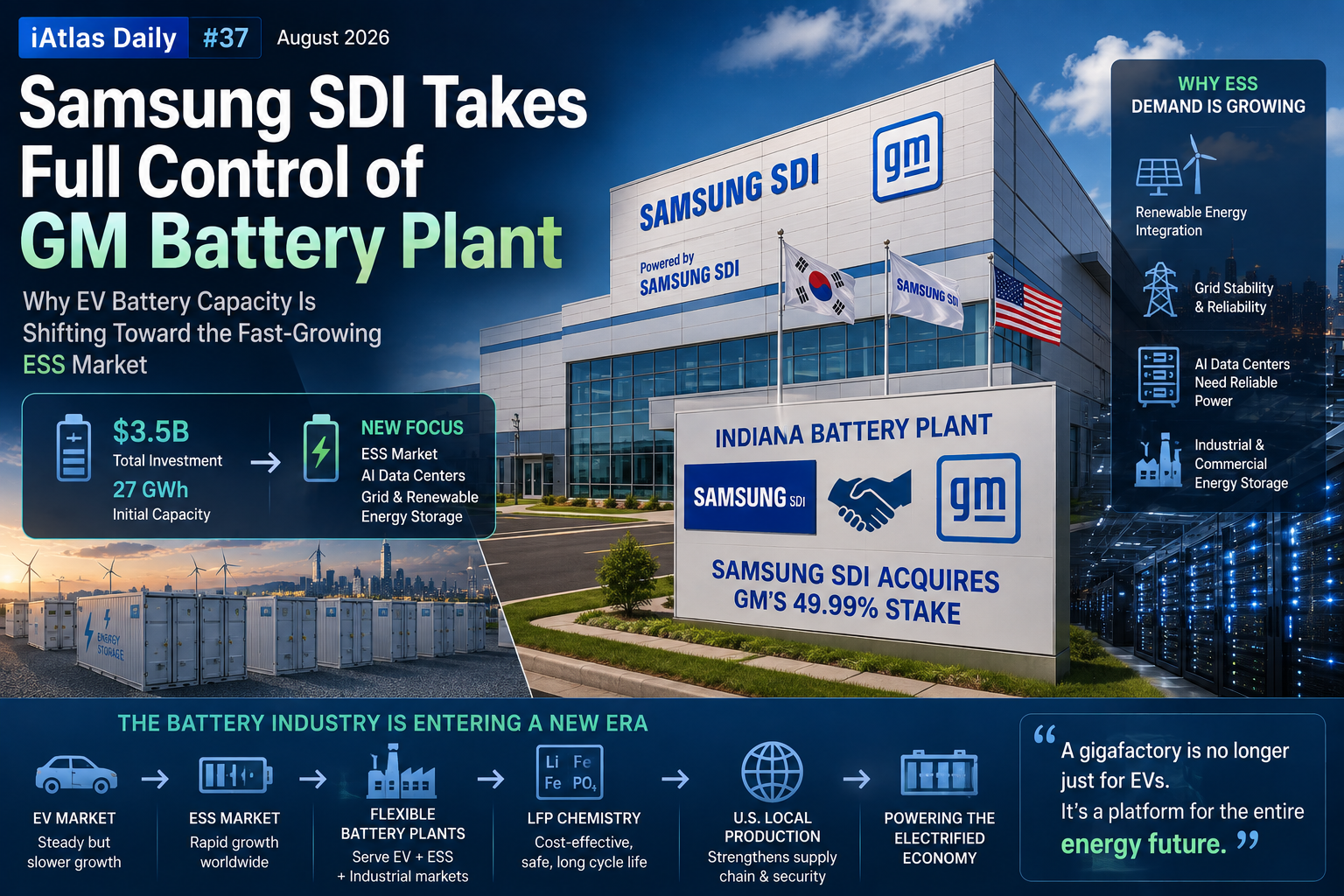
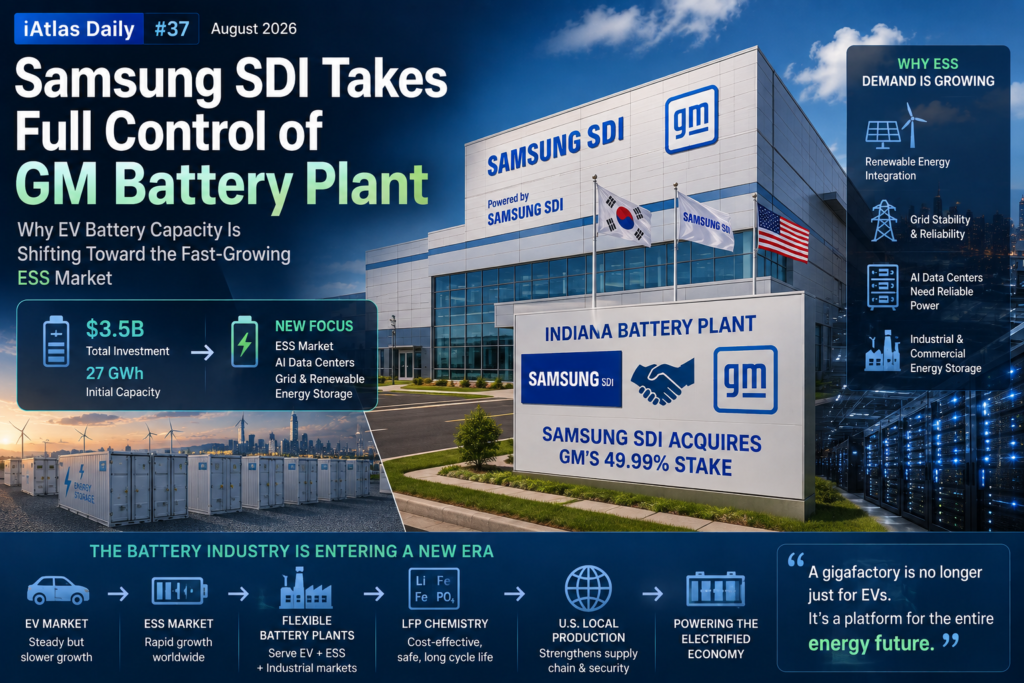
On August 11, Samsung SDI announced that it would terminate its battery joint venture with General Motors and acquire GM’s 49.99% stake in their Indiana battery project.
The two companies originally planned the approximately $3.5 billion facility as a major EV battery production hub, with an initial annual capacity of 27 GWh.
But the battery market has changed.
EV demand has developed more slowly than originally expected, while demand for stationary Energy Storage Systems (ESS) has accelerated.
Samsung SDI will now control the facility independently and plans to utilize it to respond to the growing U.S. ESS market as well as other battery opportunities.
The move highlights an important transformation:
Battery factories built for the EV boom are becoming strategic assets for the energy-storage boom.
🔋 Why This Matters
Battery Demand Is Diversifying
For much of the past decade, battery investment followed one dominant assumption:
More EVs → More Batteries → More Gigafactories
That assumption triggered enormous investments in battery manufacturing capacity across North America, Europe, China, and Korea.
But the market is becoming more complicated.
EV demand continues to grow globally, but growth rates vary significantly by region.
At the same time, another battery market is accelerating:
stationary energy storage.
ESS batteries are increasingly needed to support:
- Renewable energy
- Grid stabilization
- Industrial facilities
- Commercial buildings
- AI data centers
- Backup power
That gives battery manufacturers another major source of demand.
🏭 From EV Battery Plant to Flexible Battery Hub
The Indiana project demonstrates why manufacturing flexibility is becoming important.
When Samsung SDI and GM finalized the original agreement in 2024, the plant was designed primarily around electric vehicles.
Initial production capacity was expected to reach 27 GWh annually, with expansion potentially increasing capacity to 36 GWh.
Now the strategic environment is different.
Rather than leaving manufacturing capacity underutilized when EV demand weakens, battery manufacturers can potentially redirect portions of that capacity toward ESS.
That changes the economics of battery factories.
A battery plant may increasingly serve multiple markets:
EV + ESS + Industrial Energy Storage
instead of depending on a single end market.
⚡ Why ESS Demand Is Growing
Several structural trends are supporting energy-storage demand.
1. Renewable Energy
Solar and wind generation are inherently variable.
Battery storage allows electricity generated during periods of high production to be used later when demand rises.
2. Grid Stability
Electricity grids are becoming more complex as renewable generation, distributed power sources, EV charging, and new industrial loads expand.
ESS can help balance supply and demand.
3. AI Data Centers
This may become one of the most interesting new demand sources.
AI data centers require enormous amounts of reliable electricity.
As AI infrastructure expands, data-center operators increasingly need:
Grid Power + Backup Power + Energy Storage + Power Management
Recent industrial investment provides another indication of this shift.
Ford, for example, is repurposing underutilized U.S. EV battery manufacturing capacity for energy-storage systems aimed at data centers, utilities, and industrial customers. The company plans approximately $2 billion of investment in the business.
Battery manufacturing and AI infrastructure are beginning to intersect.
🇺🇸 Why the U.S. Market Matters
The United States could become particularly important for Korean battery manufacturers.
American ESS demand is growing while policy restrictions make dependence on Chinese battery supply increasingly complicated.
That creates potential opportunities for Korean companies with North American manufacturing capacity.
Samsung SDI is already expanding in this direction.
In March, the company announced a ₩1.5 trillion ESS battery supply agreement with a U.S. energy company.
The four-year contract initially uses NCA batteries and later expands into LFP batteries manufactured in Indiana.
Samsung SDI has also been converting part of its StarPlus Energy production capacity from EV batteries toward ESS batteries.
The latest GM transaction therefore does not appear to be an isolated event.
It is part of a broader ESS strategy.
🧪 LFP Is Becoming Increasingly Important
The shift toward ESS also affects battery chemistry.
High-nickel chemistries have historically been important for premium EV applications where high energy density matters.
Stationary storage has different priorities.
For ESS, important factors include:
- Cost
- Safety
- Cycle life
- Durability
- Thermal stability
That makes Lithium Iron Phosphate (LFP) particularly attractive.
Samsung SDI is preparing U.S. production of LFP batteries for ESS applications and has already secured LFP cathode material supply arrangements for its Indiana operations.
This means the ESS expansion could influence not only cell manufacturing but also the materials supply chain.
🔗 The Battery Supply Chain Is Changing
The shift can eventually affect multiple layers of the industry.
🔋 Cell Manufacturers
More ESS demand provides an alternative growth market when EV demand fluctuates.
🧪 Battery Materials
LFP growth creates demand for lithium, iron-phosphate cathode materials, graphite, electrolytes, and separators.
⚙️ Battery Equipment
Line conversions and new ESS capacity create opportunities across coating, calendaring, stacking, formation, inspection, and automation.
⚡ Energy Infrastructure
Battery manufacturers increasingly become part of the electricity infrastructure ecosystem.
💻 AI Infrastructure
Data centers could emerge as another important source of large-scale stationary battery demand.
📈 A Broader Industry Pivot
Samsung SDI is not the only company responding.
Across the battery industry, manufacturers are increasingly looking at ESS as a second growth engine.
LG Energy Solution has expanded U.S. ESS-oriented LFP production, while Samsung SDI has been converting some Indiana production lines toward ESS. Korean battery companies are also competing for growing domestic ESS projects.
Ford’s decision to establish an energy-storage business using excess battery capacity makes the pattern even clearer.
The strategy is gradually changing from:
EV Battery Company
to
Energy Storage Company
That distinction could become increasingly important.
👀 What to Watch
Several developments now deserve attention:
- Samsung SDI’s Indiana plant strategy
- U.S. LFP production ramp
- Additional ESS supply contracts
- AI data-center battery demand
- EV-to-ESS production-line conversions
- LG Energy Solution and SK On ESS expansion
- U.S. restrictions affecting Chinese battery suppliers
- ESS battery pricing
But perhaps the most important indicator is:
How much existing EV battery capacity is ultimately redirected toward ESS?
If this trend accelerates, it could significantly reshape global battery investment.
🎯 Atlas Insight
The battery industry’s first major growth cycle was built around the electric vehicle.
Its next phase may be broader.
EVs will remain one of the world’s largest battery markets, but batteries are increasingly becoming part of the wider energy infrastructure.
The emerging demand structure looks more like:
EV + Renewable Energy + Grid Storage + AI Data Centers + Industrial Power
This diversification changes how battery factories should be viewed.
A gigafactory is no longer necessarily an asset tied exclusively to one vehicle program.
It can become a flexible manufacturing platform serving multiple energy markets.
Samsung SDI’s decision to take full control of the Indiana project illustrates that transition.
The next battery race may not simply be about who supplies the most EVs. It may be about who can serve the entire electrified economy.
📚 Related Articles
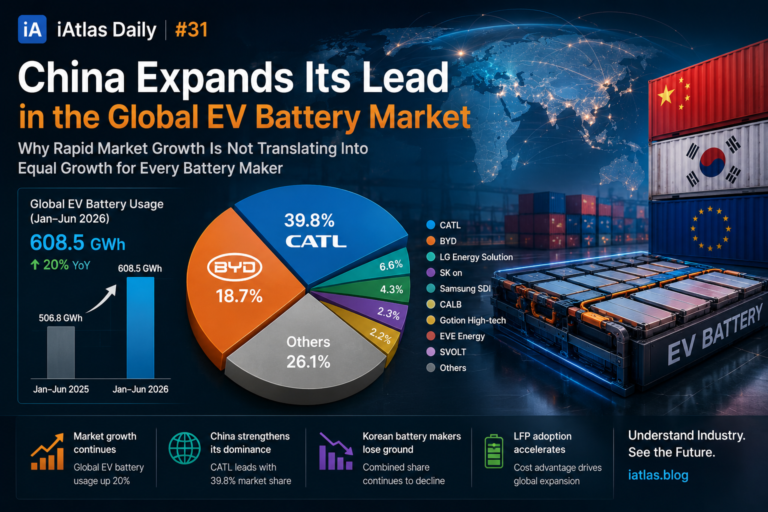
📰 iAtlas Daily #31 | China Expands Its Lead in the Global EV Battery Market
📰 iAtlas Daily #33 | NVIDIA and Wall Street Target $500 Billion for AI Infrastructure
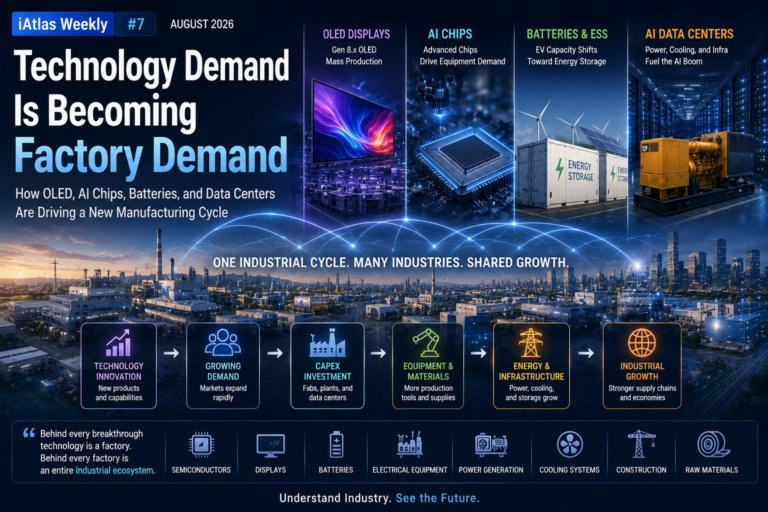
📊 iAtlas Weekly #6 | Scale Is Becoming the New Industrial Advantage
Sources
- Samsung SDI — GM Battery Joint Venture
- Samsung SDI — U.S. ESS Battery Supply
- Samsung SDI — LFP Materials & Indiana ESS Production
- Reuters — Samsung SDI to Acquire GM’s JV Stake
- The Wall Street Journal — Samsung SDI Buys GM’s Stake
- Ford — U.S. Battery Energy Storage Strategy
About iAtlas
iAtlas is an independent publication covering batteries, semiconductors, OLED, advanced materials, AI, and global industrial trends.
We transform complex industrial developments into clear, reliable, and easy-to-understand insights.
Whether you’re following today’s industry news or building long-term expertise, iAtlas helps you understand not only what happened, but why it matters.
Technology creates change.
Insight creates opportunity.
— iAtlas