Scale Is Becoming the New Industrial Advantage
Why Manufacturing, Capital, and Supply Chains Are Defining the Next Technology Race
📊 iAtlas Weekly #6 | Weekly Briefing | August 2026
🌍 Editor’s Note
Scale is becoming the new industrial advantage.
For years, technology competition was largely defined by innovation.
Who could develop the fastest semiconductor?
Who could build the highest-energy-density battery?
Who could create the most advanced AI model?
Those questions still matter.
But this week’s developments reveal another competitive layer emerging across global industries.
The ability to manufacture, finance, and scale technology is becoming just as important as the technology itself.
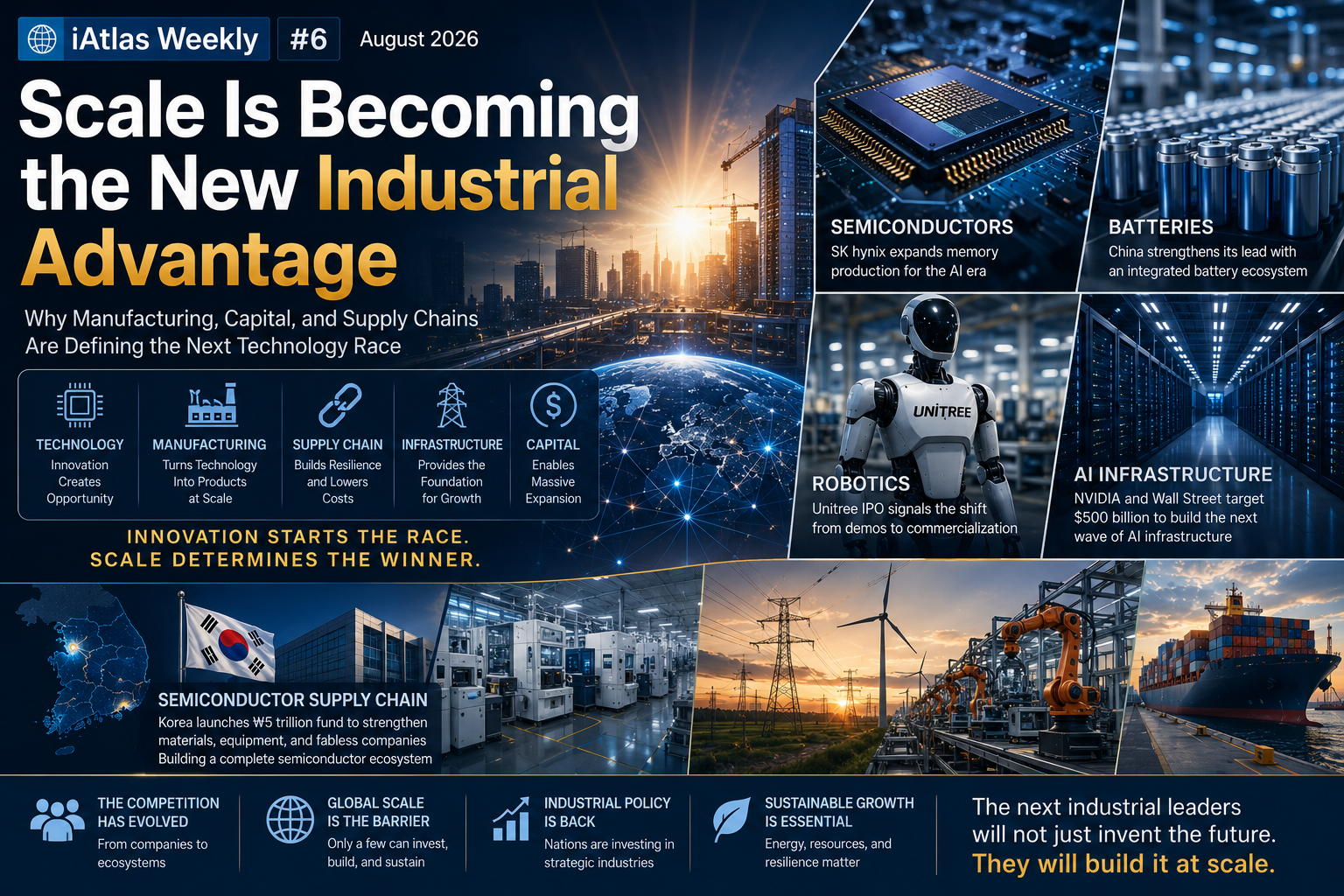
From SK hynix’s massive memory fab investment and China’s growing battery presence to Unitree’s IPO, NVIDIA’s AI infrastructure financing initiative, and South Korea’s semiconductor supply-chain fund, the same pattern is appearing across multiple industries.
Innovation creates opportunity.
Scale determines who captures it.
💻 Semiconductor
SK hynix Bets on the Next AI Memory Cycle
SK hynix is preparing for AI memory demand that extends far beyond today’s HBM boom.
The company announced major investments in new semiconductor manufacturing facilities in Yongin and Cheongju, strengthening its future production capabilities across next-generation DRAM, HBM, and NAND.
The strategic message is important.
AI memory competition is no longer only about developing the next generation of HBM.
Manufacturers must also secure the enormous production capacity required to deliver those technologies at scale.
That means future leadership will increasingly depend on:
- Wafer capacity
- Process technology
- Production yield
- Advanced packaging
- Equipment availability
- Materials supply
The AI memory race is becoming a manufacturing capacity race.
Related Daily
📰 iAtlas Daily #30 | SK hynix Invests ₩54 Trillion in New Memory Fabs
🔋 Battery
China’s Battery Advantage Is Becoming an Ecosystem Advantage
The global EV battery market continues to expand, but that growth is not being distributed equally.
Chinese manufacturers remain dominant across the global battery supply chain, with CATL maintaining a commanding position and multiple Chinese suppliers competing among the world’s largest battery producers.
The important point is not simply China’s battery market share.
It is the industrial ecosystem supporting that position.
China has developed scale across:
Materials → Cells → Battery Packs → Equipment → EVs → Energy Storage
That integration helps manufacturers lower costs, accelerate product development, and expand production rapidly.
LFP technology has further strengthened this position by offering a competitive combination of cost, safety, and cycle life.
For Korean battery manufacturers, technological performance alone may therefore no longer be enough.
Manufacturing efficiency, localization, cost, and supply-chain scale are becoming equally important.
Related Daily
📰 iAtlas Daily #31 | China Expands Its Lead in the Global EV Battery Market
🤖 Physical AI
Unitree Shows Robotics Is Moving Toward Commercialization
Humanoid robots have spent several years capturing attention through increasingly impressive demonstrations.
Now the industry is entering a different phase.
Chinese robotics company Unitree’s move toward the public market illustrates how the sector is beginning to transition from technological experimentation toward commercialization and industrial scale.
Building a successful humanoid robot requires much more than an AI model.
It requires an ecosystem combining:
- Motors and actuators
- Precision reducers
- Sensors
- Batteries
- AI processors
- Memory
- Mechanical components
- Manufacturing
- Software
The companies that can integrate these technologies while reducing production costs may gain a significant advantage.
The key question for humanoid robotics is therefore changing.
It is no longer simply:
Can the robot perform the task?
It is becoming:
Can thousands—or eventually millions—of robots perform the task reliably and economically?
Related Daily
📰 iAtlas Daily #32 | Unitree IPO Puts Humanoid Robots in the Industrial Spotlight
🏗️ AI Infrastructure
Wall Street Joins the AI Race
AI infrastructure is becoming so capital-intensive that technology companies alone may not be able to finance its expansion efficiently.
NVIDIA’s collaboration with major global financial institutions to create financing platforms targeting more than $500 billion in potential AI infrastructure investment illustrates this transition.
AI increasingly requires an enormous physical ecosystem:
Capital
↓
Data Centers
↓
AI Accelerators
↓
HBM & Memory
↓
Advanced Packaging
↓
Power & Cooling
↓
Energy Infrastructure
As AI computing expands, access to capital itself could become a competitive advantage.
This represents an important evolution of the AI industry.
The race began with algorithms.
Then came GPUs.
Then HBM and advanced packaging.
Now the competition is expanding into data centers, electricity, cooling, construction, and finance.
Related Daily
📰 iAtlas Daily #33 | NVIDIA and Wall Street Target $500 Billion for AI Infrastructure
🇰🇷 Semiconductor Supply Chain
Korea Looks Beyond the Fab
South Korea’s latest semiconductor strategy demonstrates another version of the same trend.
The government announced plans for a ₩5 trillion semiconductor fund targeting materials, parts, equipment, and fabless companies, alongside additional trade financing for suppliers.
The objective is broader than increasing semiconductor production.
It is about strengthening the ecosystem surrounding Korea’s major chip manufacturers.
A modern semiconductor industry requires:
Fabs
↓
Equipment
↓
Materials & Chemicals
↓
Components
↓
Utilities
↓
Packaging & Testing
↓
Fabless & Design
Electricity and water infrastructure are also becoming strategic considerations as semiconductor clusters expand.
The competitive unit of the semiconductor industry is therefore changing.
It is increasingly becoming:
Ecosystem vs. Ecosystem.
Related Daily
📈 Trend of the Week
From Innovation to Industrialization
This week’s stories appear to cover very different industries.
Memory semiconductors.
EV batteries.
Humanoid robots.
AI data centers.
Semiconductor materials and equipment.
But underneath them is the same structural shift.
Stage 1 — Innovation
Develop the technology.
Stage 2 — Manufacturing
Learn how to produce it reliably.
Stage 3 — Scale
Build enough capacity to lower costs and satisfy global demand.
Stage 4 — Ecosystem
Develop suppliers, infrastructure, capital, and talent around the technology.
The companies and countries capable of completing all four stages are increasingly gaining an advantage.
That is why industrial policy, manufacturing investment, supply chains, and infrastructure have returned to the center of global technology competition.
🔗 The New Industrial Equation
The emerging competitive model can be summarized simply:
Technology + Manufacturing + Supply Chain + Infrastructure + Capital
= Industrial Scale
And industrial scale increasingly determines whether innovation becomes a global business.
🎯 Atlas Insight
The technology industry spent much of the last decade celebrating disruption.
The next decade may be increasingly defined by industrialization.
AI provides a particularly clear example.
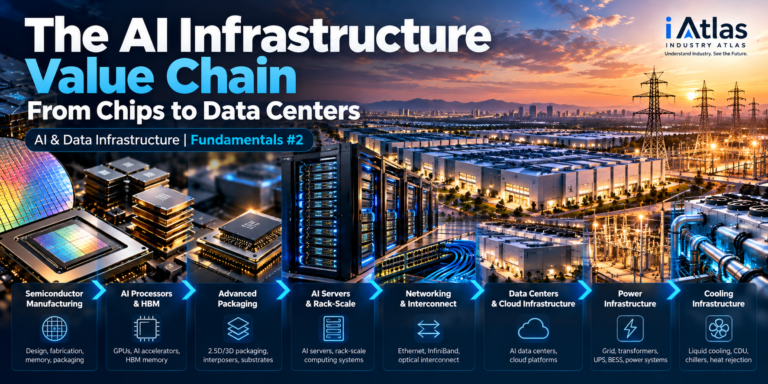
An AI model ultimately depends on:
GPUs manufactured in semiconductor fabs.
HBM produced in memory fabs.
Advanced packaging integrating those components.
Data centers housing the systems.
Electricity powering them.
Cooling systems managing their heat.
And financial capital funding the entire infrastructure.
The same logic applies to batteries and robotics.
A breakthrough technology has limited industrial impact until it can be manufactured reliably, affordably, and at enormous scale.
That is why this week’s developments matter.
SK hynix is building capacity.
Chinese battery companies are leveraging scale.
Unitree is moving toward capital markets.
NVIDIA is connecting AI infrastructure with global finance.
South Korea is strengthening the suppliers surrounding its semiconductor fabs.
Different industries.
Different companies.
Different technologies.
But one common direction:
The next industrial leaders will not simply invent the future. They will build the systems capable of producing it at scale.
👀 What to Watch Next
Several developments deserve attention over the coming weeks:
- HBM and advanced memory capacity expansion
- Chinese battery manufacturers’ overseas expansion
- Humanoid robot commercialization
- AI data-center financing
- Electricity demand from AI infrastructure
- Semiconductor equipment and materials investment
- Government industrial policies
- Localization of critical supply chains
The key question across all of them will be the same:
Who can scale fastest without sacrificing cost, reliability, or technological leadership?
📚 This Week on iAtlas
📰 iAtlas Daily #30
SK hynix Invests ₩54 Trillion in New Memory Fabs
📰 iAtlas Daily #31
China Expands Its Lead in the Global EV Battery Market
📰 iAtlas Daily #32
Unitree IPO Puts Humanoid Robots in the Industrial Spotlight
📰 iAtlas Daily #33
NVIDIA and Wall Street Target $500 Billion for AI Infrastructure
📰 iAtlas Daily #34
South Korea Launches ₩5 Trillion Fund to Strengthen Its Semiconductor Supply Chain
Sources
- SK hynix Newsroom
- SNE Research
- Reuters
- NVIDIA
- South Korean Government semiconductor policy announcements
About iAtlas
iAtlas is an independent publication covering batteries, semiconductors, OLED, advanced materials, AI, and global industrial trends.
We transform complex industrial developments into clear, reliable, and easy-to-understand insights.
Whether you’re following today’s industry news or building long-term expertise, iAtlas helps you understand not only what happened, but why it matters.
Technology creates change.
Insight creates opportunity.
— iAtlas