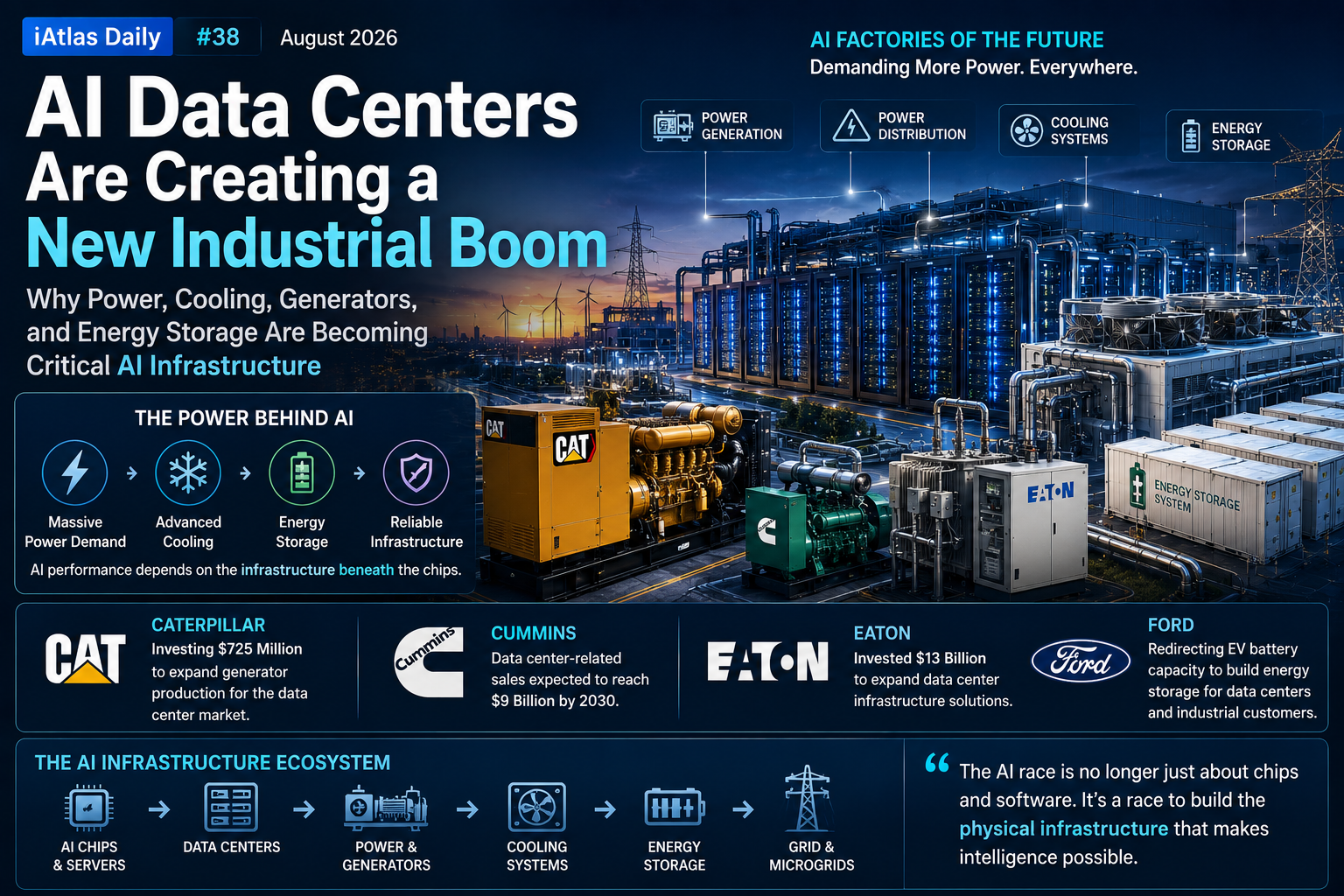
AI Data Centers Are Creating a New Industrial Boom
Why Power, Cooling, Generators, and Energy Storage Are Becoming Critical AI Infrastructure
📰 iAtlas Daily #38 | August 2026
📰 What Happened?
The AI boom is creating an unexpected group of winners.
Not only NVIDIA, semiconductor manufacturers, and cloud companies.
Traditional industrial companies are increasingly benefiting as the rapid construction of AI data centers creates enormous demand for electricity, generators, power equipment, cooling systems, and energy storage.
Companies including Caterpillar, Cummins, Eaton, and Ford are expanding their exposure to the data-center market.
Caterpillar is investing approximately $725 million to expand generator manufacturing capacity, while Cummins expects its data-center-related business to potentially reach $9 billion by 2030. Eaton has also invested heavily to expand its data-center infrastructure portfolio.
This reveals an important shift in the AI investment cycle.
The AI race is increasingly becoming a race to build the physical infrastructure underneath computing.
💡 Why This Matters
AI Has a Physical Infrastructure Problem
AI is often described as a software revolution.
But every AI model ultimately runs on physical hardware.
That hardware requires:
GPUs -> Servers -> Data Centers -> Power Distribution -> Cooling -> Electricity Generation
As AI models become larger and computing systems more powerful, the infrastructure underneath them must scale as well.
And power is emerging as one of the industry’s biggest constraints.
JLL estimates the global data-center sector could add around 100 GW of capacity by 2030, requiring roughly $3 trillion of investment across infrastructure, real estate and related financing.
⚡ The Bottleneck Is Moving From Chips to Power
For much of the AI boom, the biggest bottleneck was advanced semiconductors.
GPUs were difficult to obtain.
HBM capacity was limited.
Advanced packaging became constrained.
Those challenges have not disappeared.
But another constraint is moving rapidly up the list:
electricity.
AI data centers can require hundreds of megawatts—and future campuses are increasingly being discussed at gigawatt scale.
Connecting facilities of that size to existing electricity grids can take years.
That is forcing developers to consider alternative strategies:
- On-site generation
- Gas turbines
- Large generators
- Renewable energy
- Battery storage
- Microgrids
The data-center race is therefore becoming a power infrastructure race.
🏭 Caterpillar Finds a New AI Market
Caterpillar provides one of the clearest examples.
The company is traditionally associated with construction equipment, mining machinery and heavy industrial engines.
But AI data centers require enormous amounts of reliable backup and on-site power.
Caterpillar is responding by investing $725 million to increase generator production and bringing larger-capacity products to the data-center market.
The connection may initially seem surprising.
What does a heavy-equipment company have to do with AI?
Quite a lot.
AI infrastructure cannot operate without reliable electricity.
That makes generators and power systems part of the AI hardware ecosystem.
⚙️ Cummins Sees Billions in Data-Center Demand
Cummins is seeing a similar opportunity.
The company manufactures engines, generators and power systems used across industrial applications.
It expects its data-center-related sales could reach approximately $9 billion by 2030 and is expanding generator production to meet demand.
This represents a broader industrial trend.
The beneficiaries of AI investment are expanding beyond semiconductor companies.
They increasingly include companies that manufacture:
Generators → Transformers → Switchgear → UPS → Cooling → Power Electronics
AI is pulling traditional industrial equipment into the technology supply chain.
🔌 Eaton Shows Why Power Distribution Matters
Generating electricity is only part of the challenge.
Power must also be safely and efficiently distributed through a data center.
That requires:
- Transformers
- Switchgear
- UPS systems
- Circuit protection
- Power distribution equipment
- Monitoring systems
Eaton has spent approximately $13 billion on acquisitions as it expands its position in data-center infrastructure, and data-center-related operations now represent a significant portion of its business.
The opportunity grows as rack power density increases.
AI servers consume significantly more power than traditional computing infrastructure.
That means the electrical architecture itself must evolve.
🔋 Batteries Enter the AI Infrastructure Chain
This is where yesterday’s Daily #37 becomes especially relevant.
Battery companies are also entering the AI infrastructure ecosystem.
Ford is redirecting excess EV battery manufacturing capacity toward stationary energy-storage systems for data centers, utilities and industrial customers.
Samsung SDI is similarly expanding its ESS strategy as EV demand growth becomes less predictable.
The connection is increasingly clear:
AI Data Center -> Large Electricity Demand -> Grid Constraints -> On-Site Power + ESS
-> New Battery Demand
The AI boom is therefore creating a new connection between the semiconductor and battery industries.
❄️ Cooling Is Becoming Critical
Power entering a data center eventually becomes heat.
And AI servers generate a lot of it.
Traditional data centers relied heavily on air cooling.
But increasingly dense AI racks are pushing infrastructure toward more advanced thermal-management systems.
These include:
- Direct-to-chip liquid cooling
- Coolant distribution units
- Heat exchangers
- Chillers
- Pumps
- Advanced thermal controls
As rack density increases, cooling becomes not simply a facility requirement but part of computing performance.
A GPU that cannot be cooled efficiently cannot operate at maximum performance.
🔌 NVIDIA Is Changing the Power Architecture
The scale of the problem can also be seen in NVIDIA’s infrastructure roadmap.
On August 11, NVIDIA detailed its 800 VDC power architecture for next-generation AI factories.
The goal is to reduce power-conversion complexity and improve efficiency as AI rack density continues increasing.
Traditional data centers convert electricity multiple times before it reaches computing hardware.
At very high power levels, every conversion creates additional losses and complexity.
Higher-voltage DC distribution can simplify that path.
This demonstrates how deeply AI is beginning to influence electrical engineering itself.
🌍 The Industrial Supply Chain Around AI
The AI infrastructure ecosystem is becoming remarkably broad.
💻 Semiconductor
GPUs, CPUs, networking chips and HBM provide computing capability.
⚡ Electrical Equipment
Transformers, switchgear, UPS and power-distribution systems deliver electricity.
🏭 Power Generation
Generators and turbines provide backup or on-site electricity.
❄️ Cooling
Liquid cooling and thermal-management systems remove enormous quantities of heat.
🔋 Energy Storage
ESS provides backup power, load management and renewable-energy integration.
🧪 Materials
Copper, steel, aluminum and specialty materials are required throughout the infrastructure.
The AI boom is therefore moving far beyond the technology sector.
Korean Manufacturers Are Seeing the Same Opportunity
This shift is not limited to the United States.
Korean industrial companies are also repositioning around AI infrastructure.
Recent reporting shows Korean steel, petrochemical, electrical-equipment and engineering companies targeting opportunities in areas including specialty steel, ESS, power equipment and data-center infrastructure.
This could become particularly important for Korea.
The country already has strong industrial capabilities across:
Semiconductors + Batteries + Electrical Equipment + Heavy Industry + Engineering
AI infrastructure potentially connects all five.
📈 From AI Chips to AI Factories
The AI investment cycle can now be viewed in several layers.
Layer 1 — AI Models
Software and algorithms.
Layer 2 — Compute
GPU, HBM and networking.
Layer 3 — Data Centers
Servers and computing infrastructure.
Layer 4 — Physical Infrastructure
Power, cooling, buildings and energy storage.
Layer 5 — Industrial Supply Chain
Generators, transformers, batteries, steel, copper and engineering.
Each layer creates demand for the one underneath it.
This is why the economic impact of AI is becoming much broader than the semiconductor industry.
👀 What to Watch
Several indicators deserve attention:
- AI data-center electricity demand
- Generator and turbine orders
- Transformer availability
- Liquid-cooling adoption
- Data-center ESS deployments
- On-site power generation
- 800 VDC infrastructure adoption
- Grid connection delays
- Data-center construction spending
But perhaps the most important metric will be:
Time to power.
Having GPUs available means little if a new data center cannot secure enough electricity to operate them.
🎯 Atlas Insight
The first phase of the AI boom rewarded companies that could create computing power.
The next phase may increasingly reward companies that can deliver physical power.
That distinction matters.
The AI supply chain now looks increasingly like:
AI Models -> GPU + HBM -> Servers -> Data Centers -> Power + Cooling -> Generators + ESS + Grid Infrastructure -> Industrial Materials & Equipment
This explains why companies traditionally considered part of the industrial economy are suddenly becoming part of the AI story.
Caterpillar does not manufacture GPUs.
Eaton does not train AI models.
Ford is not a cloud-computing company.
Yet all three can benefit from AI infrastructure investment.
AI is no longer creating only a semiconductor boom. It is beginning to create an industrial equipment boom.
And that may become one of the most important industrial trends of the second half of this decade.
📚 Related Articles
📰 iAtlas Daily #33 | NVIDIA and Wall Street Target $500 Billion for AI Infrastructure
📰 iAtlas Daily #36 | Applied Materials Expands for the AI Chip Boom
📰 iAtlas Daily #37 | Samsung SDI Takes Full Control of GM Battery Plant
📊 iAtlas Weekly #6 | Scale Is Becoming the New Industrial Advantage
Sources
- The Wall Street Journal — Big Manufacturers Find New Demand in Equipping AI Data Centers
- NVIDIA — 800 VDC Power Architecture for AI Factories
- JLL — 2026 Global Data Center Outlook
- Seoul Economic Daily — Korea’s Manufacturers Bet on AI Infrastructure
About iAtlas
iAtlas is an independent publication covering batteries, semiconductors, OLED, advanced materials, AI, and global industrial trends.
We transform complex industrial developments into clear, reliable, and easy-to-understand insights.
Whether you’re following today’s industry news or building long-term expertise, iAtlas helps you understand not only what happened, but why it matters.
Technology creates change.
Insight creates opportunity.
— iAtlas